There are numerous variables that go into running a successful social media marketing strategy. Factors like quality and frequency of posts, along with proper engagement quickly come to mind. These are obviously important, but choosing the network that caters to your target audience is equally important.
Since there can be a disparity in terms of user demographics on different social media platforms, you should understand which network best fits your business before launching a full-blown campaign. Here is a rundown of the demographic of some of the most popular networks to help you choose which one to use.
Many social networking sites, such as Facebook and Instagram, boast billions of monthly active users who primarily access these platforms through mobile devices. With social media apps becoming essential communication platforms, it’s important to choose the right social networking site that aligns with your business goals and target audience.
These two heavyweights are at the top of most marketers' to-do list, and rightfully so. Facebook is the elephant among social media channels. Twitter isn’t all that far behind. Consequently, both Facebook and Twitter tend to be great places to start your campaign and test the waters.
If your business has a broad demographic, you should be able to effectively reach your audience. The same thing can be said even if you have a relatively small demographic, and you’re trying to zone in on a smaller segment of the population. Regardless of your industry, you should be able to bring exposure to your business and establish a community around it.
While creating a presence on both of these networks is applicable to nearly any business, Facebook can be even more advantageous when you’re looking to reach females between the ages of 18 and 29. According to CMS Wire, the vast majority of Facebook users are women and young adults, which makes it ideal if this is your business’s main demographic.
When it comes to Twitter, it’s also popular with a young audience between the ages of 18 and 29. A large part of its user base is comprised of African Americans and individuals living in densely populated, urban areas.
Both platforms have millions of active users, making them a great platform to promote your business and interact with your audience. While other social media platforms are also part of the social media scene, Facebook and Twitter stand out as essential channels for paid advertising and enterprise social networks.
If you’re looking to grow your business and gain B2B networking opportunities, LinkedIn is an effective way to do so. Unlike other popular social media platforms that are more casual in nature, this one is designed for educated professionals who are looking to advance their careers. According to statistics by Quantcast, the majority of users have earned either a bachelor’s degree or completed grad school. Male users outweigh females, and a large percentage of them have no children.
LinkedIn users also tend to earn considerably more money than those on other networks.
For instance, individuals earning over $150,000 annually account for the largest number of users. Not far behind are individuals earning between $100,000 and $150,000.Another factor that differentiates this network from others is the average age of its users. Unlike many that cater to a younger demographic, LinkedIn users are typically older and range between 25 to 64 years of age. If you want to connect with an audience that is well-to-do and mainly consists of business professionals, this can be the perfect resource.
This popular social media platform has really gained a lot of momentum in the past couple of years. While it pales in comparison to the user base of Facebook and Twitter, it’s seen plenty of growth since its conception and could be a major contender in the near future. The concept of Pinterest is incredibly simple, which involves “pinning” images onto boards.
This simplicity combined with its eye-appealing aesthetic probably accounts for the success it has seen. Like Google+, Pinterest also has a significant disparity in terms of gender. The difference is that it swings the other way and has a massive female user base of around 72 percent.
Most users are relatively educated and have either attended college or have at least a bachelor’s degree. Users are primarily Caucasian and between the ages of 18 and 50. Going even deeper, the top geographic location of Pinterest is the south east United States including states like Alabama, Tennessee, and Mississippi. Due to the large volume of females who use this network, some of the most widely shared content is based in the following niches.
If your business focuses on any of these areas, Pinterest can be a potential gold mine. Since this site is image-centric, it’s a great resource for displaying pictures of your products or services in action. It’s also possible to achieve a level of virality on this network because of the ease with which users can share content.
Determining whether or not TikTok is the right platform for your business first requires an understanding of the platform itself and its purpose. To begin, it is important to know that TikTok is one of those social media channels that are primarily used by teenagers and young adults for entertainment. It allows users to create short videos, share them with others, and watch content from other users. It has also become a great way for businesses to reach potential customers, increase brand awareness, and engage with their audience. As a business owner, it is important to create videos that are both entertaining and informative so that viewers will be engaged and want to watch your content.
Additionally, if you can make sure that your videos are creative and original, viewers will be more likely to remember them. TikTok, like other best social media platforms, offers collaboration tools to help you create posts that resonate with your audience and expand your personal brand. When it comes to promoting your video content on TikTok, you can use hashtags, comments, and other forms of promotion to get the word out about your business. It is also important to understand that organic social reach on TikTok is limited by its algorithm; however, you can boost your reach by running ads or doing influencer marketing. At the end of the day, TikTok is one of the best modern social media sites for businesses to reach their target market and engage with their customers. With our help, you can create an effective strategy on this business platform that will get you the results you need.
Many business owners have heard of this social media site, but aren’t necessarily sure how it can fit in with their marketing campaign. In a nutshell, Tumblr is a microblogging site that allows users to share a variety of content including text, images, audio, and links. They can upload their own original content or re-blog content from other users. It has an incredibly easy-to-use interface which many people find appealing and has contributed to Tumblr’s success. While you could consider this network in its early stages, more and more legitimate brands like IBM and J Crew are taking the time to build their presence on it.
The most noticeable aspect of this site is its young audience. If you’re in a business that’s looking to reach people over the age of 35, then Tumblr isn’t for you. However, if you’re mainly looking to connect with consumers between 13 and 25, you should definitely consider this network. One of the most interesting statistics is that more young people in this age group now use Tumblr than Facebook. According to The Real Time Report, 61 percent of teens and 57 percent of young adults use Tumblr regularly, while only 55 percent of teens and 52 percent of young adults use Facebook regularly.
While it’s not completely clear why Tumblr is so popular among young people, it’s suspected that it relates to the fact that most parents aren’t using the site. Consequently, teens and young adults can use it without their parents constantly keeping tabs like they can on Facebook and other more notable networks. If your business offers a product or service that’s youth oriented, Tumblr can be an excellent choice. The best part is that competition is likely to be minimal for at least a few years.

Social media sites like Facebook, Twitter, Pinterest, LinkedIn and Google+ have become the epicenter of marketing and social media campaigns for many businesses. According to Social Media Examiner, “83% of marketers indicate that social media is important for their business.” While the act of posting content and interacting with followers is important, it’s even more important to measure the performance of your overall campaign through social media analytics tools. Doing so should ultimately help fine-tune your efforts, minimize mistakes, and increase exposure. Here are some techniques and useful tools to accomplish this.
Perhaps the best way to get an overarching idea of how well or poorly each network is performing is by using some basic features of this platform. Google Analytics is free to use and is the choice of many marketers because of its extensive features. Clicking Traffic Sources > Social > Overview will provide a rundown of all social networks that are bringing traffic to your site. This includes the number of visits via social referral in comparison to total visits, the number of visits from each network, and the percentage of traffic from each network. Reviewing this data will give you a rough idea of how well each social media platform is performing in relation to other networks.
For instance, Facebook might be bringing in 40 percent of traffic, Twitter is bringing in 20 percent, Google+ is bringing in 10 percent and all others are combining for 30 percent. Clicking “Network Referrals” will provide a bit more information, like total pageviews, and the average visit duration of pages per visit. Clicking “Visitors Flow” is another feature that shows which pages on your website visitors are landing on and from which social media platforms. Understanding this data is important because it’s a clear indicator of which networks are working, which need some attention, and which ones may be worth scrapping altogether.
One of the main indicators of how big your presence is throughout the social media realm is how many mentions your business gets across social media channels. This buzz is also known as social signals, which are a rising factor in search engine algorithms.
Hootsuite is an effective way to track those mentions and streamline your social media strategy. It’s also one of the most popular platforms and currently has over 600 million users. There are several other statistics that can be monitored, such as how many people have added your business to their circles on Google+, how many followers you have across major social networks, recent user activity, and daily growth.
When it comes to Facebook, you can determine who your fan base is by analyzing their demographic according to region, language, and posting source. Hootsuite also makes it easy to absorb data by offering over 30 different modules with a variety of charts and graphs. Since it’s available on mobile devices, this can be a great platform for keeping up with data while you’re on the go.
This has become the go-to social media management tool for many businesses. SproutSocial offers a plethora of features that cover pretty much every aspect of the social media process along with high-powered analytics. From the dashboard, you can keep track of:
In terms of published content, you can easily determine how many clicks and responses each message received, as well as the number of people each message reached. This is helpful because it’s possible to identify which types of content are creating the most buzz, so you can rinse and repeat later. It’s also possible to determine how well your brand is faring against other competitors. This is done by creating social scores based on engagement and influence and measuring them against the competition. By producing presentation-ready reports, it’s easy to track the long-term progress of a campaign across various social networks.
If you’re looking for comprehensive data to spot trends, brand reputation, and where your company stands against competitors, this is a platform worth considering. According to Simplify 360, they “provide you with a much-needed tool to listen to what your customers are saying about your brand on social media and a means to act on it.
Be it Facebook, Twitter, blogs, YouTube, news sites, or online forums, you will never miss out on any conversations that are relevant to your brand. ”When it comes to features, this software provides the basics like information regarding your demographics, the volume of traffic from major social media networks, and competitor tracking. There are also numerous other sophisticated features such as:
Like Sprout Social, simplify 360 produces engagement and influence scores in order to tell how your brand stacks up against competitors. It also has a detailed analytics system with numerous reporting options.
This is another platform designed to measure performance that has caught the attention of notable media companies like Tech Crunch, BBC, and Mashable. Their slogan is “social media monitoring and analysis made easy,” and their concept revolves around searching for hashtags or search terms. The data can then be exported to a spreadsheet, charts, or graphs for convenient viewing.RowFeeder is a bit simpler than the previously mentioned platforms and can only be integrated with Facebook and Twitter. Nonetheless, it’s helpful for tracking your campaign in detail and seeing how your brand is performing against the competition. Businesses primarily use RowFeeder for:
Finally, a simple way to determine how much your content is getting shared on various social media sites is by installing social share buttons. For WordPress-based websites, there are many plugins available, which only take a few seconds to install. Once set up, you can see how many times a piece of content has been shared on different networks. More social shares translate to more exposure and can be a litmus test for determining what sort of content or topics are popular among your audience.
With access to numerous social media performance measurement platforms, businesses have the ability to unearth detailed information that simply wasn’t possible a few years ago. By utilizing the right social media metrics, you can avoid making the same mistakes and improve all areas of your social media efforts. Over time, this should put you in the position to better understand your target audience, improve engagement, and generate more leads via social networks.
If you’re ready to launch your social media marketing campaign, see my article "How to Determine Which Social Media Network Fits Your Business” for a great starting point.
Do you have any other tools you prefer to use for measuring social media performance?
Do you need help with your organic social presence? Get in touch!

We are a Seattle-based content marketing agency. We specialize in link building, a form of off-site content marketing, which we'll cover here shortly, and we work with companies of all sizes to plan and execute link building and content marketing strategies.
Alright, let's dig into the good stuff.
So, this is content marketing 101, and the first thing I want to do is talk about the concept of content marketing because it might be a little bit different than what you're used to, or what you thought content marketing was.
Obviously, content marketing is all about content.
"Content" can mean creating content, visual content, video content, audio content— really, anything that communicates with your customers and holds some sort of value. We'll dig a little deeper into what constitutes that "value" later on, but for now, this is a good working definition.

The goals of content marketing are to make your brand more powerful and visible, resulting in higher conversion rates, more traffic, more leads, and more sales. In essence, we're just talking about higher traffic and higher conversion rates, which are the two elements of the online revenue formula.
But there are a few misconceptions that lead people astray when it comes to content marketing.
The first is that there's a formula for content marketing that works for everyone.
Some people have been pitched the idea as a fad, or a kind of gimmick, where some agency or expert has told them content marketing is a guaranteed path to success for any business. There are a lot of objective benefits that almost any company can take advantage of, but this line of thinking implies that content is a straightforward, plug-and-play type concept, and it's not.
It demands a lot of hard work and adjustment over time—and because every company is different, there really is no set formula that works 100 percent of the time. There are some major considerations and useful strategies that any business can implement, but there really is a trial-and-error component to a lot of this.
Another major misconception is that content marketing is a standalone or isolated strategy, and again, this isn't really the case. Technically, you could stand to benefit with just a blog, or just a whitepaper series, but the true power of successful content marketing marketing is better unlocked when it's made an integral component of a much wider web of interrelated strategies.
For example, content marketing can work closely in conjunction with an SEO strategy; if you know how to optimize content for search engines, you'll end up ranking higher for more keywords and appearing in search results for more keywords overall, which will increase the visibility of your content. Knowing the ins and outs of social media marketing gives your content more reach, increasing its value even further. Email marketing, even paid ads —there are a lot of options here to expand the reach of your content.
With that in mind, let's take a look at some of the benefits that content marketing has to offer the average business.

The benefits of content marketing are more than just giving your potential customers more value; it can actually improve your business in several different areas. Obviously, the bottom line is getting more money and more customers, but there are both direct and indirect paths to those goals.
For example:
Brand visibility is about how much exposure your brand is getting. Just having your name in front of more people and being top-of-mind with a wider portion of your target demographics is valuable. It means people will be more likely to buy from you when it comes time to make a decision, and it may even help you get some word-of-mouth attention. You'll get this by publishing more content in more places and getting it shared in bigger and bigger circles.
Brand reputation is similar but distinct from brand visibility. Rather than the sheer volume of attention your brand is getting, reputation is about what people think of you. So, with good, informative content, people are going to see you as more authoritative in your industry. You have this kind of subtle way of bragging through content—look at how much of an authority we are on this subject! Look at how much we love our customers! And since it's indirect, not an advertisement, people trust it more.
Publishing more high quality content for your website makes it bigger, with more indexed pages in search engines. And as long as you keep your readers interested, more is better. It means the average user's going to spend more time hopping between your pages and learning more about your brand, and you'll have more opportunities to eventually nail down a conversion. Speaking of which…
Conversions are where you make your money, so obviously, the more you get, the better. You might have a landing page, contact page, or product pages doing a lot of the work for you here, but don't underestimate the power of a call-to-action in a well-written blog article, YouTube video, or podcast radio show.
Do this consistently, and your conversions will go way up. But successful content marketing strategy doesn't just give you more opportunities for conversions, it actually increases the rate at which visitors convert, because it strengthens the credibility, authority, and trustworthiness of your brand.

So, there are a couple of search effects that come with a good content marketing strategy. First, as you publish more content, you'll have more pages on your website, which is going to make your site more relevant for a wider range of search queries.
I like to think of every newly published page of content as dropping another hook in the water. The more you have, the more opportunities for "bites" you have from search engines! But if the page is the hook, then the bait is the quality of the content itself, and without good bait, you won't catch any keepers. So don't try to publish content with the mindset of only getting as many hooks in the water as you can – the better the bait or quality of that content, the better the catch will be.
The other main SEO benefits are the inbound links and brand mentions, which can be linked or unlinked, that result from content marketing. Much of your content marketing is going to happen off-site, which I call off-site content marketing, so that presents this opportunity for you to link back to your own domain. Even unlinked mentions of your brand name are thought to have an impact on SEO.
Those same links and mentions can result in really good referral traffic over time. I've found that providing links to relevant articles or eBooks on AudienceBloom.com within the context of other articles I've written is a great way to drive referral traffic.
Social traffic works very much the same way. As people read and share your content, you'll see traffic from those social media channels.
In particular, industries like software-as-a-service (SaaS) require customers to stay engaged with up-to-date strategies and troubleshooting guides for their ultimate success. This is why it's essential that SaaS businesses not only provide such information but also ensure they are constantly updated in order to retain customer loyalty.
Satisfy the desires and needs of your website users, including providing them with user-generated content options. This will ensure their loyalty over time - a key factor in driving long-term growth!
Okay, so here we have the principle of compounding interest as it applies to content marketing. In my opinion, this is what really separates content marketing from the pack in terms of different marketing strategies.
Now, in the financial world, you have this principle of "compound interest," where you earn interest on an investment, let's say, at a consistent rate, but every time you earn interest, you're actually earning interest both on your principal investment and the other interest you've already earned. This creates an exponential growth curve rather than a linear one, which results in tremendously better long-term benefits.

Collectively, these factors make it so content marketing pays off in a non-linear growth pattern, which means its long-term returns are just amazing.
Your sense of scale and ballooning authority are valuable at the later stages of growth, but when you first start out, you're going to feel like you're on an island.
You're going to have very few (if any) readers and a very (very) small audience. There's no getting around this. Content marketing is the best strategy for long-term payoffs, but in the short term, it's unlikely to give you instant results. You've got to be committed and patient for this to work.
As you continue your campaign and your content catches the interest of readers through paid or organic channels, you'll grow your audience steadily. Think of it as building roads and bridges to the island you started on.
Alright, now let's take a look at how you can actually build a strategy like this. I'm going to be breaking this down into a few main sections, but the two most prominent are 'on-site' and 'off-site' content.
So, your on-site content is everything that you have on your website itself. Now, there are a few main considerations you'll have for the type of content you'll want to provide here:
You want to make sure that nobody else has done this before. If you publish something that someone else has already covered, people aren't going to have any reason to read it. So, how can you make it original? That's up to you. Do some original research, come up with a unique idea, and experiment with something new—just make it stand out by making it different.
I could write about how much I love ice cream, but nobody needs to know that. However, people do need to know about content marketing efforts and how to start up their own content campaigns. On some level, your content should be practical for your audience—give them advice, tools, or information that's useful to them.
Nobody wants that fluffy content where there are a lot of words on the page, maybe, but it's not really saying anything useful. Give your readers concrete examples, creative illustrations, and specific data points. The more detailed you are, the better.
You can have good content that still isn't engaging—you need to grab your readers' attentions and get them really invested in your content. You can do this by making it more visual, or making it more entertaining. The real key here is to make your content more approachable overall.
I don't mean writing the same thing every week, because obviously you still need to be original, but there has to be some kind of similar thread between your content—the same voice, the same style, the same realm of expertise—give your readers something they can grow familiar and become comfortable with. That will keep them coming back for more.
These are the five main areas you'll really want to zero in on, and they apply to your off-site content, too.
Your on-site content is where you've got to start. Nobody's going to start accepting guest posts and submissions from you or your brand until you have some published proof of your content's quality and your brand's expertise. You can't just show up claiming you're an expert; you have to show people that you know what you're talking about, and usually, that means building up a cache of on-site content, sort of like a resume.
On-site content also gives you more creative liberties than external publishers will. There are no requirements to follow (other than the ones you set), and you won't be limited in terms of how often you want to publish, word counts, things you can and can't say, etc.
Beyond that, on-site content gives you all kinds of opportunities for customer acquisition and retention—you'll be able to include more calls to action, give your customers more value for their money, and really just strengthen your current customers' perceptions of who your brand is and how good your products and services are.
The best way to publish on-site content is with a blog on your website, and that's why I've pictured the AudienceBloom blog here. Make your blog your content hub. I recommend using WordPress because it's very user-friendly and can be augmented with a ton of useful plugins.
Off-site content, on the other hand, is a different animal in terms of the steps you need to take to execute it. The basic idea of off-site content is to publish content on behalf of your brand (usually a personal brand) on other publications. These publishers should be related to your industry or somehow reach your target audience. It's a long, slow, methodical process to guest post on some publications, but there are a ton of benefits to doing so.
What you see here is my author profile and archive at Inc.com, one of the places I contribute occasional columns. The visibility you can get for your personal brand and your company brand when you're represented in national publications like this is well worth the effort. Off-site content is where you'll get real brand visibility and reputation boosts; getting your brand's content featured in reputable publications within your industry will improve your brand awareness, trust, credibility, conversion rates, and all the other benefits we covered previously as well.

Off-site content is also a perfect opportunity to build links that point back to your website. These pass trust and authority to your site, which makes your site rank higher in search engines for relevant queries.
Now, obviously, there are a few challenges to off-site content that on-site content just doesn't have. You can write good content, sure, but meeting the quality, tone, formatting, and other requirements of external publishers can be a headache. But if you keep at it consistently and build your reputation as a great content producer, you'll easily be able to overcome those challenges.
Okay, so we've talked about on-site content and off-site content, and I've mentioned that one of the most important factors for content of any type is visibility.
Your job, with any content you produce, should be to maximize its readership in whatever way you can. Over time, that's gonna mean building up an audience of loyal followers or readers, so that every new follower you earn is another new reader for every piece of content you publish and syndicate thereafter.

There are a few keys to doing this successfully: Post regularly, respond, engage, and incorporate feedback. Let's discuss each of these briefly.
For now, I want to address this idea of getting started from scratch, which I'll admit, definitely isn't easy. When you're launching a new campaign, you'll have no followers, no external publications, no blog, and heavy investment before you start seeing any meaningful results.
So, where and how do you actually get started? I recommend starting with your on-site blog. Let's say you reach out to a new publisher to get some of your material featured. Where do you think they'll look first to see if you're the real deal? Probably your company blog. Let's say you reach out to an influencer in your industry on Twitter. After they check out your tweets, where are they going to look next? Probably your blog. So, as soon as possible, fill that blog up with the best content you can muster—think of it as a kind of resume you'll use to get your foot in the door for all the off-site content marketing you're going to do.

From there, start with relationships you might already have, even if they're not that strong or relevant. For example, you might have a connection on LinkedIn with an editor who works for the trade magazine you wish you could get featured in. Work your network to get an introduction, or introduce yourself through LinkedIn or email. Start small, and work your way up to bigger and better publishers and connections. It takes time and persistence, so don't expect it to come all at once, and don't give up when your outreach goes unanswered. Use Boomerang for Gmail to remind you when someone hasn't replied to your email after a few days so you can reach back out to check-in. Be persistent and don't give up until you get an answer, whether it's "yes" or "no."
In the same way, you can leverage the people you already know to give your social media profiles a leg to stand on. I'm talking about your friends, your family members, your employees—whoever you can get to follow your social media profiles.
Now, social media platforms aren't a numbers game—you don't just want any followers; you want good followers with the potential to actually become customers. But when you're first starting out, people may judge you based on those numbers, so give yourself a starting platform here with some initial followers or likes.
Also, when you publish and syndicate new material, have these people share it with their own friends and followers—it's the fastest way to start picking up some new connections. Don't be afraid to ask for followers and likes! There's one final but super important point I want to make. Your readership isn't just a mass of people to broadcast your content to—they're independent thinkers with thoughts and feelings on your material, and you'd do well to listen to them.
You have to nurture your relationship with your audience if you want your readers to stay loyal. That means giving them the best possible content you can and readily addressing their needs, concerns, and questions.
There should also be a degree of escalation in all your relationships, not just with your audience. Your publishers, your influencers, your readers, all of it—if you want to keep your momentum moving forward, you have to steadily increase your overall investments.
I still feel like I've only scratched the surface about what content marketing is and how to do it effectively. I've touched on the basics about what makes a good post, or about how content marketing affects SEO, or how to syndicate your content to best serve your audience. These are all topics that merit their own webinars, but I'm hoping this introductory lesson was more than enough to cover the kind of "start to finish" or "10,000-foot view" I wanted to achieve.
That being said, I've covered pretty much everything I had, and I'd like to open the floor to questions.


It's a business owner's dream: high-end clients willing to pay a premium for your product or service.
But, as the proverbial Pareto Principle would tell us, there is only a small contingency of companies on the margin who are able to maintain high-growth, high-margin, and high-profile, mid-market business.
Experience and data inform us that small changes in direction can create large swings in both revenue and profitability as you land larger enterprise deals.

Here are some tips on how business owners can move up market in a way that works best for their company's goals.
There is a temptation, especially for startups, to chase revenue from nearly any source, including smaller customers.
It's not desperation but more a situation of convenience and practicality.
If someone's willing to pay for something and revenue is tight, you might be tempted to cave.
But for a firm looking to move up-market, the discipline of knowing when to say no can be critical for both your time and your brand.
There is a measurable opportunity cost of your time and resources.

And, if you want to be a premium brand that serves higher-end clients, you'll likely want to steer clear of the riff-raff.
Having the discipline to say no to revenue can be difficult, especially when you might be desperate for more business.
Firms that start with a niche-focused strategy face this challenge with regularity.
And while the Gaussian Curve shown above tells us the curve has a tail and that we can charge more to more people, there will still be situations where discipline will be required.
When it comes to moving up-market for a unique service offering, it will be more about saying no to negotiating down for your offering than it will be about saying no to a particular niche.
Up-market movers don't JUST target specific niches; they target enterprise customers by their ability to pay and then offer a premium white-glove solution that solves a real-world problem.
Offering higher-end products or services isn't about just raising your prices.
It's about adjusting your offering to match the level of value you provide to clients. In some cases, adding more or better features can help to create a viral tipping point for your brand.
When this happens, it has a multiplier effect in that you can raise prices at the very moment demand spikes. A sales manager should be attuned to these market shifts and guide the sales team accordingly.
But, keep in mind, if your services are far superior to the competition (and even your upmarket customers know it), you may already have a premium offering.
In such a case, just raise prices. This approach can significantly increase your average contract value and refine your sales model to better target high-value clients.
High-end customers respond well to custom and flexible pricing options as they understand the value of what you're offering.
Consider creating different packages or tiers of products, services, or price points that cater to higher-end enterprise buyers without sacrificing profits.
One of the best business models where this can be implemented is in successful SaaS companies where customers can be both enterprise and entry-level.
Enterprise buyers typically have longer sales cycles but often result in higher revenue per customer, making it worthwhile to focus on fewer customers with higher spending potential.
If people can charge stupid amounts for bottled water, you should be able to eek-out a bit more margin for your offering.
By creating more sophisticated and visually appealing materials, you can demonstrate that your brand is one of quality and professionalism.
This, in turn, will help attract higher-end customers who are looking for reliable and trustworthy products and professional services.
If you are intent on charging more or getting in front of the right customer or client, you will need to invest in a marketing and sales process in the following ways:
Create customer segments that legally allow you to charge more for similar products or services based on the target demographic.
This could mean bifurcating and rebranding. In some cases, market segmentation could mean even higher margins for a larger bulk of the lower-end customers who pay less.
It really depends on both your target market and your product or service offering. When it comes to strategy, however, the following graph shows better than I could tell:

Networking with more affluent connections is an essential step for any business looking to move up the market. To do so effectively, it's important to have a plan in place that will ensure success.
First, identify the type of people you need to connect with to reach your target demographic. This could include industry leaders, key influencers, or other high-end connections in your niche.
Once you have identified these people, find ways to build relationships with them that will help you establish trust and credibility. For example, attending exclusive events and having meaningful conversations can be a great way to network with more affluent connections and get your brand name out there.
It's not enough to just offer high-end products or services – you need to make sure that customers are aware of the value they will be getting from them.
Make sure that you communicate this value clearly as part of your enhanced marketing efforts.
The sales team plays a crucial role in this process, ensuring that the benefits are effectively conveyed to potential clients. Also, your product roadmap should reflect features and improvements that support your value proposition, reinforcing your product market fit.
Prioritizing this alignment across the company can drive the company's growth, even amidst competing priorities.
Developing exclusive partnerships is an effective way to move up the market by charging more for products or services.
By partnering with other brands or businesses in the same industry, truly enterprise companies can leverage their connections and resources to create unique offerings that are tailored to higher-end customers.
In today's connected world, social media is a great place to start.
Differentiate yourself from the competition by providing a unique value-add.
If you have a product offering, that product should have something that makes it different, unique, and better than comparable offerings.
In some cases, your brand equity and innovation can be unique enough that you occupy a higher-margin value in the minds of consumers.
Achieving that realm is all about the offering and perception.
Either way, you should always be seeking to innovate, iterate and improve. If you don't, you not only won't be able to charge a higher margin, but your competitors will eat your lunch.
Not only do these programs help to increase customer loyalty, but they also serve as a way to incentivize large customers to keep coming back and buying from you.
First, solve a real problem, and then give them a reason and incentive to return.
Take input from your customers about how to improve everything from design to product features to post-purchase service.
Implement changes that provide the added value customers expect, and they are more likely to pay more.
Include changes and inputs into your CRM and marketing automation chains with your enterprise sales reps.
And, as we've stated previously, so much of what is given as "value" is often in the perception.
Customers and enterprise clients that can both have input and ownership in the process of design and feature sets are more likely to feel a sense of input and be willing to pay more.
Target higher-end customers by providing personalized, tailored services and solutions.
This means going above and beyond the usual customer service approach of simply responding to queries and resolving issues.
Instead, companies should strive to offer a more personalized experience that takes into account the individual needs of their customers.
Microsoft has almost always played catch-up with Apple in many areas, but one of the biggest areas was customer service.
Superior service and ownership of the entire value chain are the reasons Apple holds such impressive profit margins.
Because of their higher margin offering, Apple continues to best nearly every retail statistic with the Apple retail concept.
But Apple is only one high-profile example of how to provide value-added service as part of a premium offering.
You are justified in simply increasing prices if:
Adding more value via better service or improved features (and subsequently increasing prices) will, in most cases, increase your margins far above where they were previously. It has a multiplier effect.
Amazon has a mantra coined by CEO Jeff Bezos:

The idea of moving up-market with your product or service can be intimidating, but it doesn't have to be.
It is possible to increase the value you offer customers and charge more for your products or services without sacrificing quality or customer satisfaction.
In short, it's about improving customer success to make more money and improve your own profit margin.
Moving upmarket involves understanding what makes your customers tick and how they perceive value in the products and services you provide.
Moving "up market" means more than just charging more.
It often means improvement and then crafting the right marketing message targeting your ideal customer persona for your brand.
That's where we come in. We service numerous locations around the country.
Let us help you with your next marketing campaign.

Ah yes, it’s that time again. You log in to check your site metrics and—boom—your traffic graph looks like it fell off a cliff. SEO forums are in meltdown, X.com is ablaze with speculation, and somewhere, a Google engineer is sipping tea and watching it all unfold.
Welcome to another round of “What fresh hell hath the algorithm wrought?”
For SEOs and digital marketers, Google updates are less like helpful notifications from a benevolent overlord and more like jump scares in a horror movie.
We know they’re coming.
We know.
But we’re never truly ready.
Let’s talk about why these updates send the marketing world into collective hysteria—and why maybe, just maybe, it’s time to stop panicking and start adapting.
Google releases hundreds of algorithm tweaks every year.
But it’s those few labeled “Core Updates” that make grown SEO professionals cry into their keyword trackers.
Why?
Because we don’t know what they’re targeting. Google’s messaging is as clear as mud:
“We’re improving search to better help users find useful content.”
Useful. Right.
Like that “top 10 pasta recipes” site ranking for your SaaS software brand name.
As other industry prognosticators have so eloquently put it: "It's more like an unhelpful content demotion, than a helpful content update."
And anytime an update is labeled as spam, you never know if lurking shadow backlinks may be there to cause you harm.
Meanwhile, rankings tank, traffic flatlines, and clients start asking questions like “Have you tried… just submitting it to Google again?”
It also doesn't help that when webmasters weigh the 50/50 chance of help vs. hurt in Google Algorithm Updates, they typically lean into their fears, many of which have been recently justified by drops like:

Here’s the typical monthly algorithm soap opera:
Meanwhile, your inbox is full of subject lines like:
“HELP! My keywords are dying.”
Let’s give them some credit. Google isn’t (just) trying to ruin your month. They're aiming to:
And let’s be honest: they’re also trying to keep more traffic on Google itself. That zero-click search life is very real.
What gets my blood boiling even more is the terrible user experience (UX) of seeing click ads interspersed between every other organic result:
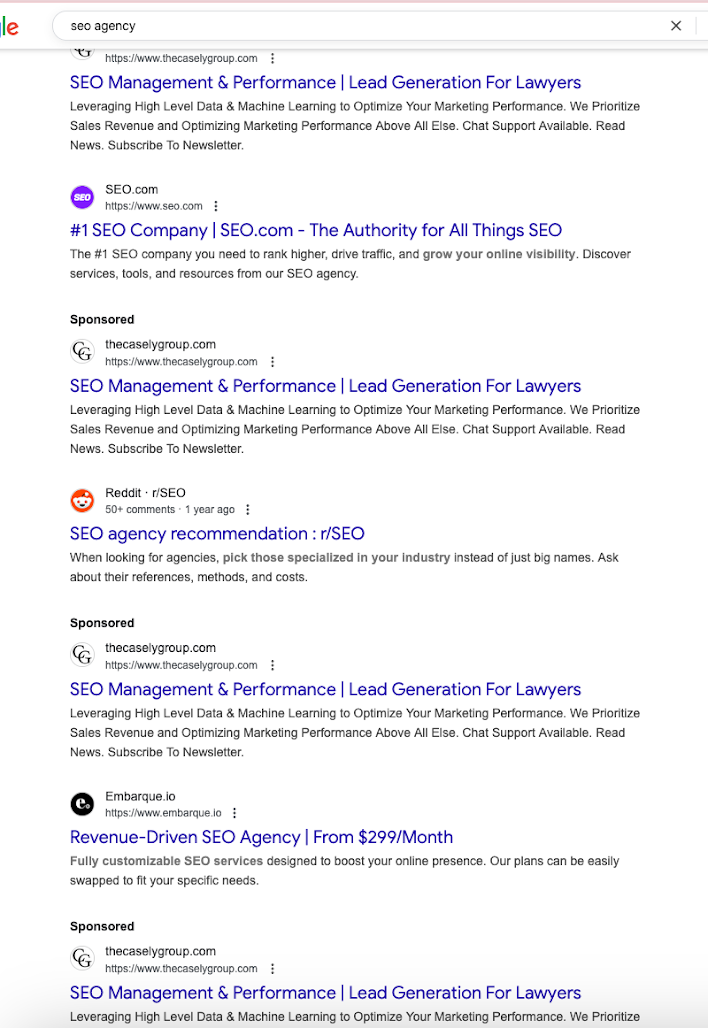
How is seeing the same ad five times in the first page of results a "helpful" user experience?
What Google is actually working to do is maximize revenue for shareholders.
They own the platform and the power of being a winner-take-all market leader is that you can ruin the search experience and still not be fully punished.
We publishers wish we welding at least some of that power, but alas.
It’s easy to joke about algorithm updates when you're managing enterprise sites with deep pockets, massive content teams, and a safety net made of paid traffic. But for small and mid-sized businesses (SMBs), Google updates can feel like a digital guillotine.
These businesses aren’t just chasing vanity rankings—they rely on organic traffic to drive actual sales, leads, phone calls, and foot traffic. And when a broad core update drops out of nowhere and shuffles the search deck, some of them fall completely off the map.
We’ve seen it:
These aren’t hypothetical. These are the real, painful consequences of being over-leveraged on organic search.
And if you run a digital agency as one of our own white label digital marketing partners, your reporting dashboard becomes a weapon your clients use against you.
We have sadly seen the results of tarnished websites that never appear to recover from their "glory days," only to wait around for months
Even worse? SMBs often don’t have the resources to recover quickly.
They don’t have an in-house SEO team.
They can’t just spin up a $10K/month paid search campaign to fill the gap.
They're stuck scrambling—Googling SEO guides, calling up their nephew who “knows computers,” or firing their agency without realizing the update wasn’t their fault to begin with.
When your entire funnel depends on being visible in local and organic search, a Google update isn’t just an inconvenience.
It’s an existential threat.
Here’s the good news: panicking won’t help, but preparation will. Here’s how to keep your head:
Focus on fundamentals: E-E-A-T, page experience, crawlability. The stuff Google keeps screaming about.
Diversify traffic: If 90% of your traffic is organic, you’re living dangerously. Get some email, paid, and referral love.
Communicate with clients: Set expectations early and often. "SEO is a long game" is your new mantra.
Use data, not vibes: Traffic is down? Check GSC, GA4, and actual rankings. Don’t make decisions based on one keyword and a gut feeling.
Diversify your content strategy: This can mean several things including 1) using video, YouTube, TikTok; 2) having a multi-domain strategy to ensure the latest updates don't hit a single website 3) use paid search management to smooth out the rocky bumps in organic traffic.
Now before you rage-quit SEO and start a goat farm in rural Vermont, hear us out: not all Google updates are evil.
In fact, some of them are... good. (We know—wild concept.)
While Google algorithm updates can absolutely feel like a digital punch to the gut, they also serve a purpose: to clean up the garbage and reward sites that are actually helpful, trustworthy, and user-focused.
If your competitors were gaming the system—stuffing keywords, buying shady links, or spinning mass quantities of AI content like a blender full of gibberish—there’s a decent chance they just got torched.
That’s your opportunity.
We’ve seen sites that:
In other words, Google updates can be the great equalizer—especially if you’ve been playing the long game.
They shake up the stale, reward the real, and offer a window for ethical SEOs and well-managed websites to rise. If your site survives and even improves after an update, that’s not luck—it’s a sign your foundation is solid.
And if you did take a hit, but you're not doing anything shady? Great. You now have a reason to re-evaluate, refresh, and level up your site quality. That’s not a punishment—it’s a growth plan in disguise.
Here’s a wild idea: sometimes the panic is actually an opportunity.
Let’s be clear: not all freak-outs are created equal. You should worry if:
Otherwise, take a breath and chill and continue to practice the fundamentals.
At the end of the day, SEO is a game of endurance. Google updates will keep coming. The rules will keep changing. And marketers will keep Googling “Why did my traffic drop overnight.”
The trick isn’t to avoid the panic. It’s to expect it—and outlast it.
If you’re tired of white-knuckling your way through every update, maybe it’s time to bring in some help.
At Marketer.co, we build SEO campaigns that don’t just survive updates—they’re built to thrive in spite of them.
Let’s turn your monthly panic into a long-term plan.
Contact us before the next update drops.

Paid ads are a powerful way to generate leads and keep your pipeline full. Unlike search engine optimization (SEO), pay-per-click advertising drives immediate traffic to your website. Once a prospect clicks on your ad, your landing page acts like a brand ambassador tasked with delivering a clear pitch to make the sale. But crafting landing pages that convert takes more than just writing a bunch of content and adding some CTAs at the end.
Getting results requires crafting pages intentionally from the ground up, including every headline and image, your color scheme, and even the typography. If you want to turn clicks into sales, this guide will help.
Before you can create optimal landing page performance, you need to understand what the norm is in your industry or niche. This will set the stage for progress. Conversion rates aren’t the same for every business and vary wildly between both industry and audience. Without benchmarking, you risk chasing unrealistic goals or settling for low numbers.
The broad conversion rate average across all industries is around 6.6%, so if your conversion rate is somewhere around there, you’re not necessarily failing. However, you’re probably leaving money on the table.
Truth be told, most businesses don’t do what it takes to achieve a high conversion rate and hover in the 2.35% range. But businesses that focus on user-centric design, persuasive copy, and a seamless user experience can push their conversion rate up to 5.31% or higher. This means simply optimizing your landing pages can double or triple your ROI without increasing your ad spend.
What may not be obvious if you’re new to marketing is that a landing page isn’t just a page you send paid traffic to. While any page on your website can be considered a “landing page,” the pages that convert best are created for a specific purpose tied to a specific campaign. For example, the page might provide access to gated content, a free trial, a service consultation, or a free download. These types of pages with a specific focus outperform all other pages. To get those big results your pages must be built with purpose.
Benchmarking tells you your true potential. If you’re sitting at 2% while your industry averages 7%, that’s a wakeup call and an invitation to improve. If you’re at 8% you’re ahead, but don’t stop optimizing. The key is to establish your baseline first, then compare it to trustworthy benchmarks, and set aggressive yet realistic goals. You have to know what “good” looks like in your niche before you can push to become “great.”
A single high-performing landing page can do wonders for any campaign but relying on a single page means missing out. The more hooks you cast into the sea of potential buyers, the more bites you’ll get. Don’t stop at just one or two landing pages. Instead, scale your portfolio by adding multiple pages for each campaign. You’ll be able to capture and convert more traffic by targeting more specific audiences with unique offers tailored just for them.
Studies show that businesses with more landing pages consistently outperform those with fewer. The logic is simple. Every new page adds another opportunity for potential customers to buy from you. But you can’t just toss up a bunch of pages and call it a day. Each page needs to be specifically crafted to reach the intended audience, tracked, and optimized with split testing.
When you scale your landing pages, the impact compounds. According to research, businesses with 31-40 landing pages generate seven times more leads than those with five or fewer. When you scale your landing pages you’re building an ecosystem full of conversion funnels that all work together.
Use tailored messaging with volume
When scaling your landing page quantity, remember to design each page with a specific segment of your audience in mind. Catch-all landing pages with general messages don’t sell as well as specific messages that speak directly to a group of targeted people. For example, if you’re selling socks you can get more sales by marketing to specific reasons people buy socks (hikers need thick socks with traction, minimalists want thin socks, some people value organic materials, teens thrash regular socks too fast, kids want fun designs, etc.).
Matching your message to specific market segments will dramatically increase the relevance of your sales copy and will drive more conversions. However, it’s not just audience segments you want to target. You also need to target different stages of the buyer journey. For example, one landing page might capture top-of-the-funnel leads with a free download, while another page drives mid-funnel engagement with a webinar, and a third page captures bottom-of-the-funnel leads with a high-ticket offer. In each case, the messaging that works for one funnel stage won’t work for the others, so it helps to target all three stages.
When you’re working with paid lead generation, volume will give you the power to meet your audience exactly where they are with a message tailored to their needs. This is how you can scale your results dramatically.
It should go without saying that speedy pages convert better, but you’d be surprised to see just how many landing pages load slowly enough to make buyers bounce. When you’re spending money to bring traffic to your web pages, the last thing you want is to lose prospects because your pages are dragging. Every extra second costs attention and revenue.
· Milliseconds matter. Page speed directly corresponds with conversion rates. Research shows that landing pages that load within one second can convert as high as 31.79%. If you can shave off even a fraction of a second you can increase your ROI. Fast enough is not good enough. Your pages need to be faster than your visitors expect.
· Delays cost real money. A one-second delay can cut conversions by 7%. When that delay reaches three seconds you could lose more than one-fifth of your potential sales. With a high-volume paid ad campaign, that can translate to thousands of dollars in wasted ad spend.
· Mobile browsing is picky. Attention spans are shorter than ever today, but mobile users are notoriously impatient. With smaller screens and distractions, even minor lags can feel unbearable. Mobile users bounce at rates much higher than desktop users, making speed optimization essential. According to Google’s research, 53% of mobile users bounce when a page takes more than three seconds to load.
· Your platform matters. Sometimes the content management system (CMS) you’re using can cause pages to load slowly. For example, if you’re using Elementor with WordPress your pages will load slower than desired. You can get around slow-loading WordPress pages by using a caching plugin but that won’t always work. If you’re dependent on a heavy visual page builder like Elementor or WP Bakery, it’s worth considering migrating to a different CMS.
Speed is non-negotiable for high-converting landing pages. Optimize all of your images, use a content delivery network (CDN), employ caching, upgrade your hosting, use lazy loading scripts, and do whatever it takes to preserve your ROI.
The purpose of a landing page is to guide visitors to take a specific action. That action might be downloading a freebie, signing up for a free trial, or making a purchase. Anything on the page that gives users other options will work against your conversion rate.
Everything on the page should guide the visitor toward the end goal without any detours or distractions. Every extra link or element is like a side door inviting visitors to leave before they convert. Paid clicks are expensive and you can’t afford to lose money to preventable distractions.
· Remove the navigation menus. The primary cause of distractions is the top nav bar on a web page. Main navigation is essential for other pages, but it’s going to tank your conversions on your dedicated PPC landing pages. Research has shown that removing the main navigation can double your conversion rates because visitors aren’t tempted to click on other links to explore the rest of your site. Instead, they stay focused on your offer.
· Minimize images. Having too many images on your landing pages can make it look cluttered and cause people to miss important headlines and text. Every image on a landing page should serve a purpose directly related to conversions. If it’s just for decoration or to fill out a spot in a pre-made template, ditch it.
· Simplify forms. Long forms create friction and hesitation. Nobody wants to type out their life story just to download a free guide. If your forms have 5-10 input fields they’re too long. Cutting forms down to just four fields can boost conversions by 120%. Only collect the details that you actively use in your email marketing campaigns. You can always collect more information from your list later.
· Use one clear CTA. Each landing page should have a single CTA that is repeated throughout the page. Even when different wording means the same thing it’s best to stick to one phrase. For instance, “Sign Up,” “Learn More,” “Buy Now,” “I Want This,” and “Contact Us” are all clear CTAs but they shouldn’t be used together. If you have multiple offers on a single page condense it down to one only.
Take a minimalist approach to your landing page design for the best results. Every element you add is going to be another opportunity for distraction and a higher bounce rate. Craft your content and layout to guide the visitor through the process of taking the action you want them to take.
Your landing pages will live or die by trust. If you’re not a big, well-known brand you can’t rely on your name alone. That’s where social proof comes into play. It helps you establish credibility fast, and when done right it can reassure even the most skeptical visitors that doing business with you is the right choice.
Testimonials are a main driver of belief. Humans are wired to trust other people more than brands and their shiny marketing tactics. A real person’s experience holds enormous persuasive weight, especially when accompanied by their name, location, and photo. But testimonials must be genuine to work. Fake reviews, AI-generated endorsements, and fake quotes will backfire. People can usually spot fake testimonials from a mile away and even if your product is the best in the world, deceptive practices will destroy trust. Collect real feedback from customers and let their authentic expressions do the heavy lifting.
Landing page optimization requires testing. Split testing, also called A/B testing, allows you to compare two variations of a page to see which performs better. The key is to only change one element between the two pages you’re testing. For example, change the headline or the CTA. Once you see which page performs better, use that page and then change one more element and run another test.
On average, only one in every eight tests will produce significant improvements but that’s a good thing. It will tell you which elements don’t really matter and as you test more, you’ll eventually discover the elements that make bigger differences.
With that said, not all variables should be tested. Focus on high-impact elements first like your headlines, CTAs, visuals, and form fields. Even small changes to these elements can generate a big impact on conversions. Once your main elements have been optimized, then start testing secondary factors like button colors and typography.
Nothing kills trust faster than inconsistency. When a visitor clicks an ad and lands on a web page that doesn’t look related, the disconnect creates instant doubt. People hate feeling tricked into clicking on irrelevant ads, and if your landing page doesn’t echo your ad’s style, many people will bounce. When your message and design align it reassures visitors that they’re in the right place.
Mismatched messaging is a common mistake. For example, an ad might say, “Sign up for a free 30-day trial” but the landing page says, “Welcome to our company.” This mismatch makes visitors feel misled. Sure, you might offer a 30-day trial somewhere on the page but it should be the first thing people see since that’s the expectation your ad created.
Consistent visuals are equally important. Between your ads and your landing pages, everything should match, from the colors and images to the typography.
When using a strategy like retargeting, consistency can drive more sales. For instance, people will encounter your messages and ads across a variety of platforms like YouTube, Instagram, LinkedIn, Facebook, and TikTok. Make sure your messages and visual design are consistent across all platforms where you advertise to maintain familiarity and trust.
Landing pages have the power to turn paid traffic into a full pipeline, but only when your ad spend isn’t being wasted. With the right strategies, you can create targeted landing pages that generate a steady stream of revenue. If you’re not sure where to start, we can help.
Tired of bleeding ad spend? Ready to scale your leads? At Marketer.co, we engineer landing pages that drive measurable revenue. Reach out today and let’s turn your ad clicks into paying clients.

Global ecommerce and retail marketing is entering a performance-and-first-party era: online sales continue to set records even as overall ad-budget growth cools, forcing teams to squeeze more yield from every channel (Adobe, eMarketer). Discovery is shifting toward social platforms and retailer ecosystems, accelerating the rise of retail media networks with high-signal, closed-loop measurement and growing budget share (eMarketer).
At the same time, rising CPC/CPM and tightening privacy guardrails require consented data, durable measurement, and lifecycle programs that compound—email/SMS, loyalty, subscriptions—augmented by AI to speed creative testing, merchandising, and product discovery (WordStream, Privacy Sandbox, Litmus).
This report distills the latest benchmarks and channel dynamics—what’s working in search, retail media, social/video, and onsite conversion—and how leaders are containing CAC, raising LTV, and turning seasonal spikes into sustained growth over the next 12–24 months.
Global retail media ad investment (USD billions): $128.2B (2023) → $153.3B (2024) → $176.2B (2025). Source: WARC/Global Ad Trends. WARC+2WARC+2

Digital advertising ≈ 75% of total global ad spend in 2025; traditional ≈ 25%. Within digital, retail media’s share is rising fast (mid-teens of total ad spend globally). Sources: eMarketer (digital share) and WARC (retail media). EMARKETER WARC

Notes & how to read this section
Below are three high-signal ecommerce/retail buyer archetypes you can target and measure against, with attributes grounded in current behavior shifts.

Source notes:
This illustrates how paid media budgets skew across platforms in a large ecommerce cohort: Meta ~70.7%, Google ~23.1%, TikTok ~2.9%, Other ~3.3% (Pinterest, Snapchat, Reddit, etc.). Triple Whale

Method notes:
Where the momentum is: HubSpot continues to grow its installed base per 2025 earnings updates, while Salesforce remains the incumbent for large, global retailers that need deep customization. (Directional growth per HubSpot’s Q2-2025 results; Salesforce widely entrenched with very high review volume.) Skai G2
What’s changing: Marketing automation is the most-replaced martech category for the fifth year running, with integrations and features the top drivers for switching; cost is the top consideration for new purchases. Expect continued migrations from generic ESPs to commerce-centric platforms (Klaviyo, Braze, Iterable). MarTech+1 Chief Marketing Technologist
Stack direction: GA4 + BigQuery (warehouse) + reverse-ETL into the ad stack is becoming the default measurement spine; teams layer Mixpanel/Amplitude for journey insights where app usage or granular events matter. G2
Where share is moving: Shopify continues to expand share across e-commerce technologies; Adobe/Woo/BigCommerce hold in niches (custom, B2B, content-heavy) but face app-ecosystem pressure. BuiltWith
What’s trending: Budget flow into retail media keeps climbing, with teams consolidating onto cross-retailer platforms (Pacvue, Skai) for unified pacing/optimization and more consistent measurement. Pacvue Skai

Ratings & counts (sources):
Shopify 4.4/5, 4,706 reviews; integrations list includes Klaviyo, GA/BigQuery, Meta/TikTok, HubSpot, Salesforce. G2
Klaviyo 4.6/5. G2
Mailchimp 4.3/5. G2
Salesforce Sales Cloud 4.4/5. G2
HubSpot Sales Hub 4.4/5. G2
Google Analytics 4.5/5; native BigQuery export noted in integrations. G2
Sources (dated within last 12 months):
Torrid full-funnel TikTok case study and results (+31.8% apps, +7% purchases, +27% recall; 15/85 spend split; Unified Lift) published by TikTok for Business in 2024; Ovative case study (Mar 19, 2025) reinforcing incrementality (24× vs last-click). TikTok For Business Ovative Group
Matt Sleeps full-funnel Black Friday results (3× purchases, +128% traffic), Think with Google (Feb 2025). Google Business
HEYDUDE Amazon DSP + Buy with Prime outcomes (11.4× ROAS, 47% NTB, +13.3% AOV; +3.9% purchase-rate lift), Amazon Ads case study (2025) and Buy with Prime customer story (Mar 2025). Amazon Ads Buy with Prime
Key sources & corroboration:
How to read it:
Startup (pre-scale / <$5–10M GMV)
Growth (multi-channel / $10–50M GMV)
Scale (>$50M GMV / omnichannel)

Marketing in the Information Tech & Software sector enters 2025 with a disciplined growth mindset: budgets continue to expand but are being reallocated toward channels with defendable revenue impact, as buyers shortlist fewer vendors and expect transparent pricing, ungated proof (trials/POCs, benchmarks, customer evidence), and fast time-to-value.
Rising media costs and uneven signal quality—even after Chrome’s cookie U-turn—are pushing teams toward first-party data, consented measurement (MMM/incrementality), and compounding owned channels (SEO, email, community), while AI shifts from experimentation to production to accelerate research, content, creative, and activation. Acquisition mixes are tilting toward rep-optional, product-led motions and lifecycle programs that grow expansion ARR and LTV to offset higher CAC and longer payback.
This report synthesizes the latest benchmarks, channel economics, and buyer-behavior shifts across B2B SaaS, enterprise software development, developer tools, and IT services, and examines the martech stack choices and creative formats outperforming now. It closes with data-anchored playbooks for startups, growth-stage firms, and scaled enterprises to allocate budgets, test formats, and instrument KPIs that correlate with pipeline quality, NRR, and durable growth.
Implication: Software remains a secular grower; marketing expansion persists but with sharper efficiency and mix discipline than 2024.
Implication: High digital maturity (cloud + AI) shortens time-to-value expectations and raises the bar for proof-driven marketing.


ologyAdvice

What this means for your marketing (quick hits)
Below is a pragmatic, channel-by-channel view grounded in current benchmarks for IT & Software (B2B-heavy). I’ve included a Webflow-ready HTML table (with inline source links) and a stacked bar visual showing how budgets are typically allocated across channels.


Below are three anonymized but real-world campaigns (enterprise + PLG SaaS) executed between Q3’24–Q2’25. Metrics are rounded to protect the brands; each tactic is tied to verifiable sources so you can replicate the play.
Who/ICP: DevOps platform (Series D), ACV ~$35–50k, North America & UK enterprise
Goal: Increase qualified demos and opportunity creation from high-intent search while holding CPL
Timeframe & Spend: Q1’25, $150k media (Search 60%, LinkedIn 25%, YouTube 10%, Other 5%)
Who/ICP: Enterprise security SaaS (F1000 target), ACV ~$100k+, 6-person buying groups
Goal: Turn intent surges into committee-ready meetings and SQOs
Timeframe & Spend: Q4’24–Q1’25, $240k media (LinkedIn 55%, Programmatic 20%, Search 15%, Events 10%)
Who/ICP: Developer tool (freemium), global; low-friction signups, activation is the wall
Goal: Grow quality trials (not vanity signups) and lift activation rate
Timeframe & Spend: Q2’25, $110k media (TikTok 40%, Meta 25%, Search 20%, YouTube 10%, Other 5%)
Why LinkedIn for upper-funnel? In B2B tech, most paid awareness and consideration budgets sit on LinkedIn; using LinkedIn CPM/CTR here gives you a truer planning baseline than consumer-heavy Meta averages. NAV43
These mid-funnel rates are useful to convert top-of-funnel KPIs (impressions/clicks) into pipeline math (MQLs, SQLs, opps). If you’re far below these ranges, inspect qualification rules and meeting-set processes before increasing spend. First Page Sage

Marketing leaders in IT & Software are juggling auction inflation, privacy flux, AI-scale content, and decaying organic reach—all while pipeline targets keep climbing. Tech & electronics ad investment is still growing ($90.3B in 2025, +5.5% YoY), amplifying auction pressure across the channels B2B teams rely on most. WARC
What’s happening
Why it matters
Auction inflation forces hard choices: either push more budget into high-intent slices (brand, competitor, pain-keywords) or rebuild the mix around durable CAC channels (SEO, email, partner, review sites). Without these shifts, CAC drifts upward even when CVRs hold.
What to do next (data-backed plays)
What’s happening
Why it matters
Even without cookie deprecation, signal quality from browsers and walled gardens is noisier. Teams that shore up consent and server-side data flows will feed better conversions back to ad platforms and reclaim performance.
What to do next (data-backed plays)
What’s happening
Why it matters
AI can compress creative cycles and enable dynamic personalization, but undifferentiated, low-fidelity content underperforms in B2B tech where security, ROI, and integration specifics drive trust.
What to do next (data-backed plays)
What’s happening
Why it matters
Traditional “rank → click → convert” funnels erode. You must win in the SERP (and in the answer), and win off-site (reviews, communities, social, newsletters)—not just on your .com.
What to do next (data-backed plays)

Why these mixes?
Tech MailerLite
WordStream NAV43 Tamarind's B2B House First Page Sage+1 Unbounce Maxio Benchmarkit LinkedIn Business Solutions Google Help+1 Google for Developers Varos Cisco

Note: Relative index (Q3’25 = 100). Directional forecasts informed by platform cost trends (e.g., WordStream 2025 CPL $70.11), search usage and zero-click shifts, LinkedIn growth indicators, and TikTok CPC medians. Use your own baseline CAC/LTV to localize. WordStream

Includes: Server-side conversions & offline/imported conv., GEO/zero-click content, AI agents for SDR/CSM, warehouse-native activation, LinkedIn doc/video & creators, privacy ops (CMP+consent), hybrid/usage-based pricing, MMM/incrementality-light. Reuters+1

.svg)