The eCommerce industry is constantly growing, evolving, and providing businesses with phenomenal opportunities to profit.
To take advantage of this ever-expanding sector, businesses need to develop powerful marketing strategies that reach the right audience at the right time.
It can make your online store more visible and capture the attention of potential customers who are actively looking for products and services- like yours in major search engines, social media platforms, and other digital channels.
In this blog, we will discuss paid eCommerce marketing strategies such as Search Engine Marketing (SEM), Social Media Advertising, Display Advertising, and more.
We'll also provide some examples from different companies so you can see which ones are succeeding in an increasingly crowded market filled with competitors eager to snatch away a piece of your pie before it even cools off!

Search Engine Marketing (SEM) is a type of internet marketing that involves using paid advertisements to rank highly in search engine results.
It includes optimizing landing pages as well as improving visibility and relevance through other methods such as pay-per-click (PPC), keyword research, and targeted ad placement.
Google Ads, which uses targeted advertising placed at the top of SERP results, and Yahoo marketing which focuses on contextual ads.
Other SEM strategies such as Bing & MSN have also become increasingly popular due to their low-cost options and ability to target specific demographics with paid search.

Social Media Advertising is a type of paid digital marketing that places ads on different social media platforms such as Facebook, YouTube , Instagram, Twitter and LinkedIn.It helps businesses reach their target market through sponsored posts, carousel adverts and video adverts to spark interactions with potential customers by sharing relevant content in an engaging way.
Examples of successful Social Media Advertising campaigns range from Nestlé's Oat Bites product launch to Burger King's #ScaryGoodCostaRica hashtag campaign.
Each one created content that was relevant and engaging to the target market, helping them increase brand recognition, visibility, and loyalty with customers.

Display advertising is a type of marketing strategy that involves placing ads on different websites in display format. This includes everything from banners and videos to interactive media ads, so businesses can get their message across to consumers through visuals or sound.
Examples of display advertising campaigns include using retargeting to serve ads to warm leads , Native Ads which blend into the website and targeted banners placed on high traffic sites related to your product or service.

Influencer marketing is a type of online marketing where influencers, which are individuals with high-level reach and engagement, promote brands' products or services to their large audience base. It incorporates content creation and shares through multiple digital channels such as blog posts, social media platforms, video campaigns, and more.
These are integrated into platforms such as YouTube, Instagram, TikTok, and other popular websites in order to increase brand reach and engagement.

Affiliate Marketing is a type of e-commerce digital marketing that enables brands to increase their customer base by partnering with other businesses (affiliates) and incentivizing them to promote the brand's products or services. In exchange, affiliates receive a commission for each sale generated from their referrals; this is mostly a popular strategy now considering its many benefits.
Examples of successful affiliate marketing campaigns include Amazon's program, where the brand engages millions of affiliates around the world to help promote its products. Other companies such as REI and Blue Apron have also seen great success with their affiliate programs by providing incentives to customers for referring friends or followers to purchase their goods and services.

Email marketing is a form of digital marketing that involves sending promotional emails to potential and current customers. It allows businesses to build relationships, deliver value, promote their products, keep customers informed, and drive ecommerce sales.
Benefits of Email Marketing
Key Components of Email Marketing
This will enable businesses to craft messages that resonate with the customers and deliver value at every step of their journey. This is particularly important for ecommerce stores looking to enhance their ecommerce marketing tactics.
Examples of Email Marketing Campaigns
Companies can also use automation to trigger certain events based on customers' activities for a more personalized experience.

Retargeting is a type of online advertising whose main purpose is to re-engage customers who have previously interacted with a business or its marketing campaigns. It uses tracking codes placed on websites and segments users through cookies in order to show ads only to relevant audiences.
Benefits of Retargeting
Key Components of Retargeting
Examples of Retargeting Campaigns
Each campaign provides a unique opportunity for businesses to re-engage with their audiences by addressing specific interests. This is an effective tactic in any ecommerce marketing plan.

Video Advertising is an effective way to reach potential customers. It involves creating compelling visual pieces, often using multimedia platforms such as YouTube or Vimeo, that send a powerful verbal and non-verbal message about the advertised product or service. It furthers brand recognition and increases engagement among your target audience for increased ROI.
Benefits of Video Advertising
It also allows marketers to track viewer behavior, like how long they watched, which provides valuable insight into optimization efforts for ecommerce brands.
Key Components of Video Advertising
Examples of Video Advertising Campaigns
Choosing the right Paid ecommerce marketing strategy for your business can be a daunting task. It is important to understand what goals you are trying to achieve, who your target audience is, and how they use various marketing channels before settling on one strategy or another.
You should carefully weigh the advantages and disadvantages of each strategy, as well as their associated costs and labor-intensive elements, to choose one that best fits your needs. Knowing these will give you insight into devising strategies tailored towards specific customer segments, thus optimizing results within budgeted ecommerce marketing efforts. This will directly influence your online sales.

Cryptocurrency digital marketing has re-entered a high-stakes, high-visibility phase. With the global market cap pushing toward $4 trillion and institutional flows increasing via spot Bitcoin ETFs—now holding $145 billion in AUM as of August 2025 ([Bitbo])—crypto brands are seeing stronger upper-funnel momentum across both retail and institutional segments.
However, despite surging adoption, public confidence remains mixed. Only 17% of U.S. adults report having invested or used crypto, and 63% still say they’re not confident in its safety or reliability ([Pew Research]). For marketers, this means education, proof, and transparency are more important than ever—especially in creative messaging and funnel UX.
Cryptocurrency digital marketing in 2025 blends privacy‑safe measurement, KYC‑aware funnel design, and region‑specific compliance (e.g., MiCA, SEC) with community‑led growth. For exchanges, wallets, and L2 ecosystems, the winning mix pairs certified search + SEO compounding with Telegram/Discord activation, authentic KOLs, and lifecycle programs that drive first deposit/trade—and 30‑day active use.
Meanwhile, Google Ads policy updates now allow crypto Search and YouTube campaigns in multiple regions—including the U.S. and Canada—but only with certification and jurisdictional compliance. As a result, top-performing strategies in 2025 center around regulated acquisition channels (Search + SEO), plain-English landing pages, and crypto-native media buys (e.g., Coinzilla, Cointraffic) where display CPMs remain efficient (~€3–€10) ([Coinzilla]).
Institutional buyers—particularly those in the ETF, custody, and hedge fund space—are also significantly increasing their exposure, with 83% planning to grow digital asset allocations in 2025 ([EY–Coinbase Survey]). For retail-facing brands, that validation acts as social proof. Campaigns referencing regulated products like ETFs or [MiCA-licensed platforms] are outperforming “moonshot” messaging.
But, before we dive into the juicy data, we are going to toot our own horn a bit.
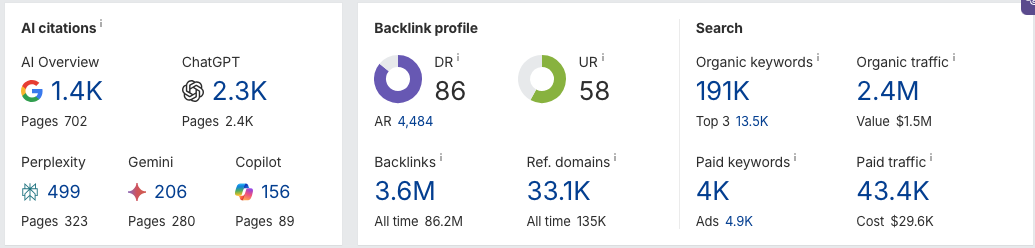
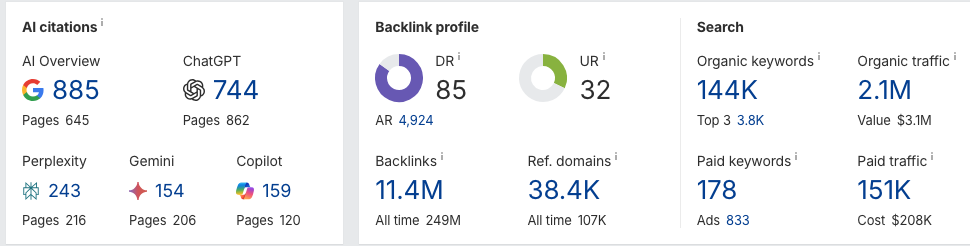
As an agency, we have worked with two very large players in crypto, helping to scale-up their authority, organic traffic and revenue.
Because we maintain high levels of confidentiality with the majority of our clients (most don't want to give away the secret sauce), these screenshots are offered blindly.
However, further details, including the client names and our strategies, can be made available upon request.
Ok, enough bragging. Back to the report!
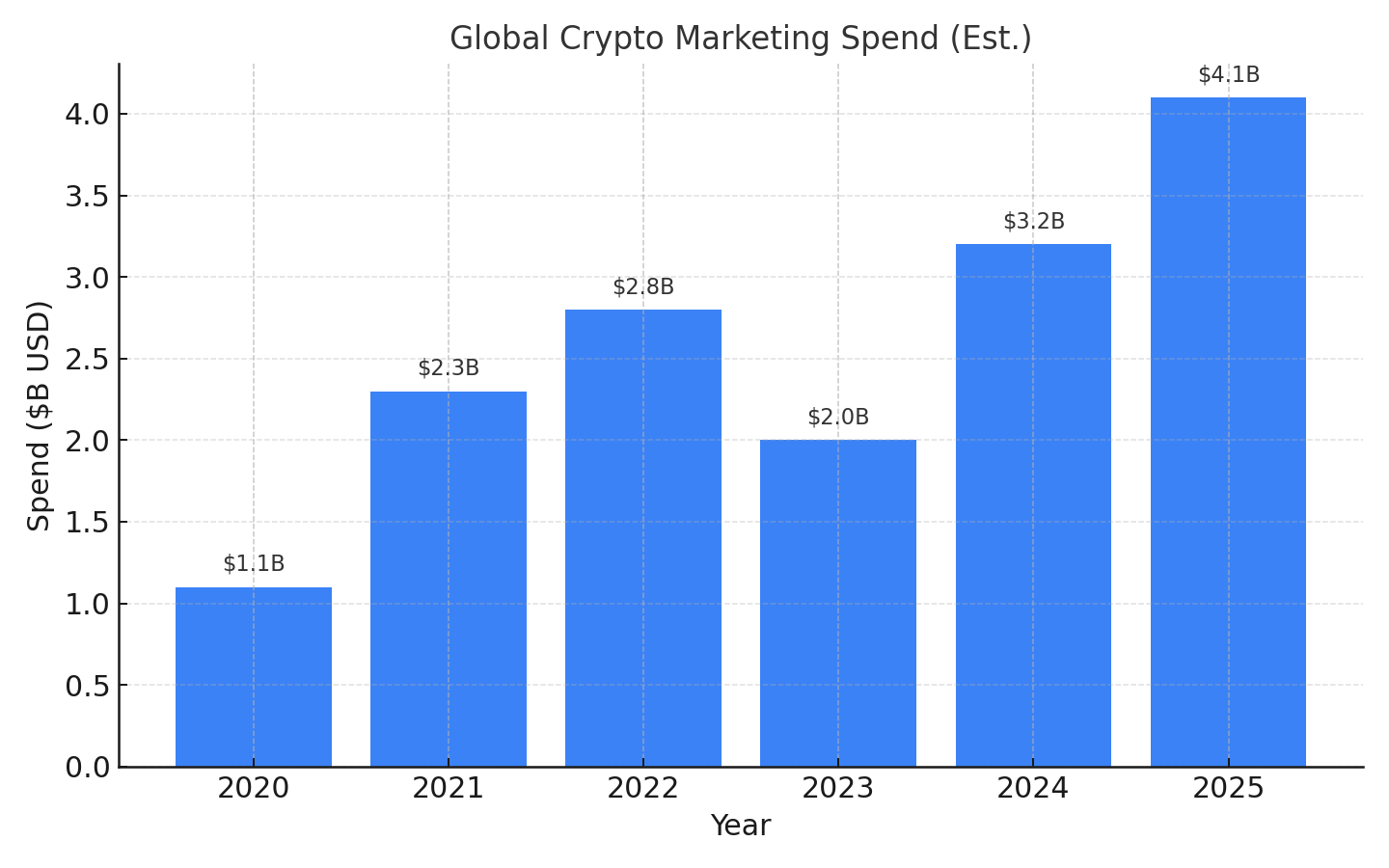
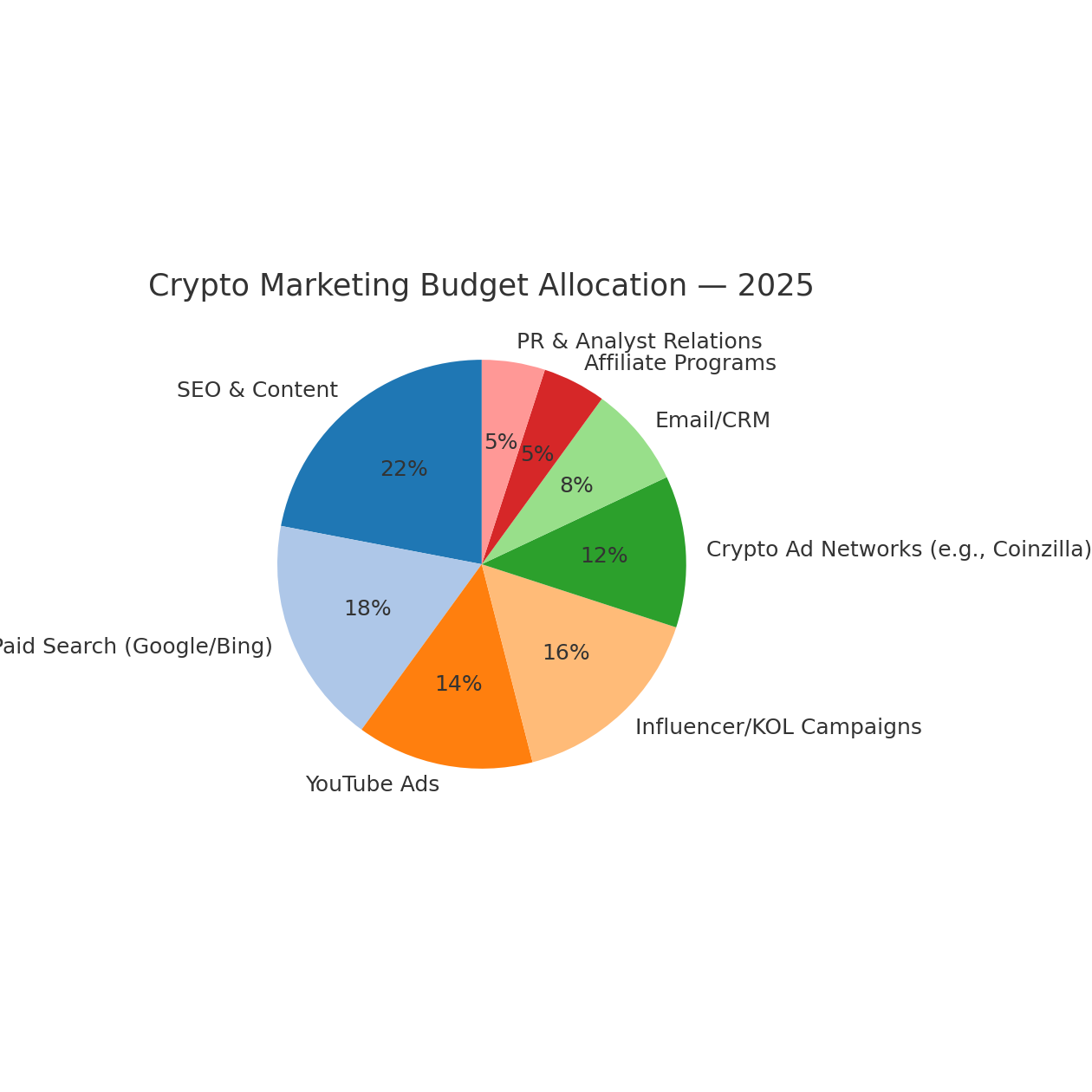
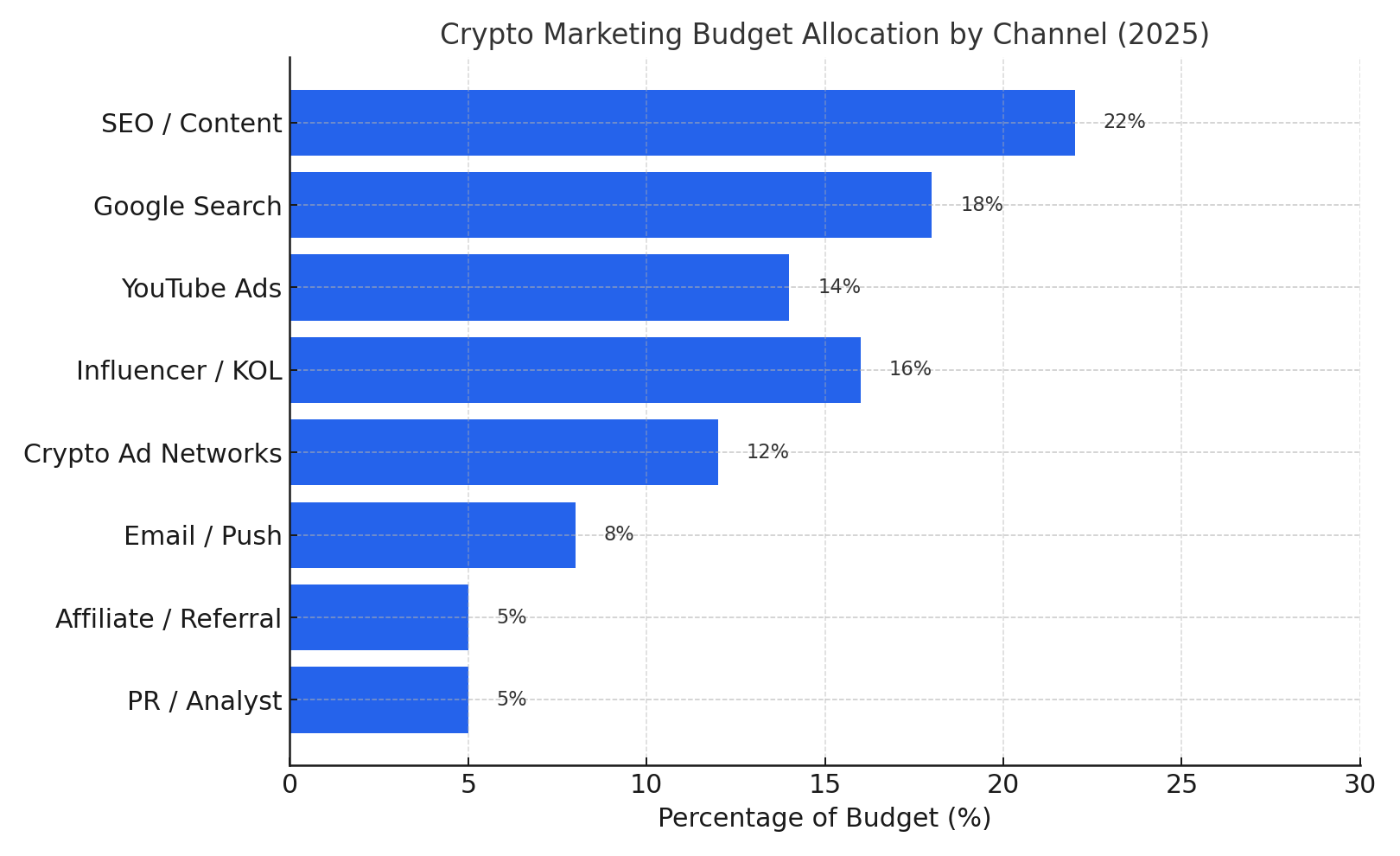
The chart below reflects a modeled breakdown of Web3 marketing budget allocation for 2025, based on aggregated data from crypto-native media networks, performance benchmarks from Web3 marketing agencies, and adjusted global digital ad spend trends. While exact splits vary by company maturity and jurisdiction, the pattern is clear:
Search, content, and KOL-led education now dominate acquisition strategy, while compliant display ads (on crypto ad networks like Coinzilla and Cointraffic) provide cost-efficient reach. Lifecycle channels like email/CRM and affiliates remain underutilized, especially among early-stage Web3 projects.
This model reflects a hybrid funnel reality—where both institutional capital and retail community users must be educated, converted, and retained under increasing regulatory scrutiny.
Because crypto is a hybrid industry—serving both retail consumers and institutional buyers—successful GTM strategies must segment audiences with radically different intents, risk tolerances, and onboarding expectations.
Creative/UX must branch based on compliance level and sophistication. Retail users want simplicity and social proof. Institutions want risk disclosures, whitepapers, and cost structure clarity.
Crypto marketers in 2025 are navigating a channel ecosystem that’s part regulated, part renegade. While traditional channels like Google Search and YouTube now allow crypto advertising (with certification), others—like TikTok and Meta—remain regionally restricted or algorithmically volatile. Crypto-native ad networks (e.g., Coinzilla, Cointraffic) are seeing renewed adoption due to cost efficiency and DeFi reach.
Here’s a performance matrix comparing major paid and organic channels used across retail and institutional crypto funnels:
As crypto teams mature, they’re building more resilient and compliant marketing infrastructure. From CDPs that handle pseudonymous wallet behavior, to crypto-friendly CRMs and analytics stacks, the martech ecosystem in Web3 is quickly bifurcating into:
In crypto marketing, creative strategy is now inseparable from compliance, clarity, and community alignment. Gone are the days of hype-heavy slogans and meme-only landing pages—especially for brands operating in regulated markets or targeting institutional users.
Instead, leading Web3 teams are adopting a trust-first creative framework:
In 2024–2025, the highest-performing campaigns in crypto weren’t necessarily the flashiest—they were the ones that blended regulated reach, creator trust, UX simplicity, and regional localization. Below are three standout campaigns across different Web3 segments.
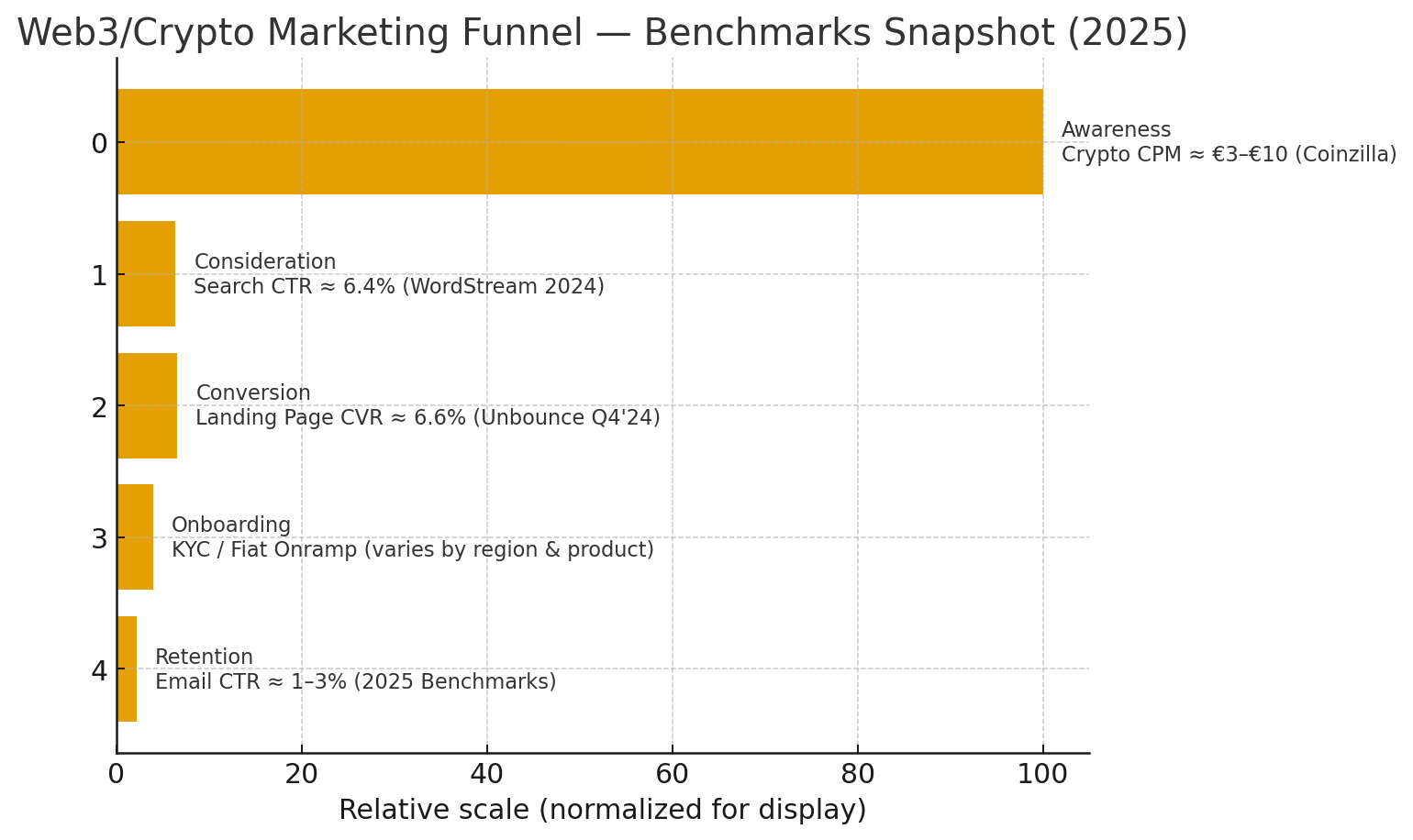
How to read this: The funnel below is a benchmarks snapshot that pairs a visual with sourced, paste‑friendly stats. Values are normalized for display (not absolute). Use the cited ranges to calibrate against your own data.
Where teams lose the most users:
Crypto marketers in 2025 are navigating a dual reality:
Below is a quadrant highlighting the highest-impact risks and emerging opportunities for growth teams in crypto and Web3.
Below are practical playbooks by company maturity and a Webflow‑ready 3×3 strategy matrix (Channel × Tactic × Goal). Tactics reflect the hybrid nature of crypto (institutional + retail) and the realities of certification, compliance, and community.
A) Early / Launch (exchanges, wallets, protocols pre‑PMF)
B) Growth / Scale (regional PMF, multi‑asset products)
C) Enterprise / Global (custody, ETFs, RWA/tokenization)
How to use: Pick 1–2 tactics per cell for this quarter. Reallocate 10–20% of spend toward the best performers each Q.
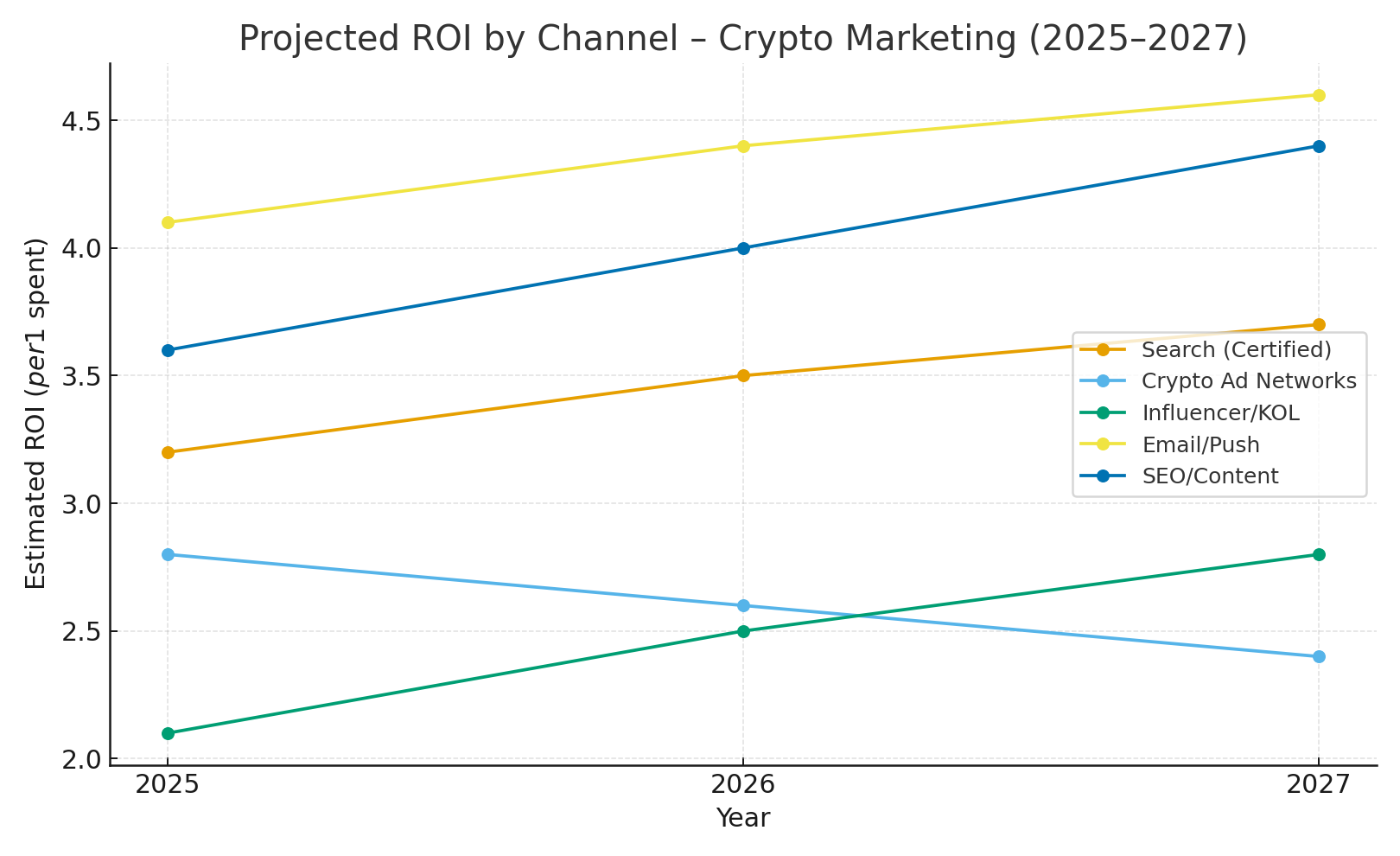
With spot Bitcoin ETFs approved, MiCA regulation enforced, and SEC/CFTC positioning stabilizing, crypto marketing is moving into a compliance-first, asset-backed phase. Creative must reflect this:
Prediction: By 2026, 50%+ of high-performing campaigns will mention licensing, audit, or ETF alignment in ad copy or landing pages.
As cookies continue to decline and wallet-hopping remains rampant, attribution and lifecycle engagement will be powered by:
Prediction: By late 2026, 70%+ of advanced Web3 brands will be running AI-personalized lifecycle campaigns tied to wallet cohorts, not CRM emails.
Post-KYC drop-off is still the biggest leak in most crypto funnels. We expect an increase in:
Prediction: The most effective retail crypto apps will lead with “your custody, your choice” narratives.
As Web3 globalizes, regional compliance (e.g., MiCA in EU, MAS in Singapore, SEC exemptions in U.S.) will dictate media allocation:
Prediction: By 2027, most exchanges will run country-specific LPs + asset/feature toggles by IP or device locale.
You’re free to excerpt tables/graphics in marketing materials with credit:
“Source: Marketer.co, Web3/Crypto Marketing Report 2025 (compiled from public data and modeled benchmarks).”


The global cybersecurity services sector is entering a new phase of accelerated growth, driven by escalating digital threats, AI adoption, and heightened regulatory scrutiny. Marketing within this industry is evolving just as rapidly: buyers are more selective, shortlisting fewer vendors, and demanding transparency, proof of value, and trust at every stage of the journey.
Traditional lead generation models are giving way to brand-led growth strategies that emphasize thought leadership, reviews, and customer advocacy, while rising ad costs and signal loss from third-party cookies push marketers toward first-party data and compounding organic channels.
This marketing report provides a comprehensive analysis of the latest trends, performance benchmarks, and channel dynamics shaping B2B cybersecurity marketing in 2025. It highlights how leading firms are adapting their acquisition strategies, which tools and creative formats are outperforming, and what KPIs executives should track to align marketing investments with pipeline quality and customer lifetime value.
Our cybersecurity marketing clients, including SEC.co, among others, prompted the creation of this report.
The sections that follow offer not only up-to-date statistics and industry insights but also actionable strategies tailored for startups, growth-stage firms, and scaled enterprises in the cybersecurity space.
Key sources: Gartner forecast via ITPro IT Pro; TrustRadius stats summarized by Shopify Shopify; WordStream Google Ads benchmarks (PDF) WordStream; Unbounce conversion median Unbounce; LinkedIn cost trend (NAV43) NAV43; HubSpot open rate & Salesforce CTR guidance HubSpot BlogSalesforce; First Page Sage CAC (Security row) First Page Sage; Demand Gen Report content friction (PDF) Rackcdn; Reuters on Chrome cookies shift Reuters.
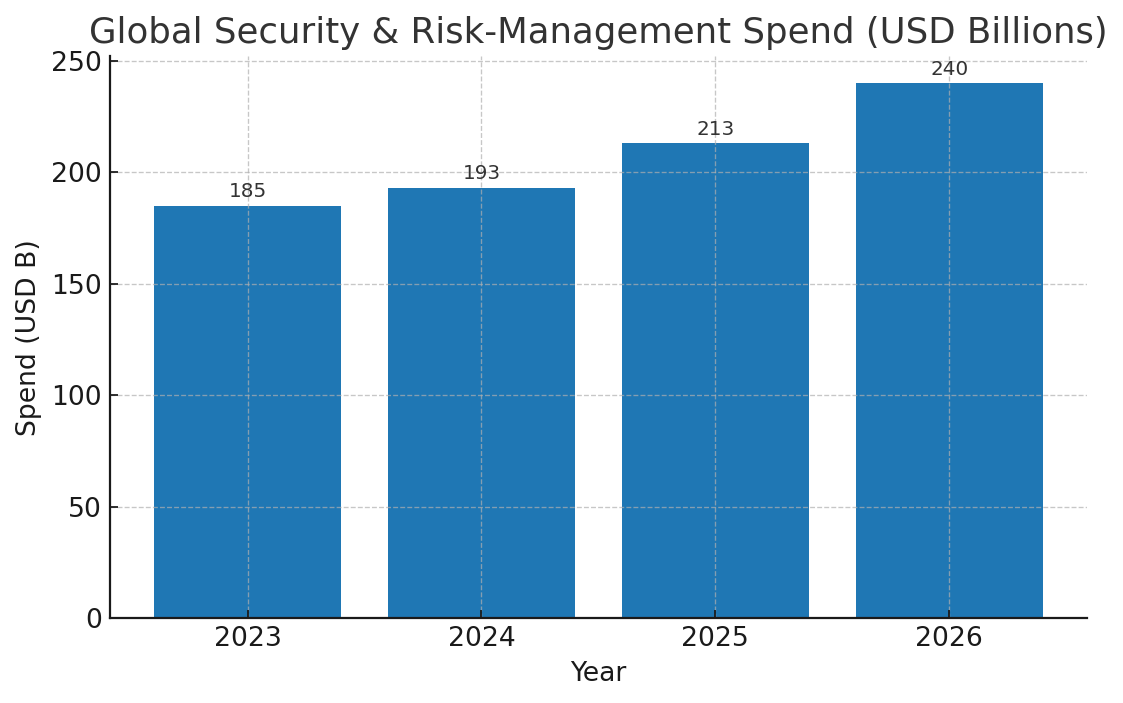
Security budgets are expanding faster than general IT, with services (MSS/MDR, consulting, co-managed SOC) outpacing product growth. This enlarges the addressable pipeline for service providers and raises competitive density in paid channels—making brand, category presence, and review velocity strategic levers to win shortlists.
Implication: Mature cloud and Zero Trust adoption push buyers toward managed detection, identity, cloud posture, and access modernization—high-intent categories where review sites, SEO, and analyst presence materially influence vendor inclusion.
Verdict: Maturing (not saturated). Growth is robust, but efficient acquisition requires trust-led plays (analyst/peer validation, proofs, transparent pricing) and first-party data readiness as third-party signal becomes less reliable.
This shows the industry’s macro spend trajectory (proxy for TAM expansion).
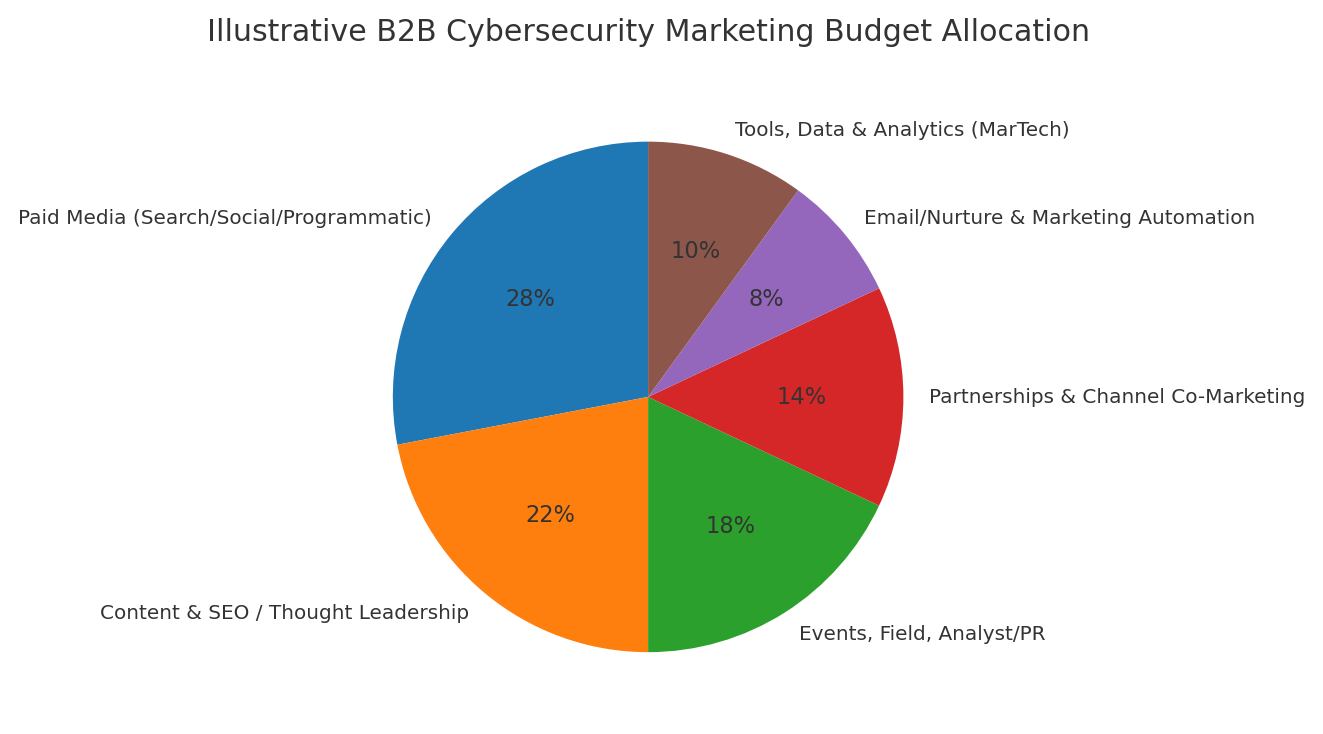
Synthesis of recent B2B benchmarks (Forrester/Gartner/CMO trends). Actual mixes vary by ACV, motion (PLG vs SLG), and sales cycle length.
Breakdown used in chart (example):
Sources for directional allocation context: digital share rising to 61.1% in 2025 (ChiefMarketer, summarizing Gartner CMO spend); Forrester B2B budget benchmarks (avg. ~8% of revenue invested in marketing) and partner ecosystem emphasis. Chief MarketerForrester+1
Primary ICPs for B2B cybersecurity services typically segment by company size, industry risk profile, and IT/security maturity.
Sources: Flexera Cloud Report (2024) on adoption trends, PwC cyber survey, Ponemon Zero Trust adoption.
Digital-dominant research:
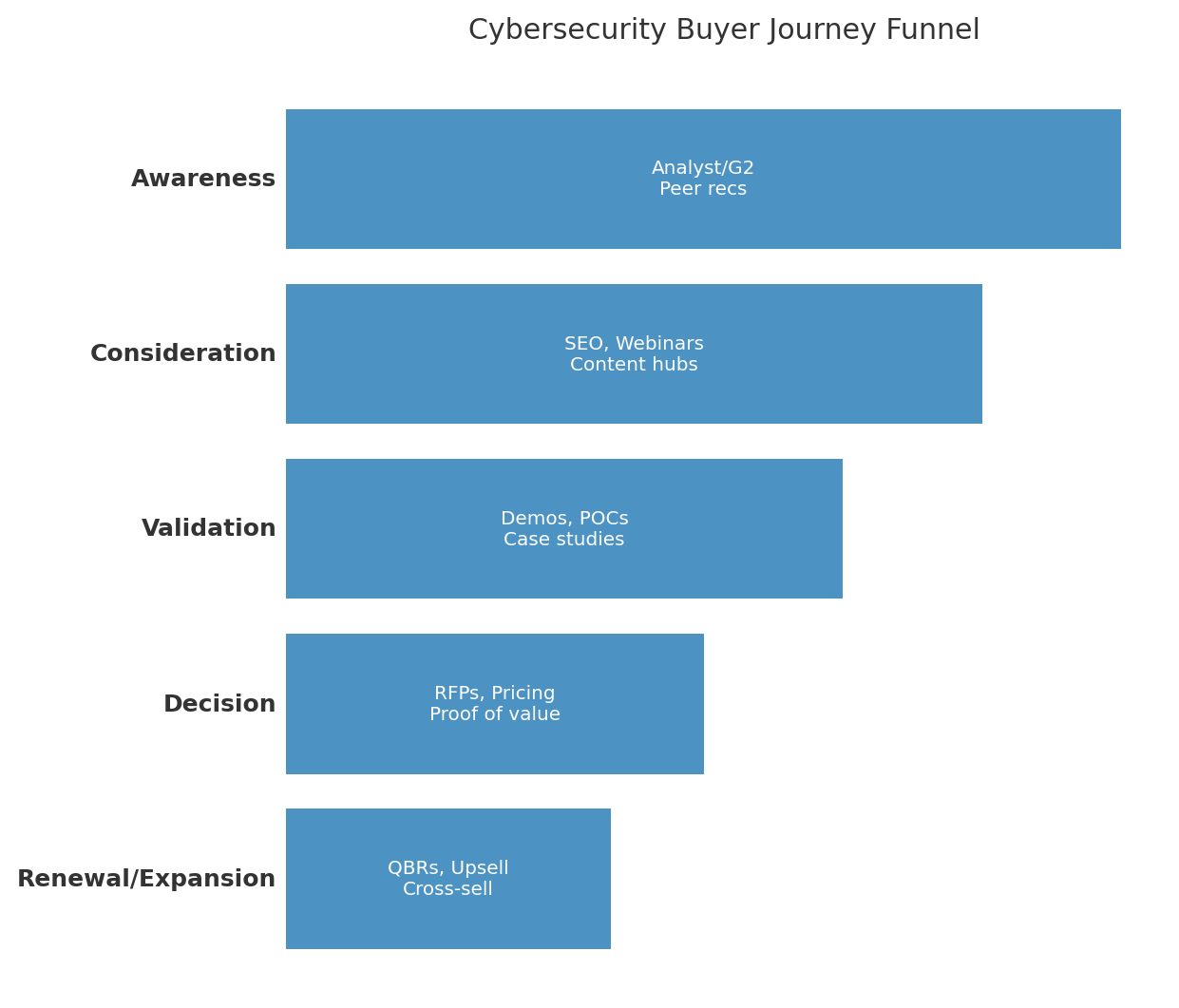
Typical Cybersecurity Buyer Funnel:
The B2B cybersecurity buyer funnel is reflective of other industries, with some slight industry-specific nuance:
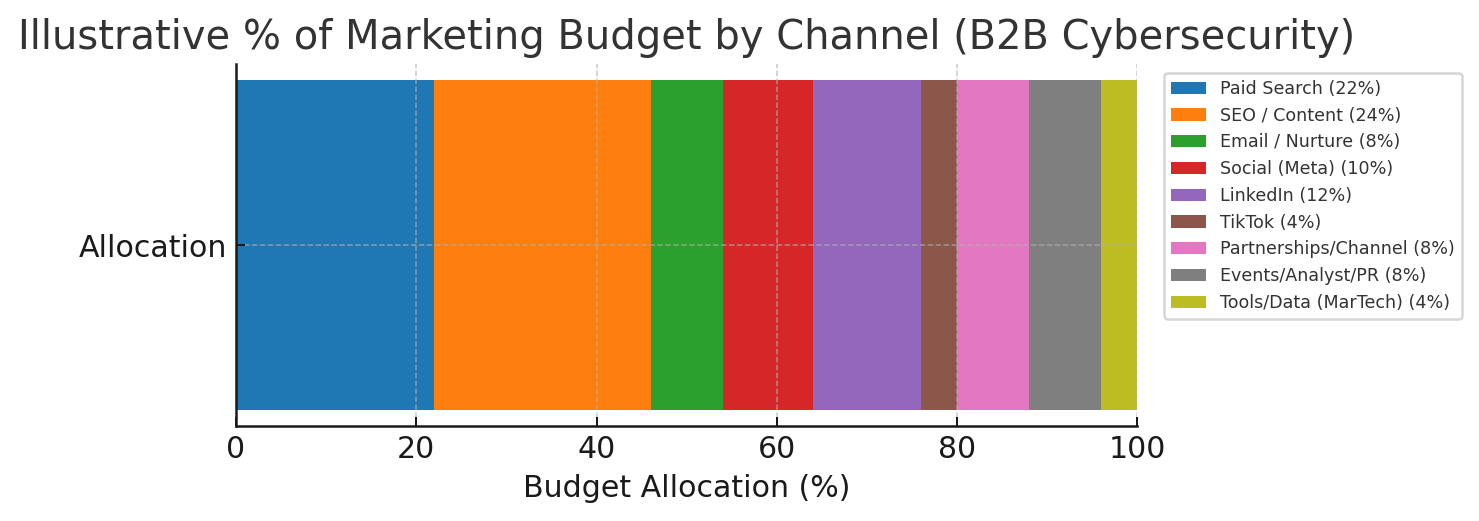
Below is a tabl comparing core acquisition channels on Avg. CPC, Conversion Rate, and CAC with sourced notes. Where a metric doesn’t apply (e.g., SEO CPC). CAC figures use the latest 2025 B2B CAC by channel study from First Page Sage; CPC/CR benchmarks use current industry reports.
Citations:
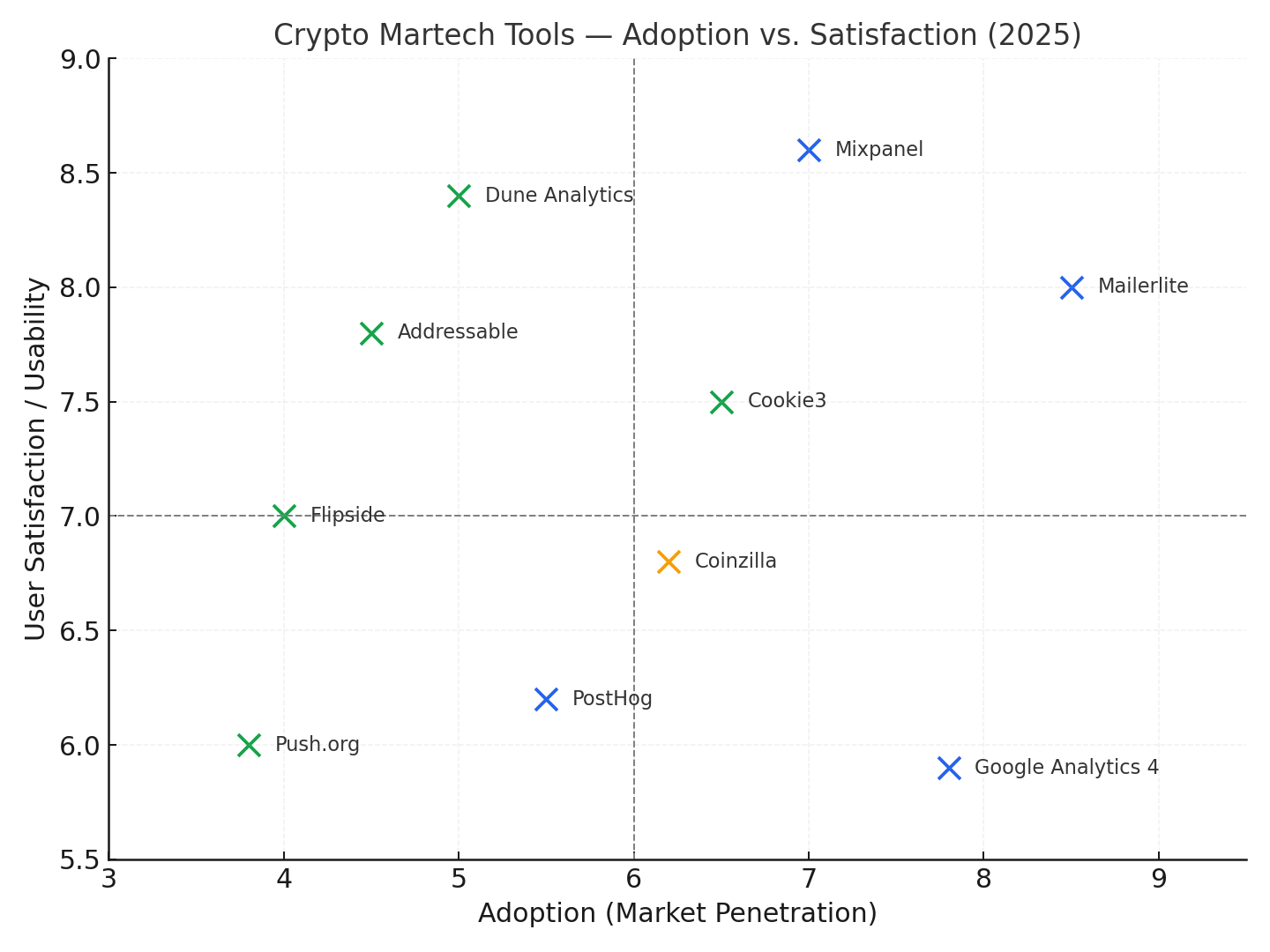
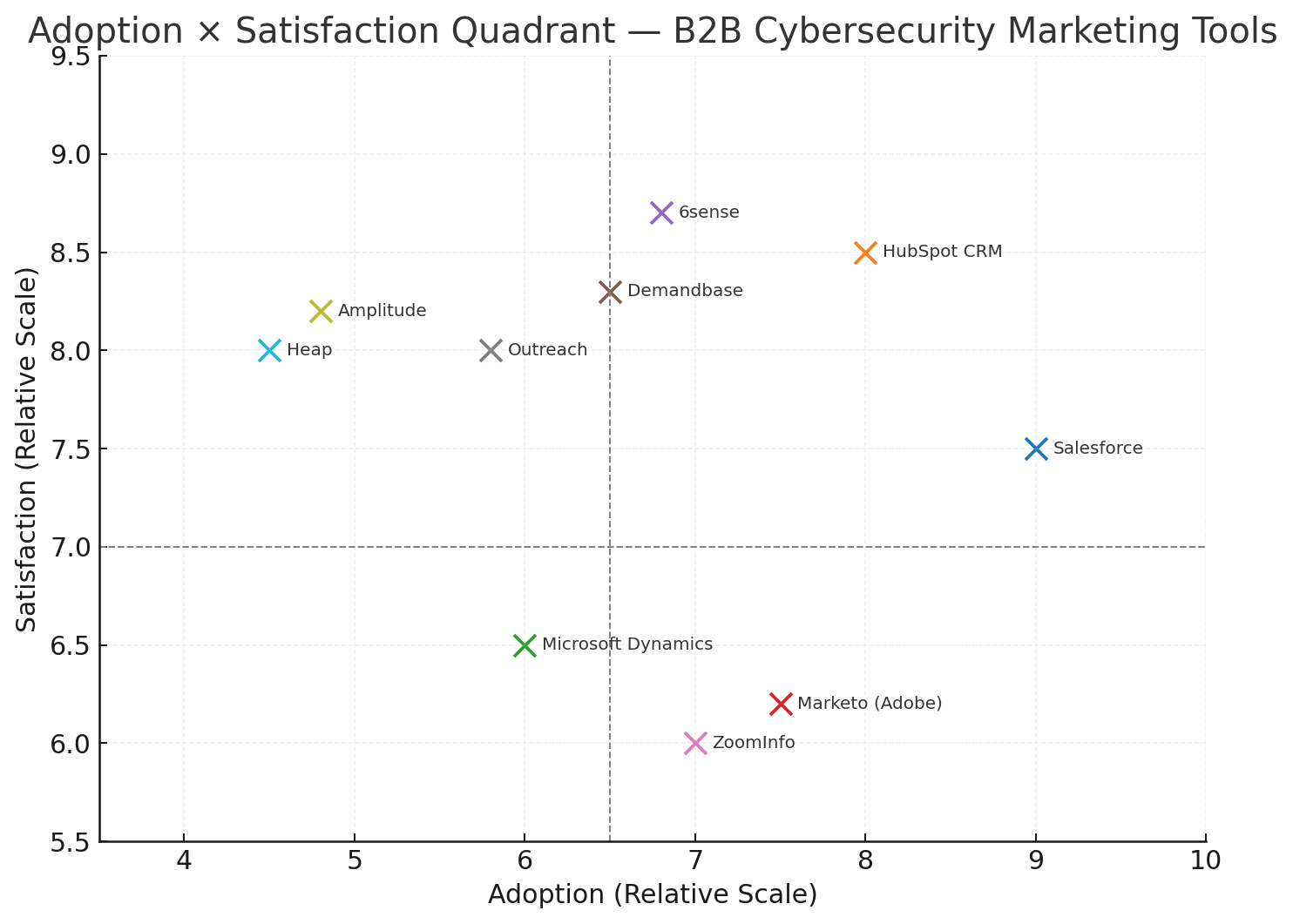
Marketing teams in the cybersecurity services sector rely heavily on CRM, automation, analytics, and ABM platforms to manage long sales cycles and complex buying committees. Below is a breakdown of the current toolscape, followed by a quadrant visual of Adoption vs. Satisfaction.
I mapped the top tools using directional data from G2/TrustRadius reviews + Gartner peer insights (not vendor self-reports).
To ground the benchmarks and trends, here are 3 standout campaigns from the past 12–18 months that highlight different acquisition strategies. Each case includes channels used, goals, budget ranges, results, and lessons learned.
Objective: Drive enterprise demo requests for CrowdStrike Falcon (endpoint + cloud workload protection).
Objective: Position Rapid7 as thought leader in cloud posture & compliance.
Objective: Educate CISOs on identity security & Zero Trust adoption.
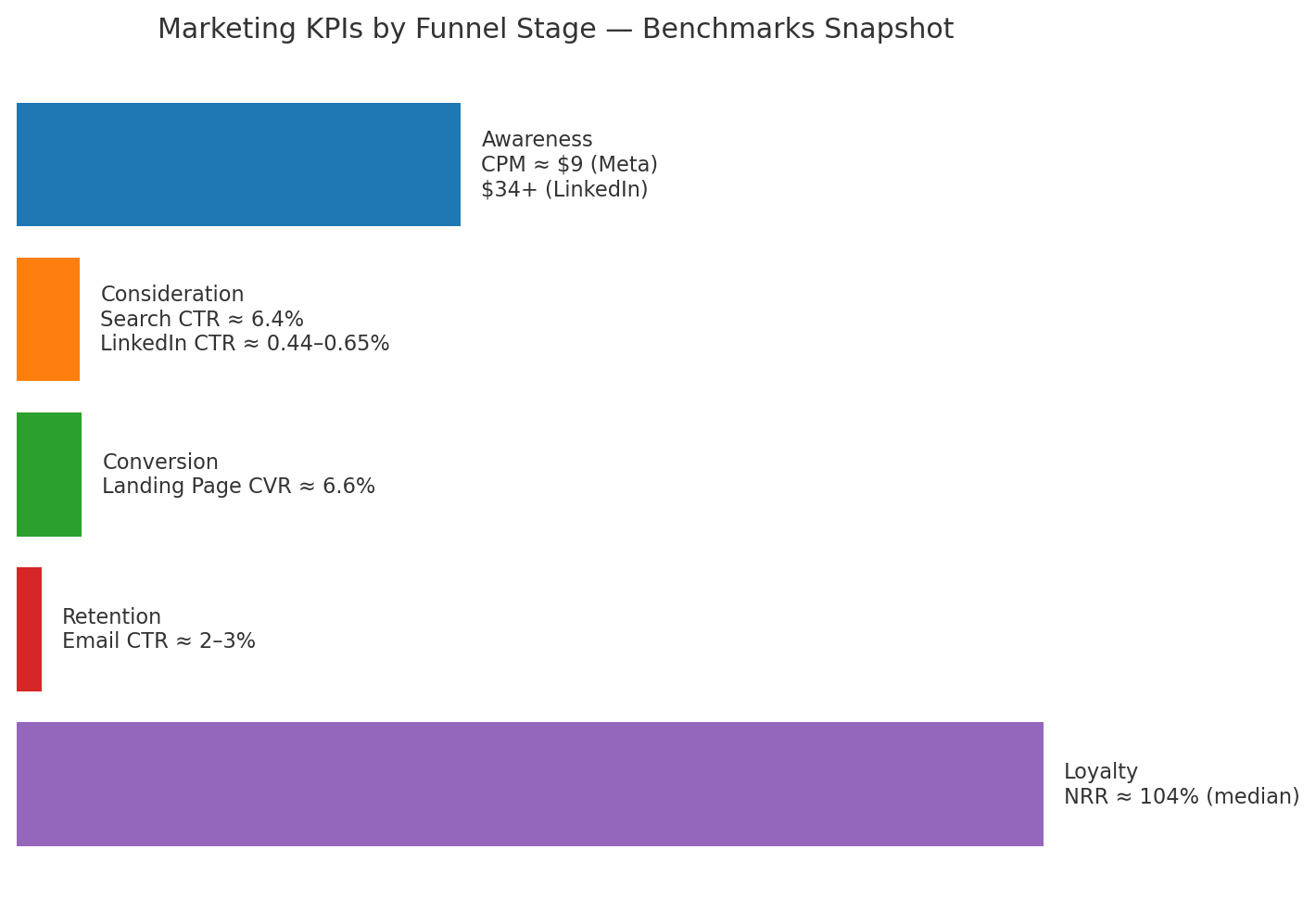
Note: Where cybersecurity-specific benchmarks aren’t published at scale, we use current cross-industry baselines and call out B2B security nuances in the notes. For your internal dashboards, replace the “Average” column with your rolling 90-day medians and keep the “Industry High” as stretch targets.
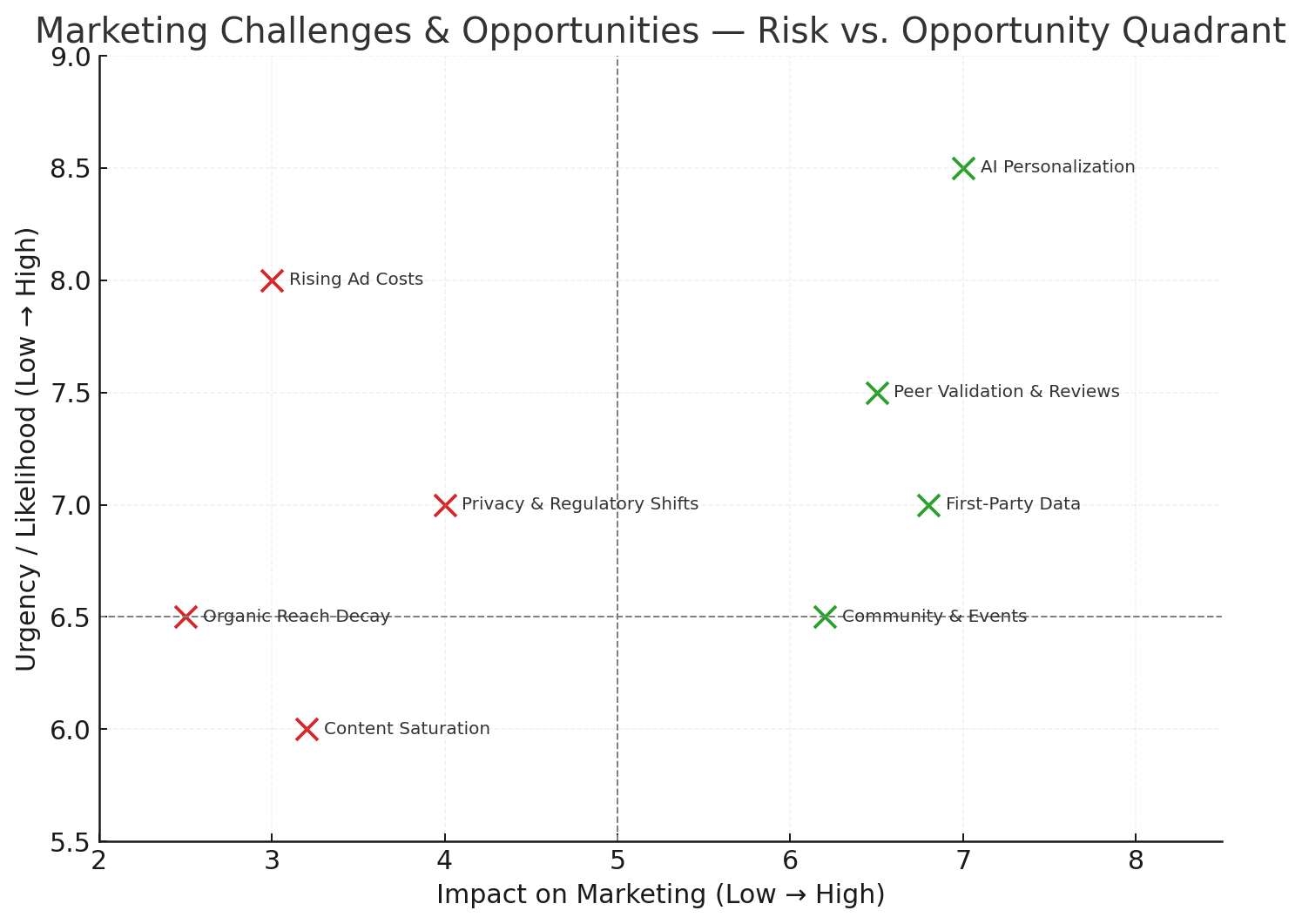
The cybersecurity services sector faces unique headwinds (rising ad costs, privacy shifts, organic reach decay) alongside new opportunities (AI-driven personalization, peer-review ecosystems, first-party data leverage). Below is a structured breakdown, followed by a risk/opportunity quadrant visual.
Below are practical playbooks by company maturity, followed by a 3×3 strategy matrix (channel × tactic × goal). Recommendations reflect the benchmarks we’ve already established (e.g., higher LinkedIn CPLs but strong reach into CISOs; SEO/Thought Leadership compounding ROI; first-party data resilience).
The cybersecurity services marketing landscape is entering a critical period of recalibration. Growth in the B2B sector remains strong, but buyers are more cautious, regulators more demanding, and channels more expensive. Below is a breakdown of the market trajectory, budget expectations, and strategic pivots we project between now and 2027.
.png)
Implication for CMOs / CROs:Expect 2–3× more content effort per deal (for multiple stakeholders), a tightened scrutiny on ROI, and higher paid media costs. Survivors will be those who shift early into compounding trust channels (SEO, reviews, analyst relations) while maintaining precision spend in Paid Search/LinkedIn.

You probably know that Instagram is a powerful lead generation channel.
It might be because you're familiar with the data, or simply because you're an active user on the platform and you know how addictive and influential it is.
Either way, you might already have Instagram included in your arsenal of lead generation tactics.
But you probably aren't getting the fullest potential out of your Instagram lead generation approach.
To be successful with lead generation on Instagram, there's a lot you'll need to keep in mind.
That's why we put together this guide – so you can have a much better chance of getting the lead generation results you want from your Instagram campaign.
It's hard to overstate how valuable Instagram can be for lead generation.
These are just some of the reasons why it's become such an influential channel in the realm of digital marketing:
· Reach. There are more than 2 billion monthly active users on Instagram. These users come in all ages, demographics, and locations, so no matter what your business is or who your business serves, you'll probably find customers on Instagram. Reach is also appealing because it's ridiculously easy to scale up a campaign once you get going. At the upper echelons, you can reach literally millions of people.
· Accessibility. At the same time, Instagram is a relatively accessible platform. In fact, you might already have an Instagram account for yourself or your business, simply because it's so easy to set up and get going. Obviously, running a sophisticated lead generation campaign is more challenging than posting occasional photos on a personal account, but the accessibility dynamic is still there.
· Inexpensiveness. Many people appreciate Instagram lead generation for its inexpensiveness as well. There are literally hundreds of options for lead generation, but some of them are prohibitively expensive unless you already have a massive revenue base. Although Instagram lead generation campaigns can be expensive in some contexts, they can also be free or close to free with the right approach.
· Relevance. In addition to being capable of generating a high quantity of leads, Instagram lead generation lends itself to a high quality of leads. That's because Instagram is a platform designed to connect people to things they're genuinely interested in. With the right inbound approach, you can make sure your content reaches only people who are genuinely interested in it, and you can nurture those leads until they're legitimately ready to purchase your products and services.
· Flexibility. There are countless ways to approach an Instagram lead generation strategy, including both inbound and outbound tactics, and both paid and organic opportunities. You can also pursue media and communications in practically unlimited ways. Because of this, almost any business can take advantage of Instagram and use it in whichever ways are most likely to benefit it.
· Scalability. Similarly, Instagram is extremely scalable, and it's usable to businesses of all shapes and sizes. Owners of even the smallest businesses can make use of Instagram for its inexpensiveness and accessibility, but CMOs of massive organizations with massive budgets can harness the full power of the platform.
With that in mind, let's dig into the mechanics of a successful Instagram lead generation strategy.
Lead generation on Instagram can manifest in many forms. You may use one, some, or all of these methods as part of your lead generation approach.
· Total inbound lead generation. Instagram has tremendous potential as an inbound lead generation platform. Essentially, that means posting content and nurturing leads so that people naturally gravitate to your business/brand. The idea here is to build up an organic following on a primary Instagram account, so that when you post links to your website or landing pages, your loyal followers will gladly click.
· Advertising. Instagram offers a multitude of advertising options. If you're willing to pay for the opportunity, you can put your visuals and copy in front of almost any conceivable demographic. Although this is more expensive than the organic, inbound approach, it's also more reliable in terms of generating leads – and it gives you a massive amount of control over who sees and engages with your content.
· Affiliate linking. Some brands prefer to go the affiliate linking route, working with known influencers and prominent people on the platform to showcase their products and services. There are many options here, but many brands opt for product placement (or something adjacent to it) to introduce their offerings. Generally, affiliate linking style approaches only force you to pay for leads that are actually generated, so it can save you a lot of money compared to advertising.
· Collaborations and partnerships. Another approach is to use collaborations and partnerships to boost the visibility of your brand and its products. Depending on the nature of your brand, this might include working on content with other people in your industry, getting in touch with influencers in your space, or creating innovative experiences with other popular entities on the platform.
If we had to boil down the secret to a successful Instagram lead generation campaign to one factor, it would be ROI optimization. As a marketer, you probably already know that ROI stands for return on investment, and is arguably the most important metric to consider when planning or optimizing a marketing campaign.
ROI is a reflection of how much value a campaign brings to your organization, compared to what it costs. In the context of Instagram, the goal is to drive the greatest number of high-quality leads for the lowest possible cost. Because there are so many different possible approaches to lead generation on Instagram, and because it's not only possible but common for people to waste their time on tactics that don't yield a return, it's critically important to make all your Instagram decisions with the background objective of increasing ROI.
Having a large number of followers is certainly appealing, but is that really what's going to drive value to your organization? Similarly, it might be exciting to partner up with a major influencer in your field, but if that doesn't result in actual quality lead generation, the money and effort necessary to sustain that partnership may not be worth it.
Once you shift your mentality to focus on optimizing for ROI, the entire Instagram lead generation game changes. You'll have a much easier time avoiding and filtering out tactics that don't work, and you can spend all of your time and money on the tactics that do work.
Obviously, this is going to take some time and experimentation to figure out, but it's okay if you don't see tremendous results right away. What's important is that you have a consistent focus and a consistent process that will eventually lead you to better lead generation results.
In the sections that follow, we'll explore some of the most important topics to keep in mind when optimizing for ROI in your Instagram lead generation campaign.
Arguably the most important factor for success in Instagram lead generation is customer research and understanding. You need to understand who your customers are and how they think if you want to appeal to them on this platform. This is true regardless of whether you want to nurture an organic following, advertise to specific demographics, or even collaborate with influencers. Unless you have a truly solid understanding of your target market, you won't be able to create effective messaging.
Make sure to create thorough customer personas long before you create any Instagram content – and potentially before you decide on a high-level strategy.
Similarly, you should do your research on influencers before choosing to partner with them or collaborate with them. Just because an influencer has a large number of followers doesn’t mean they're going to be a good fit for your organization, and just because an influencer works in your field doesn't mean they're a good fit for your brand.
When researching influencers, you need to consider reputation, industry, relevance, reach, and dozens of other factors. Not every influencer is worth working with.
Social media advertising is just one way to use these platforms for lead generation. It's an outbound strategy that requires more investment, but in exchange, you'll get access to tighter controls over which users you reach and practically guaranteed results (since you're often charged based on actual clicks).
However, if you're going to get the fullest value and return on investment from advertising, you need to understand what you're doing. That means reading as much as possible to better understand how these advertising platforms work, but it also means conducting live experiments so you can better gauge how your audience reacts to different kinds of messages on Instagram.
Advertising research and testing should be done on an ongoing basis, as the advertising environment is constantly in flux. You're never going to perfectly understand how to effectively advertise to your Instagram leads and prospects, but you can gradually inch closer to that hypothetical ideal.
Your ground-level tactics are going to change almost constantly, as you test, experiment, and adjust your weight to better results. However, you should always have a consistent high-level direction and vision for your Instagram campaign. What does your brand represent, and how should that be presented to your target audience? What are you trying to achieve, objectively? How would you define success in the context of your Instagram lead generation?
Keep in mind that even the best Instagram lead generation strategy is going to fall apart unless it's backed by good landing pages and best practices for conversion optimization. When you generate meaningful traffic, you need to meet it with highly relevant, informative, optimized landing pages. This is a major, independent topic that we don’t have space to fully explore here.
Lead nurturing is arguably indispensable if you want to get the fullest value from your efforts. Essentially, that means following up with leads and prospects on a periodic basis, so your brand stays top of mind and so you can gradually push indecisive leads to make a decision.
With the purely organic approach, this is fairly straightforward; posting new content and regularly engaging with your fans is typically ample to nurture your leads. However, you'll need to have some sort of plan and process in place if you want to nurture leads generated by other means. For example, if you use advertising to drive leads to a landing page, and you secure the contact information of those visitors, you should consider something like a drip email campaign to continue following up with those people.
Finally, you'll need to find ways to drive up your visibility. Assuming all the core mechanics of your Instagram lead generation strategy are in place, from demographic understanding to landing page optimization, the biggest barrier to improving your results will be the scale of your operations.
So how are you supposed to reach more and more people while maintaining the branding and processes that have led you to success at lower levels of operation?
That partially depends on your brand and its unique approach to Instagram lead generation. However, potential solutions could be cultivating a bigger organic following (via things like link building and digital PR), working with more prominent influencers, or spending a bit more money on ad placements. This can be a tricky business, especially if you're working with a limited budget, but you'll eventually need to find some way to scale up if you want to keep increasing revenue and/or profitability.
We understand that making a lead generation campaign successful on Instagram isn't easy, even if you're familiar with the fundamentals.
That's why we've made a concentrated effort to share our expertise with the people who need it.
On our team, we have expert marketers with a diverse array of experiences in Instagram lead generation – and countless other marketing strategies. Together, we can come up with a plan to make your organization more visible, more attractive, and ultimately more profitable.
If you’re ready to get started, reach out to us today!

Do people like your brand?
Do people even know your brand exists?
Without a solid digital PR strategy in place, they might not.
You can offer the best products and services. You can hire the best people. You can have an exceptional track record for customer service.
But none of that is going to help you if you don't have the visibility and familiarity necessary to take your brand to the next level.
That's why digital PR services exist.
But with so many digital PR firms and agencies to choose from, it's hard to know the best fit for your organization.
So what are the best digital PR services available?
Digital PR takes many forms, and usually involves promotion across many different digital channels. This includes search engine optimization (SEO), social media marketing, link building, relationship management, content marketing, press releases, and more.
The end result is that more people become acquainted with your brand, you earn respect as a thought leader or similar authority, you generate more traffic to your website, and you ultimately cultivate a bigger stream of revenue.
Of course, all this is only possible if you execute your digital PR strategy effectively. That means reaching as many people within your target audience as possible, differentiating yourself from the competition, building your reputation as an expert, and keeping expenses to a reasonable level.
With the best digital PR services in the world, your job becomes much easier.
As digital PR experts in our own right, we have enough knowledge of the industry to make evaluations of digital PR services.But in an effort to remain as objective as possible, our selection criteria are as follows:
These are some of the best digital PR services currently available:

Of course, we need to mention our own Digital PR brand – Marketer.co. Obviously, we care a lot about SEO and digital marketing, but that’s really only the beginning. With our team of seasoned experts, we offer consulting, content marketing, link building, PPC advertising, and a host of other services. Every client is unique, so we don’t have a “one size fits all” package, but if you’re interested in putting together a comprehensive digital PR strategy for your brand – contact us today!

Impression focuses on “creative, measurable digital PR strategies focusing on business goals.” It has won several awards, including “best use of data in a content campaign” from the UK Content Awards 2022 and “best use of PR in a search campaign” from the Global Search Awards 2022. Pricing is available upon request.

Siege Media has earned a reputation in the realms of content marketing, SEO, and PR because of its commitment to quality. With a focus on industries like Fintech, eCommerce, and SaaS, Siege Media provides stellar digital PR efforts to a wide range of clients – and more than 6,000 pieces of coverage every month. Pricing is available upon request.

Aira is a UK-based digital PR agency that serves B2B and B2C brands alike, utilizing creative thinking across a variety of channels to build brand visibility and familiarity. It creates and sustains valuable relationships to support greater traffic flow – and offers thorough reporting to prove its results. Pricing is available upon request.

Dofollow.com is a link building and digital PR agency that uses powerful backlinks to support SaaS and other businesses interested in growth. This agency prioritizes relevance and uses AI-powered search to connect clients to the best PR opportunities online, forming a positive relationship between businesses, publishers, and of course, Google. Pricing is based on DA of referring domains.

Go Fish Digital uses in-depth data analytics to drive its content strategy. This digital PR agency primarily serves retail, B2B, travel and leisure, and real estate organizations, and uses a mix of SEO, link building, influencer marketing, and general online reputation management to serve its clients. Pricing is available upon request.

Green Flag Digital uses resource page link building to promote its clients and produces content that’s valuable both for clients and the users who read it. Adhering to the priorities of publishers, users, and clients allows this digital PR agency to thrive in an increasingly competitive world and its 15-step PR process helps it remain consistent. Pricing is available upon request.

uSERP, as you may have guessed from the name, uses a unique blend of content marketing, SEO, backlink building, and traditional PR strategies to earn more visibility and traffic for its clients. By focusing on thought leadership, experience, and trustworthiness, uSERP gets results for its clients – and proves those results with objective metrics. Pricing is available upon request.

Power Digital Marketing specializes in influencer campaigns, but it can help you with a wide range of different digital PR needs. In fact, most of its clients pursue total omnichannel support, which includes coverage in SEO, social media, content marketing, CRO, and other forms of PR. Pricing is available upon request.

NP Digital was recently celebrated as the 2023 Global Performance Marketing Agency of the Year and is known for its leadership in the digital PR space. Offering a wide range of digital marketing and PR solutions, NP Digital caters to a multitude of clients in almost every imaginable industry. Pricing is available upon request.

MacNaught Digital is a smaller digital PR firm on this list, based in Saddleworth, Greater Manchester. Primarily focusing on tactical link building, this agency uses many different link building strategies and content creation to support their clients. However, MacNaught Digital tends to be selective about the clients they choose to accept. Pricing is available upon request.

Loganix offers services across the digital marketing and PR landscape, including SEO, local SEO, content marketing, PPC advertising, link building, and conventional PR management. It’s home to a robust team of specialized experts and offers plenty of flexibility, as you can customize your own plan. Pricing is available upon request.

Omniscient Digital is primarily a content marketing and SEO agency, but it uses a wide variety of mediums to form a cohesive, overall PR strategy for their clients. Focusing on brand reputation and organic traffic, Omniscient Digital prioritizes measurable results. Pricing starts at $8,000 per month.

Builtvisible is a UK-based, independent digital marketing agency that relies on data to drive its digital PR and SEO campaigns. Its signature approach incorporates elements of many different marketing strategies and channels, all focused on storytelling and positive reputation building. Pricing is available upon request.

Digital Olympus brands itself as a “relationship-based” link building agency. Their main strategy is connecting with bloggers, influencers, and thought leaders in a variety of niches to secure better placement opportunities for their clients. They have options for a wide range of clients across most industries. Pricing is based on the DA of referring domains.

Shout Bravo is a UK-based digital PR agency that offers services related to digital PR, content marketing, and influencer marketing. It has experience with clients in sectors like healthcare, technology, fashion, finance, and entertainment, but it’s open to other types of clients as well. Pricing is available upon request.

WeOutreach is a link building services agency that promises to increase your organic search traffic by 30 to 100 percent in 6 to 12 months. They have excellent link building practices, but few other services, so if you’re interested in many aspects of digital PR, they may not be the best fit. Pricing is available upon request.

BibiBuzz is a fun-named digital PR agency that provides its clients with a diverse mix of PR strategies, with a special focus on SEO, content marketing, and link building. Content is at the core of everything they do – and they specialize in finding ways to subvert or overcome the competition. Pricing starts at $5,000 for a package of 10 links.

Help a Reporter Out, or HARO, is an organization that facilitates connections between journalists and experts. For free, you can sign up as a source and automatically be notified of potential opportunities where you can share your expertise with journalists. It’s not technically a digital PR agency, but because of its incredible PR potential, it deserves to be mentioned here.

Are you interested in the benefits of getting HARO links, but reluctant to invest the time necessary to get the job done? Consider working with Reporter Outreach. Reporter Outreach is a digital PR firm that helps brands connect to journalists so they can get more positive exposure for their organizations. Pricing starts at $2,999 per month or $300 per link. Digital PR is a nightmare to manage.
That is, unless you have a reliable digital PR agency working on your behalf. With the right team, PR becomes easy. And your brand reputation will begin to flourish. Are you ready to launch a digital PR strategy of your own? Are you ready to see what your brand is capable of when it reaches peak visibility and popularity? Then let’s start the conversation. Contact us today!

Google’s AI Overviews have completely changed the way search engines bring websites relevant traffic. Before overviews existed, users had to click on a search result and read page content to find the information they were looking for. In the process, business owners were able to generate sales, leads, and brand awareness from those clicks. Some searches ended without clicks, but it wasn’t as common. Now zero-click searches are the majority.
According to a SparkToro study, since 2024, 58.5% of U.S.-based Google searches have ended without users clicking any links. On mobile devices where convenience is critical, 75% of searches end without clicks. And it’s not because users aren’t finding what they need, but because the AI-generated overviews are answering their questions at the top of the page. AI overviews aren’t always accurate. In fact, sometimes they can be outrageously inaccurate. Still, users seem satisfied with the information they’re being given.
Because of AI Overviews, many business owners are starting to notice a drop in organic traffic, especially in retail, travel, and media. This massive shift requires business owners to reinvent how they approach digital marketing strategies designed to generate visibility, authority, and conversions online.
A zero-click search is exactly what it sounds like: a search that results in zero clicks. The user types a query into the search box, hits enter, and then for whatever reason, they don’t click on any links. In the past, zero-click searches were usually the result of users refining their search or giving up. Today, it’s the opposite – users are finding what they need in the AI overview box and don’t feel it’s necessary to click on any search results to explore further.
The rise of zero-click searches
Google’s AI Overview feature has been around since May 2024, and it’s just one of many features that continue to reduce traffic from organic search results. Between Featured Snippets, People Also Ask boxes, and AI Overviews, clicks have been down by nearly half compared to what they were before 2022. Even news outlets are experiencing fewer clicks since Google is summarizing news articles as well.
This shift has real consequences for business owners. Even if your website ranks well, users may never click through. Your content might get featured in an AI Overview or Featured Snippet, but that still doesn’t guarantee clicks.
In May 2024, Google launched its Search Generative Experience (SGE) to provide users with a summary of their search query. SGE uses content from numerous web pages to provide users with a quick overview that summarizes key information so the user doesn’t need to click on a dozen links and read a bunch of content.
· How Google selects sources. Around 52% of the pages used to create AI Overview summaries are typically ranked in the top 10 for the given query. According to Ahrefs research, 99% of Featured Snippets come from pages that already rank on the first page. This makes ranking in the top 10 critical for getting clicks from Google’s AI-generated results.
· The adoption of AI Overviews. Currently, AI Overviews show up in 30-35% of U.S.-based Google searches, with an even bigger presence for queries related to problem-solving.
· How click-through rates are impacted. Even though Google includes clickable citations in AI Overviews, many website owners are noticing a decline in traffic. Despite clickable citations, a large percentage of users are satisfied with the overview.
Now that zero-click searches are dominant, Google’s AI summaries are changing the fundamentals of SEO.
· Traffic. Although clicks were never guaranteed, ranking in the top positions in the search engine results pages (SERPs) used to be an excellent way to get traffic to your website. Today, ranking number one no longer means getting the lion’s share of clicks.
Higher rankings are still better than being buried on page 10, but even web pages that rank in position one are seeing a significant loss of clicks. In fact, MailOnline reportedly loses over half its clicks when an AI Overview appears in Google’s search results. If users are satisfied with the AI-generated summary, they won’t even scroll down to the actual search results, let alone click on any links.
However, if you rank in the top positions, Google might use your content to write an AI Overview or Featured Snippet, but that doesn’t guarantee clicks, either. Users won’t necessarily click through to your website’s citation after reading the AI summary.
· Visibility. AI overviews take up even more space at the top of the page, forcing organic search results down even further out of view.
· Keyword density. Keyword stuffing has been dead for a long time, but even just using relevant keywords and phrases has been weakened by AI. Keywords alone can’t compete with the power of citations and trust determined by a well-trained AI algorithm.
· Metadata is different. Since the name of the game has now shifted to getting your content cited in AI Overviews, metadata is important in a different way. For instance, Schema markup helps AI understand your content better for use in overviews.
· EEAT is essential. Google’s EEAT framework (Expertise, Experience, Authoritativeness, Trustworthiness) has always been important for ranking, but now it determines what content gets cited in AI Overviews.
In short, SEO has evolved from simply maximizing keywords and phrases to building trustworthy, authoritative content. This shift has been happening for many years, but with AI running the show, it’s much harder to trick the system into thinking content is genuinely authoritative.
Google’s AI-generated summaries don’t seem to be going away anytime soon, so it’s critical to have a content strategy that works with this new system to avoid being left in the SEO dust. In addition to ranking, your content needs to be visible to AI, worthy of being cited, and enticing enough for users to click. Here’s how that’s done:
· Lead with concise and accurate answers. To get AI algorithms to pick your content for summaries and overviews, you need web pages with clear, concise answers at the top of the page, followed by a deeper context. This is the structure that AI will understand best when choosing citations.
· Use structured data. Schema markup is essential for getting content chosen for AI summaries. Use formats like “FAQ” and “HowTo.” Websites that correctly apply FAQ schema see a significant increase in traffic.
· Get specific and detailed. The more specific your content is at addressing topics, the better. AI tends to favor case studies, examples with dates, and quotes from experts. This signals high value, trustworthy content.
· Position yourself as an authority. Demonstrate EEAT through your credentials, citing your sources within your content, and publishing author bios. AI algorithms view this information as trustworthy.
· Optimize your content for direct answers. Content optimized for direct answers (answer engine optimization or AEO) will get better visibility. For instance, create FAQ sections, paragraphs with definitions, and short summaries inside longer pieces of content.
When clicks from search results drop, you need a different strategy for measuring performance and results. Here are five ways to overhaul your tracking system to fit in with the new AI-powered paradigm.
Clicks to your website might be the ultimate goal, but now that there are barriers in place, AI citations are the new goal. Start tracking where your content shows up in AI citations using Semrush or SurferSEO.
A lower CTR used to indicate that users aren’t seeing your content. However, a lower CTR today might be offset by higher visibility in AI overviews. In other words, they see your content, but just don’t click.
In Google Search Console, filter queries that are triggering AI Overviews. Compare the impressions to clicks before and after this feature rolled out.
Branded searches still generate clicks and should be optimized for conversions.
AI Overviews are generated from authority mentions and quotes. Use social and brand monitoring tools to manage your reputation and improve the way AI Overviews mentions your brand.
When you’re getting fewer clicks because of Google’s AI Overviews, your offsite link building strategy needs more power. In addition to a strategy for ranking, you need a plan that includes the following:
· Authority building through brand mentions. You need citations from trusted sources, like blogs, publications, and expert roundups to get AI to rank your content for inclusion in AI summaries.
· Authority positioning. It helps to be well-represented in terms of your brand across authoritative sources, like Wikipedia entries, about pages on your website, and various profiles across the web.
· Diversified traffic sources. Zero-click search highlights the importance of not relying entirely on Google for your traffic. It’s wise to invest your time generating traffic from email marketing, social media, partnerships, and customer/client referrals.
· Generate high-quality citations. When you can earn quotes and data references in respected publications, it will signal depth and trust to the algorithm that creates AI Overviews.
The tools and strategies in a zero-search world are still evolving, but for now, start using these basics:
· Platforms for AI optimization. Tools like Semrush, Ahrefs, SurferSEO, and MarketMuse offer AI Overview analysis and snippet alignment. For example, Semrush’s Position Tracking tool will tell you what keywords trigger AI Overviews and whether or not your site was included in the citations.
· Generative Engine Optimization (GEO). Leverage AI-specific metadata. For example, many website owners are starting to use the llms.txt file to help large language models understand and process their website more easily. This is a simple markdown file that provides a structured overview of a website’s content specifically tailored to LLMs. For example, the file includes summaries, important links, and contextual information to help LLMs avoid HTML and use the content to answer questions more easily.
While there’s still a debate regarding whether or not this actually makes a difference, it doesn’t hurt to experiment. Considering how crucial sitemaps are for search engines, it makes sense that llms.txt could become equally essential in the near future.
· Use ChatGPT to refine content. Start prompting ChatGPT to simulate AI Overviews and test if your content is used.
· Regular content audits. As always, continue performing regular content audits, improve FAQ sections, revamp content, and update data to ensure your content stays fresh for AI.
All the traffic lost to AI Overviews may not be as bad as you think. Losing traffic isn’t inherently a problem if that traffic doesn’t convert anyway. If you’ve lost traffic since AI Overviews were introduced, but your leads and sales haven’t dropped, you probably don’t need to worry too much.
When users are satisfied with an AI Overview, they’re probably not looking to buy and are still at the top of the funnel gathering information about a given topic. While it’s important to capture leads at all stages of the customer journey, users who simply gather information from an AI Overview and bounce are not going to buy from you right away. This means the queries that end in zero clicks aren’t going to be your most immediately profitable search terms.
Start creating and ranking content for queries that indicate a user is ready to buy. Users who are ready to buy and are actively looking for products and services will continue scrolling to the organic search results.
We have officially entered a new world where zero-click searches and AI-generated summaries are the standard. While traditional rankings are still important, they no longer guarantee visibility or traffic. In 2025, SEO means optimizing your content to be seen and cited by AI, not just to get clicks. Business owners who can align their content with answer engines through structured, authoritative, conversational content will dominate the new search world. Those who don’t will quietly vanish as AI answers take over the top real estate in the SERPs.
If you’re watching your search traffic drop, wondering how to stay relevant now that AI Overviews have changed the game, you don’t have to figure it out on your own. Our team of digital marketing experts can help you adapt to the future by optimizing your content for visibility, authority, and conversion through SEO as well as professional digital marketing strategies. Contact us now for a free consultation and let’s turn AI-powered search into your competitive advantage.

Generating leads can be tough.
Turning those leads into customers can be even tougher.
That's true even when the leads are warmed up, familiar with your brand, and ostensibly ready to buy.
One of the most important strategies in your arsenal is going to be the art of following up – a simple concept that many marketers and salespeople fail to implement successfully.
Why is following up with warm leads so important?
And what are the tactics that can help you turn all those warm leads into paying customers?
Across the industry, you'll find different specific definitions for the exact line between cold leads and warm leads. But generally speaking, a warm lead is any lead who has already had at least one significant interaction with your brand.
It might be that you've reached out to them before, that they've signed up for a newsletter subscription on your website, or that they've accepted a complimentary product from your brand.
Warm leads have a unique psychology that you'll need to understand to make the most of them.
These are people who know you already. But for some reason, they're not ready to move forward.
Obviously, there are many potential reasons for this. Some of your warm leads aren't in a strategic position to buy. Some of them don't have the money ready. Many of them may just want to see more from your brand before they're ready to move forward.
Following up with warm leads is important for several reasons. For the people not ready to buy, it gives repeated opportunities to buy in the future. For people who have objections to buying, you'll have an opportunity to overcome those objections. And for people who want to understand your point, and plenty of meaningful interactions.
In any case, following up with warm leads is indispensable for capitalizing on those leads, increasing the value of your lead generation strategy, and ultimately building a bigger customer base for your brand.
Roughly 60 percent of customers will say no four times before eventually saying yes. Despite that, nearly half of salespeople give up after a single “no.”
This alone should motivate you to build a better follow-up strategy with your warm lead pool. Even a simple, singular follow-up message could lead to a sale, or a better relationship that leads to sales in the future.
Following up gives multiple opportunities simultaneously, which vary depending on your strategic approach and each individual message.
· More information. Each follow-up with a warm lead is an opportunity to provide them with more information. You can clarify things they may not understand, introduce products they may never have seen, or tell them something about your brand that they may not have realized. Assuming this lead is at least marginally interested in your brand and its products, this can build up your relationship and make a purchase much more likely.
· Brand visibility and exposure. As you're probably aware, repeated brand exposure and greater brand visibility both lend themselves to greater brand awareness and trust. As consumers see more of your brand and have more opportunities to interact with your brand, even if it's something as simple as an email newsletter message, they'll become better acquainted with your brand and more likely to trust it and buy from it. A good follow-up strategy puts your brand in center stage, increasing its visibility and meaning for most.
· Opportunities for conversation. It's possible that some of your warm leads are simply too busy to buy or have meaningful conversations with you. Each time you follow up with your warm leads, you'll introduce new opportunities for conversation. They can ask you questions, they can do more due diligence on their potential purchase, and they can eventually make that purchase.
· New incentives. You can also use follow-up messages as a way to introduce new incentives for your leads to move forward. If they weren't willing to buy your product at $100, would they be willing to buy it at $80? Would they be willing to buy it at $100 if you also threw in a free sample of one of your other products? Depending on the peculiarities of your specific target audience, offering more rewards and incentives could be exactly what you need.
· Different angles. Even with the perfect understanding of your target demographics, individuals within those demographics are going to behave in slightly different ways. Following up with your warm leads multiple times, using multiple tactics, gives you a chance to experiment with different angles. This way, you can appeal to a much broader range of people, and you can glean more information that you can use to improve your lead generation and nurturing strategies in the future.
· Overcoming objections. Some warm leads didn't move forward because they have significant objections to the proposed exchange of value. Maybe they think your product isn't good enough, or that it isn't worth the money. Following up is an opportunity to address these objections, as well as better understand them. For example, if you find that many leads refuse to move forward because they're concerned about the safety aspects of your product, you can send a follow-up message that helps people understand just how safe your product is.
· Nurturing the relationship. Today’s economy is built not just on transactions, but on relationships. That's why part of your warm lead follow-up strategy is about nurturing the relationships you've already established. Figure out what drew people to your brand, tap into that, and help people understand your unique value proposition.
With that in mind, how exactly do you form a solid follow-up strategy for your warm leads?
Everything starts with setting your goals.
Now obviously, your ultimate goal is to win more customers. But what are the ways that you're going to achieve that? And are there forms of meaningful progress that you would accept short of attracting more major purchases?
For example, are you hoping to convert a specific percentage of your warm lead pool by a certain time? Are you more interested in improving brand awareness and trust generally, so that you can facilitate more transactions in the future?
And what would you say is the overall focus of your follow-up strategy? Are you interested in a “means to an end” approach that reliably culminates in more purchases? Or are you more focused on creating more intricate brand consumer relationships and customer experiences?
There are no right or wrong choices at this stage. What's important is that you set goals and a vision for your follow-up strategy that fall in line with your broader marketing and sales goals.
Your follow-up strategy simply isn't going to work unless you understand your customers.
Market research is your best friend.
The first step of the process, therefore, is to better understand the nature of the warm leads in your lead pool. Who are these people? How have they interacted with your brand in the past? How might they interact with your brand in the future? And what's holding them back from doing so?
The better you can answer these questions, the better you can craft follow-up messages. For busy decision makers, you can provide quick, spaced-out informational messages. For nervous, budget-conscious people, you can reiterate the long-term benefits of using your product, compared to the costs of purchasing it. For people who have already bought and might buy again in the future, you can focus on building up your relationship.
Segmentation and tracking are going to be essential tools in your approach.
With segmentation, you can divide your customers into discrete groups, even within the warm lead category, and you can cater to them with highly specialized messaging. This is going to make your messaging much more relevant, and therefore more persuasive.
With advanced objective tracking and analytics, you can better monitor how your follow-up messages are working – and improve your approach in the future.
Another key element in your follow-up strategy is going to be timing.
The exact numbers are going to look different for each business and each lead follow-up strategy. But there are a couple of core principles that everyone needs to follow.
You need to send follow-up messages soon enough and frequently enough that your brand is still somewhat top of mind. If a customer interacts with your brand directly, and you don't talk to them for a year, they're going to forget all about you.
However, it's important not to rush the process or overwhelm your customers. If a customer gets four emails from you in the first couple of days after interacting with your brand, they're probably going to unsubscribe and think poorly of your brand in the future.
Your exact timing will depend heavily on your unique situation. However, you can at least start with one or two follow-up messages per week, depending on the context.
Part of your sales optimization process is going to be choosing the right channels.
And in the realm of nurturing warm leads as part of your marketing strategy, you have practically unlimited options. Email and calls are perhaps the most universally accessible communication methods, but you can also reach out to people through apps, social media, and more.
When choosing channels for your follow-up strategy, think about what types of mediums your customers prefer, the cost effectiveness of each medium, the accessibility to both you and your customers, and the special context of each channel.
Your warm leads are going to be much more likely to engage with your brand, and eventually make a purchase, if you provide them with some kind of value. That's because it's a great way to make your brand seem more respectable and authoritative, but also because it triggers an instinct of reciprocity.
Fortunately, there are many ways that you can provide value to your customers. As a simple example, you can provide freebies, extend free trials, or offer steep discounts on your best products. But you can also offer inside information, expertise, guidance, and other forms of knowledge.
Ultimately, your goal is to make it so that your customers are always happy to hear from you. When they see an email from you in their inbox, they should know that it contains something that's useful to them; otherwise, they may be less willing to open it.
Whatever you determine in terms of messaging channels, content, and timing, you should focus on engaging with your warm leads consistently. If you send a message once a week, but then you drop off the map, people may forget about you. If you follow too many different variations of your strategy with too many different demographic segments, you'll never be able to figure out what works and what doesn't.
Additionally, recall that many warm leads will say no many times before saying yes. The more consistent you are in following up, the more likely you'll be to eventually get to that yes.
Another important element of your strategy is going to be tracking and measuring results. You need an objective way to determine whether your follow-up strategy is working, and which tactics were most material in your success.
Once you have a solid tracking system in place, you should experiment with small variations in phrasing, timing, offers, and other variables. This way, you can gradually guide your warm lead follow-up strategy to perfection.
Maybe you're struggling with a follow-up strategy for your warm leads.
Maybe you don't have a rich pool of warm leads to begin with.
No matter where you are in your lead generation efforts, or how you plan to transform your sales and marketing approach in the future, Marketer.co can help.
We have the lead generation, sales, and marketing experts who can transform your business for the better.
Are you ready to get started? Contact us today for a free consultation!
.jpg)
One day your site’s doing great in the SERPs, and you’re generating a steady flow of organic traffic and leads to your business.
Then your traffic flatlines and you’re left scrambling. If you’ve seen a sudden, unexplainable drop in organic search traffic, don’t panic, but don’t sit on your hands either.
Traffic crashes are rarely random.
They’re signals that something (either on your side or Google’s side) has changed.
This guide walks you through a systematic, technical assessment to diagnose and recover from an organic traffic drop.
Let’s get the worst-case scenario out of the way first. When your organic traffic takes a dive out of nowhere, your site may have been impacted by a Google penalty. A manual action can dramatically impact your site’s visibility (and halt your revenue).
If you get hit by a manual action, you’ll get a notice from Google explaining what rule you violated. For example, if you get caught with an unnatural backlink profile, Google will tell you they’ve devalued those links and you can expect your rankings to take a dip.
Manual actions are imposed when a human reviews a website suspected of violating Google’s Search Essentials (formerly Webmaster Guidelines). Getting a manual action is a big deal. It can lead to dropped rankings or a complete removal from Google’s index. If your website brings you leads and/or sales, that means lost revenue.
Head over to Google Search Console and go to Security & Manual Actions > Manual Actions. If you’ve received a penalty, you’ll see it here in full detail.
Common manual action triggers include:
It’s possible to recover from a manual action, but it takes some work. You’ll need to address the issues outlined by Google, make sure the rest of your site is in compliance, and submit a request for reconsideration.
Sometimes the culprit isn’t a penalty, but another algorithm update. Algorithmic changes don’t come with an announcement, but they can still hit you hard. If you wake up one day and your site isn’t ranking where it used to be, but you haven’t received a manual action, you aren’t in trouble with Google. However, you’ve got some work to do.

Algorithm changes typically result in the following consequences:
Although it’s impossible to confirm with certainty, there are signs that your drop is connected to an algorithm update. Check Google’s update timeline and cross-reference the date your traffic dropped to see if there’s a connection. Usually, this is the case.
There are three types of updates that hut sites the most:
Unlike manual actions, you can’t just make some changes and request a review. You’ll need to work on improving your website’s quality and wait to see what happens. Working with a professional SEO agency can help.
There was a time when Google indexed everything it could find and rarely deleted anything. Now, that’s not the case. Sometimes pages get deleted from the index even when they aren’t in violation of the rules.
Use the URL Inspection Tool inside Google Search Console to verify your top-performing web pages are indexed. If not, that’s likely your problem. Look deeper into your index coverage report and see if there’s a trail of errors like the following:
If you see these errors, fix canonical issues and make sure your pages can be crawled easily.
Check your robots.txt file to make sure you aren’t blocking your home directory or any other directory critical to traffic. Google has a robots.txt test tool you can use to find out if there’s an issue.
Next, check your HTML and make sure you aren’t using noindex tags accidentally. For example, check for:
<meta name=“robots” content=“noindex”>
If you’re using this tag sitewide, it will kill your traffic.
If you’re using a content management system (CMS) like WordPress, make sure you aren’t blocking robots from indexing your site in the admin panel. Everything may have been working just fine last week, but that doesn’t mean a CMS core update or plugin didn’t silently change things.
Backlinks can make or break your domain authority. When you have a bunch of toxic links or lose good links, your rankings can drop significantly. To find out what’s going on, use a backlink checker tool like Ahrefs, Moz, or Semrush to get a look at your backlink profile. If you don’t already have an account, you can get a free 7-day trial from Semrush and Moz, but Ahrefs doesn’t offer any discounts.
Look for a rapid increase in low-quality domains, suspected link networks, and exact match anchor text from spammy blogs. These types of links can really hurt you. If you have these links, they may have come from hiring a shady SEO company that buys backlinks, or they could have been created by a competitor, although that’s rare.
Reaching out to request removal is your first line of defense when you discover spammy links. If that doesn’t work and you have a substantial amount of toxic backlinks to deal with, consider disavowing those links. However, there are some things you need to know before you disavow a link. For instance, Google doesn’t have to honor the request to disavow links. And if you don’t know how to discern truly toxic links, disavowing links can harm your rankings. Before using this tool, consult with an SEO specialist, especially if you’re already working with an agency.
Surface-level content sometimes gets off to a good start, but then drops off the radar when Google fully analyzes the content to discern its value. If that’s the case, you’ll need to beef up your content strategy.
Look at all of your content to identify pages that don’t provide unique or clear value compared to your competitors. For example, if you’re running a law firm and have individual pages for each practice area, but the content is thin, you can be sure your competitors with full pages are ranking instead of you. Either update these pages with more in-depth content or remove them and redirect those URLs to existing comprehensive content.
Last, audit your content to see if it’s still relevant and useful. If anything is outdated, update the content. Make sure the content addresses a user’s search intent based on your business goals. If you need help figuring this out, tools like Surfer SEO and Clearscope can help.
Technical SEO isn’t glamorous, but it powers your website. Check your site’s architecture to ensure it’s not buried 6-10 layers deep so search crawlers can access it for indexing. Tools like Screaming Frog are excellent for identifying broken links, duplicate titles, meta tag issues, and redirect chains.
It also helps to submit an updated sitemap in Google Search Console. Doing this will ask Google to crawl your site instead of just waiting and hoping your site will get crawled again someday.
Sometimes it’s not your ranking that changes. Instead, it’s the layout of the search engine results pages (SERPs) that pushes you down out of sight. Google is constantly tinkering with how it presents information to users, and these updates can majorly impact click through rates even when your position remains the same.
SERP features that can push you down include featured snippets, image carousels, shopping ads, “People Also Ask” boxes, and local map packs. These elements take up the top half of the page and push organic results below the fold. If your organic listing sits below these features, it might be “high ranking,” but it’s still below the fold out of sight.
To overcome this obstacle, you’ll need to:
If your search rankings are dropping, it’s time to start spying on your competitors. See who’s gaining traction in your industry where you’re falling and try to reverse engineer their content and site structure. If this sounds daunting, a professional SEO agency can do it for you.
If your site got hacked, it may not be obvious to you, but Google might already see the signs. Run a security audit on your entire site to look for injected code, spammy redirects, and hidden iframes. These are often hidden in header and footer templates.
Whether or not you find any security
issues, now is a good time to implement protections if you haven’t already. Keep your plugins and core files updated, use a Web Application Firewall (WAF), and back up your site regularly.
Not every traffic drop is your fault (or caused by Google’s algorithm). A growing number of users are turning to AI tools instead of using traditional search engines, and that’s changing how (and where) people find information.
Internet searches are no longer limited to traditional sites like Google, Yahoo, and Bing. People are using tools like ChatGPT, You.com, and Perplexity.ai to get answers, summarize information, and get service recommendations. If your website isn’t showing up in these AI searches, you’re missing out.
Another element to consider is how Google AI overviews impact click throughs. Your site might still be ranking, but people don’t notice because their questions are answered at the top of the page by Google’s AI overview.
There is a direct correlation between the introduction of this feature and a measurable decline in clicks. For instance, Ahrefs found a 34.5% drop in clicks for the first position when AI overviews were present. And a study by Semrush found that nearly 57% of all mobile searches and 53% of all desktop searches result in zero clicks. That’s significant. It means a large number of people are satisfied with the answer they get from Google’s AI overview and that’s the end of their search.
To stay competitive, you’ll need to adapt your marketing strategy and optimize your content for AI search. This involves:
If your ranking hasn’t changed, but your traffic has tanked, AI search behavior might be to blame. Part of SEO involves adapting to changes in both search algorithms and user behavior.
Traffic drops are scary, but they’re not the end of the world. If your traffic dropped off a cliff, use this checklist to diagnose potential causes and take action toward recovery.
But if you’re short on time, bandwidth, or just want a pro to handle it for you, we’re here to help. At SEO.co, our experts will audit your site, identify what’s thinning out your traffic, and build a strategy to get you back in the game.
Whether you’re dealing with a manual action from Google, algorithmic ups and downs, spammy backlinks, or anything else, we can help.
Contact us today for a free consultation and let’s get your traffic flowing again.

.svg)