The Role of Influencer Marketing in Lead Generation

Samuel Edwards
|
April 8, 2026

If your business is doing the same old thing and continually getting inadequate results, it’s time for change. The marketing landscape has changed fast and the digital age is now upon us. And while the old ways of running marketing campaigns can work in some situations, you’re making a mistake by ignoring digital marketing.

Consumers are a fickle bunch and are becoming more skeptical of direct advertisements. They’re more likely to be convinced to make a positive purchasing decision by relying on personal recommendations and sources they find authentic and dependable. This considerable shift in consumer behavior has contributed to the increasing importance of influencer marketing.

The growth speaks for itself. Influencer marketing has become a core part of modern marketing efforts, not just a trend. Statista reports that the worldwide influencer marketing segment was worth $21.1 billion as of 2024. That's more than triple since 2019. It adds that the influencer endorsement market continues to mature as a sector and that the size and worth of influencer marketing platforms continue to grow each year, making strategic partnerships between brands and creators increasingly profitable. Marketers in the know are leveraging the power of the movers and shakers on social media to communicate their unique value propositions to potential customers.

Influencers with a strong social media presence and sizable list of online followers can be help move the needle on the influencer marketing lead generation front. But how exactly does influencer marketing drive lead generation? Keep reading to learn more about how influencer marketing impacts lead generation -- and how Digital.Marketing can help you maximize your influencer marketing strategy.

What is Influencer Marketing?

Global Internet vs Social Media Users Growth
Influencer marketing works because brands can reach people where they already spend time. This line graph shows how both internet use and social media adoption have steadily grown, creating a larger audience for creator-led campaigns.
Internet users
Social media users
0 1B 2B 3B 4B 5B 2015 2016 2017 2018 2019 2020 2021 2022 2023 2024 2025 Year Users Worldwide (Billions) 5.56B 5.24B

Influencer marketing is a type of social media marketing. There were 5.56 billion internet users globally as of February 2025, which makes up 67.9% of the worldwide population. Meanwhile, the number of global social media users comes in at 5.24 billion, making up 63.9% of the global population. That’s reason enough for every business to develop online marketing strategies. Failing to do so means losing out since your rivals are likely already targeting people online.

Businesses pursue influencer marketing because it enables them to reach a wider target audience through trusted sources who come with loyal followers. That can lead to higher engagement and conversion rates versus traditional marketing. For influencer marketing to work effectively for your business, the influencer and the influencer’s audience should be part of your company’s target demographic so that endorsements are impactful and yield results. These creators have built personal relationships with their followers, and that connection carries weight.

With billions of people online and active on social platforms, brands have an opportunity to meet people where they already spend their time. The right influencers can introduce your product in a way that feels natural, not forced.

Types of influencers include:

  • Mega-Influencers: Celebrities and public figures with follower count in the millions
  • Macro-Influencers: Influencers with between 100,000 to 1 million followers
  • Micro-Influencers: Influencers with between 10,000 to 100,000 followers
  • Nano-Influencers: Everyday consumers with south of 10,000 followers who have loyal audiences

Which type of influencer your company works with will depend on what you’re looking to achieve and how much you want to invest. Micro influencers and niche influencers often drive stronger engagement metrics and better lead quality because their audiences trust them more deeply. That’s where working with Digital.Marketing, a business specializing in cutting-edge lead generation strategies, can help you come on top. We specialize in helping businesses ranging from startups to Fortune 500 companies with choosing the right influencers and other digital marketing strategies.

Ways That Influencer Marketing Drives Lead Generation

Influencer marketing lead generation works because it meets people at the intersection of trust and attention. Instead of interrupting, it blends into influencer content people already enjoy.

There are at least five ways that influencer marketing generates leads. Here’s an overview:
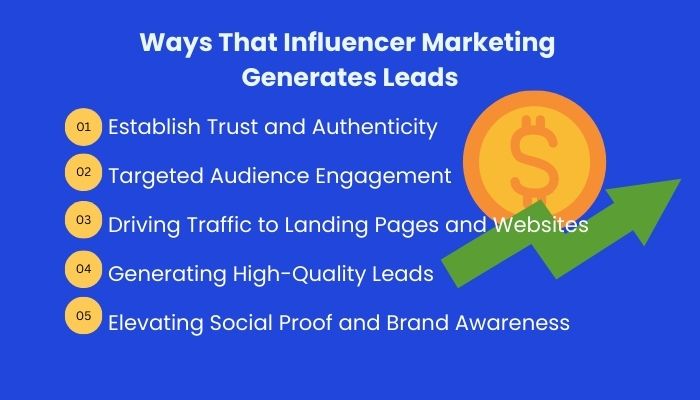
  1. Establish Trust and Authenticity
    • People are more likely to transact with brands recommended by influencers they trust.
    • Influencers create authentic content that their audience can relate to. Over time, that leads to loyal customers who come back again and again.
  2. Targeted Audience Engagement
    • One of the biggest advantages of influencer marketing campaigns is precision. You’re not shouting into the void. You’re speaking directly to a target audience that already cares about a specific niche.
    • Brands can focus on influencers whose audiences are a natural fit.
    • Unlike traditional advertising, influencer marketing enables companies to zero in on niche demographics, potentially improving conversion rates.
    • A fitness influencer, for example, can introduce a health product to an audience that’s already interested. That alignment increases the odds of turning viewers into qualified leads.
  3. Driving Traffic to Landing Pages and Websites
    • Strong influencer campaigns don’t just create awareness. They move people. Influencers can share unique promo codes or direct calls to action that direct the influencer's followers to a business’ landing pages or websites.
    • Because the recommendation feels personal, those clicks often turn into higher-quality lead generation results compared to traditional ads.
    • Engaging social media posts, YouTube videos, and other content can drive organic traffic and encourage would-be customers to make buying decisions.
  4. Generating High-Quality Leads
    • Influencers don’t just promote. They create content that feels native to their platform. This kind of content creation blends storytelling with subtle promotion, making it far more engaging. That content can often double as user generated content for your own channels, stretching its value even further.
    • Influencers regularly engage with their followers, so their recommendations translate into higher-quality leads compared to cold calls or generic advertising.
    • Influencer audiences often have a genuine interest in the promoted offering.
  5. Elevating Social Proof and Brand Awareness
    • When a respected influencer uses and recommends a product, this show of confidence can in turn boost consumer confidence.
    • Influencer partnerships can establish brand authority and recognition.
    • That familiarity leads to trust. And trust builds brand visibility, helps build brand awareness, and keeps your business top of mind when potential customers are ready to buy.

Best Practices for Influencer Marketing in Lead Generation

With more than 50 million influencers worldwide, businesses have plenty of options to work with. But that doesn’t mean your company can succeed with just any influencer. It’s important to do your homework and find an influencer with followers that are natural fit for your brand.

The truth is that the right fit matters and can make or break your digital marketing strategy. Depending on who you ask, businesses should invest between 5% and 10% of revenue on digital marketing. When earmarking that amount on anything, you need to know what you’re doing. Otherwise, you might fritter away financial resources on strategy doomed to failure.

Here are some things to consider to ensure you get maximum impact when using influencer marketing for lead generation:

1. Find the Right Influencers

  • Select influencers whose brand values and audience are a good fit with your brand.
  • Consider engagement rates rather than just the number of followers influencers have. Focus on audience quality, engagement metrics, and how the influencer's followers interact with their content.

2. Create a Clear Campaign Strategy

  • Choose specific objectives for the digital marketing effort, such as increasing website traffic or boosting sales, so you can more easily assess results.
  • Give creators some breathing room. The best results come when you allow creative freedom. Influencers know how to speak to their audience better than anyone.
  • Determine the type of content to be used -- whether blog posts, Instagram posts, or TikTok or YouTube videos.

3. Run Special Promotions

  • Give influencers discount codes to share with their followers so it’s easier to track leads and conversions.
  • Entertain options like giveaways or contests to encourage lead generation.

5. Track and Measure Performance

  • Employ UTM parameters, which are snippet codes you can attach to the end of a URL, to assess the performance of content and campaigns.
  • Key metrics to track include:
    • Click-through rates
    • Cost per lead
    • Engagement (likes, comments, shares)
    • Conversion rates

6. Establish Long-Term Relationships with Influencers

  • Long-term partnerships create authenticity and credibility.
  • Ongoing promotions by the same influencers build trust and boost brand loyalty.
  • And don’t forget to track what matters. Look at lead generation metrics like click-through rates, conversions, and overall lead quality. This helps you refine your influencer strategy as you go.

Mistakes to Avoid When Pursuing an Influencer Marketing Strategy

When developing an influencer marketing strategy, you’ll want to avoid missteps. Making any of the following mistakes will lead to wasted time, effort, and valuable financial resources:

1. Choosing the Wrong Influencers

  • Teaming up with influencers who aren’t a logical fit with your brand’s core values and whose followers aren’t part of your target demographic is a no-no. You’ll be doomed to low engagement and ineffective digital marketing campaigns.

2. Ignoring Authenticity

  • Authenticity is key. Don’t make the mistake of prioritizing finding the highest-profile influencer than on ensuring the influencer is the right one. Otherwise, your influencer collaborations may appear inauthentic or forced -- which won’t go over well with prospective clients.

3. Failing to Set Clear Goals and KPIs

  • You won’t be able to ascertain the performance of influencer marketing campaigns without measurable objectives like conversions, engagement rates, or brand awareness.

4. Failing to Track Performance and ROI

  • In addition to setting clear goals and KPIs, your business must stay on top of key metrics, such as click-through rates and sales. Otherwise, it’ll be hard to ensure a good ROI.

Develop Your Influencer Marketing Strategy with Digital.Marketing!

Influencer marketing has become a reliable driver of lead generation -- giving companies another way to find, reach, and engage with their target demographics. But understanding the importance of influencer marketing and developing a winning strategy that yields measurable results are two separate things.

Influencer marketing lead generation isn’t just another tactic. It’s becoming a core part of how brands connect with people.

As the marketing landscape continues to evolve, businesses that focus on real relationships will stand out. That means building partnerships, not just running influencer campaigns.

When done right, influencer collaborations can help you attract potential customers, create content that resonates, and turn attention into action.

If you’re willing to invest the time to find the best influencers and build meaningful partnerships, the payoff can be significant.

At Digital.Marketing, we have the expertise to ensure you get results, including a measurable ROI. Get in touch today to learn how we can help -- whether you’re a startup, a Fortune 500 enterprise, and somewhere in between -- to develop an impactful influencer marketing plan.

Author

Samuel Edwards

Chief Marketing Officer

Throughout his extensive 10+ year journey as a digital marketer, Sam has left an indelible mark on both small businesses and Fortune 500 enterprises alike. His portfolio boasts collaborations with esteemed entities such as NASDAQ OMX, eBay, Duncan Hines, Drew Barrymore, Price Benowitz LLP, a prominent law firm based in Washington, DC, and the esteemed human rights organization Amnesty International. In his role as a technical SEO and digital marketing strategist, Sam takes the helm of all paid and organic operations teams, steering client SEO services, link building initiatives, and white label digital marketing partnerships to unparalleled success. An esteemed thought leader in the industry, Sam is a recurring speaker at the esteemed Search Marketing Expo conference series and has graced the TEDx stage with his insights. Today, he channels his expertise into direct collaboration with high-end clients spanning diverse verticals, where he meticulously crafts strategies to optimize on and off-site SEO ROI through the seamless integration of content marketing and link building.

The Role of Influencer Marketing in Lead Generation

Samuel Edwards
|
April 8, 2026

If your business is doing the same old thing and continually getting inadequate results, it’s time for change. The marketing landscape has changed fast and the digital age is now upon us. And while the old ways of running marketing campaigns can work in some situations, you’re making a mistake by ignoring digital marketing.

Consumers are a fickle bunch and are becoming more skeptical of direct advertisements. They’re more likely to be convinced to make a positive purchasing decision by relying on personal recommendations and sources they find authentic and dependable. This considerable shift in consumer behavior has contributed to the increasing importance of influencer marketing.

The growth speaks for itself. Influencer marketing has become a core part of modern marketing efforts, not just a trend. Statista reports that the worldwide influencer marketing segment was worth $21.1 billion as of 2024. That's more than triple since 2019. It adds that the influencer endorsement market continues to mature as a sector and that the size and worth of influencer marketing platforms continue to grow each year, making strategic partnerships between brands and creators increasingly profitable. Marketers in the know are leveraging the power of the movers and shakers on social media to communicate their unique value propositions to potential customers.

Influencers with a strong social media presence and sizable list of online followers can be help move the needle on the influencer marketing lead generation front. But how exactly does influencer marketing drive lead generation? Keep reading to learn more about how influencer marketing impacts lead generation -- and how Digital.Marketing can help you maximize your influencer marketing strategy.

What is Influencer Marketing?

Global Internet vs Social Media Users Growth
Influencer marketing works because brands can reach people where they already spend time. This line graph shows how both internet use and social media adoption have steadily grown, creating a larger audience for creator-led campaigns.
Internet users
Social media users
0 1B 2B 3B 4B 5B 2015 2016 2017 2018 2019 2020 2021 2022 2023 2024 2025 Year Users Worldwide (Billions) 5.56B 5.24B

Influencer marketing is a type of social media marketing. There were 5.56 billion internet users globally as of February 2025, which makes up 67.9% of the worldwide population. Meanwhile, the number of global social media users comes in at 5.24 billion, making up 63.9% of the global population. That’s reason enough for every business to develop online marketing strategies. Failing to do so means losing out since your rivals are likely already targeting people online.

Businesses pursue influencer marketing because it enables them to reach a wider target audience through trusted sources who come with loyal followers. That can lead to higher engagement and conversion rates versus traditional marketing. For influencer marketing to work effectively for your business, the influencer and the influencer’s audience should be part of your company’s target demographic so that endorsements are impactful and yield results. These creators have built personal relationships with their followers, and that connection carries weight.

With billions of people online and active on social platforms, brands have an opportunity to meet people where they already spend their time. The right influencers can introduce your product in a way that feels natural, not forced.

Types of influencers include:

  • Mega-Influencers: Celebrities and public figures with follower count in the millions
  • Macro-Influencers: Influencers with between 100,000 to 1 million followers
  • Micro-Influencers: Influencers with between 10,000 to 100,000 followers
  • Nano-Influencers: Everyday consumers with south of 10,000 followers who have loyal audiences

Which type of influencer your company works with will depend on what you’re looking to achieve and how much you want to invest. Micro influencers and niche influencers often drive stronger engagement metrics and better lead quality because their audiences trust them more deeply. That’s where working with Digital.Marketing, a business specializing in cutting-edge lead generation strategies, can help you come on top. We specialize in helping businesses ranging from startups to Fortune 500 companies with choosing the right influencers and other digital marketing strategies.

Ways That Influencer Marketing Drives Lead Generation

Influencer marketing lead generation works because it meets people at the intersection of trust and attention. Instead of interrupting, it blends into influencer content people already enjoy.

There are at least five ways that influencer marketing generates leads. Here’s an overview:

  1. Establish Trust and Authenticity
    • People are more likely to transact with brands recommended by influencers they trust.
    • Influencers create authentic content that their audience can relate to. Over time, that leads to loyal customers who come back again and again.
  2. Targeted Audience Engagement
    • One of the biggest advantages of influencer marketing campaigns is precision. You’re not shouting into the void. You’re speaking directly to a target audience that already cares about a specific niche.
    • Brands can focus on influencers whose audiences are a natural fit.
    • Unlike traditional advertising, influencer marketing enables companies to zero in on niche demographics, potentially improving conversion rates.
    • A fitness influencer, for example, can introduce a health product to an audience that’s already interested. That alignment increases the odds of turning viewers into qualified leads.
  3. Driving Traffic to Landing Pages and Websites
    • Strong influencer campaigns don’t just create awareness. They move people. Influencers can share unique promo codes or direct calls to action that direct the influencer's followers to a business’ landing pages or websites.
    • Because the recommendation feels personal, those clicks often turn into higher-quality lead generation results compared to traditional ads.
    • Engaging social media posts, YouTube videos, and other content can drive organic traffic and encourage would-be customers to make buying decisions.
  4. Generating High-Quality Leads
    • Influencers don’t just promote. They create content that feels native to their platform. This kind of content creation blends storytelling with subtle promotion, making it far more engaging. That content can often double as user generated content for your own channels, stretching its value even further.
    • Influencers regularly engage with their followers, so their recommendations translate into higher-quality leads compared to cold calls or generic advertising.
    • Influencer audiences often have a genuine interest in the promoted offering.
  5. Elevating Social Proof and Brand Awareness
    • When a respected influencer uses and recommends a product, this show of confidence can in turn boost consumer confidence.
    • Influencer partnerships can establish brand authority and recognition.
    • That familiarity leads to trust. And trust builds brand visibility, helps build brand awareness, and keeps your business top of mind when potential customers are ready to buy.

Best Practices for Influencer Marketing in Lead Generation

With more than 50 million influencers worldwide, businesses have plenty of options to work with. But that doesn’t mean your company can succeed with just any influencer. It’s important to do your homework and find an influencer with followers that are natural fit for your brand.

The truth is that the right fit matters and can make or break your digital marketing strategy. Depending on who you ask, businesses should invest between 5% and 10% of revenue on digital marketing. When earmarking that amount on anything, you need to know what you’re doing. Otherwise, you might fritter away financial resources on strategy doomed to failure.

Here are some things to consider to ensure you get maximum impact when using influencer marketing for lead generation:

1. Find the Right Influencers

  • Select influencers whose brand values and audience are a good fit with your brand.
  • Consider engagement rates rather than just the number of followers influencers have. Focus on audience quality, engagement metrics, and how the influencer's followers interact with their content.

2. Create a Clear Campaign Strategy

  • Choose specific objectives for the digital marketing effort, such as increasing website traffic or boosting sales, so you can more easily assess results.
  • Give creators some breathing room. The best results come when you allow creative freedom. Influencers know how to speak to their audience better than anyone.
  • Determine the type of content to be used -- whether blog posts, Instagram posts, or TikTok or YouTube videos.

3. Run Special Promotions

  • Give influencers discount codes to share with their followers so it’s easier to track leads and conversions.
  • Entertain options like giveaways or contests to encourage lead generation.

5. Track and Measure Performance

  • Employ UTM parameters, which are snippet codes you can attach to the end of a URL, to assess the performance of content and campaigns.
  • Key metrics to track include:
    • Click-through rates
    • Cost per lead
    • Engagement (likes, comments, shares)
    • Conversion rates

6. Establish Long-Term Relationships with Influencers

  • Long-term partnerships create authenticity and credibility.
  • Ongoing promotions by the same influencers build trust and boost brand loyalty.
  • And don’t forget to track what matters. Look at lead generation metrics like click-through rates, conversions, and overall lead quality. This helps you refine your influencer strategy as you go.

Mistakes to Avoid When Pursuing an Influencer Marketing Strategy

When developing an influencer marketing strategy, you’ll want to avoid missteps. Making any of the following mistakes will lead to wasted time, effort, and valuable financial resources:

1. Choosing the Wrong Influencers

  • Teaming up with influencers who aren’t a logical fit with your brand’s core values and whose followers aren’t part of your target demographic is a no-no. You’ll be doomed to low engagement and ineffective digital marketing campaigns.

2. Ignoring Authenticity

  • Authenticity is key. Don’t make the mistake of prioritizing finding the highest-profile influencer than on ensuring the influencer is the right one. Otherwise, your influencer collaborations may appear inauthentic or forced -- which won’t go over well with prospective clients.

3. Failing to Set Clear Goals and KPIs

  • You won’t be able to ascertain the performance of influencer marketing campaigns without measurable objectives like conversions, engagement rates, or brand awareness.

4. Failing to Track Performance and ROI

  • In addition to setting clear goals and KPIs, your business must stay on top of key metrics, such as click-through rates and sales. Otherwise, it’ll be hard to ensure a good ROI.

Develop Your Influencer Marketing Strategy with Digital.Marketing!

Influencer marketing has become a reliable driver of lead generation -- giving companies another way to find, reach, and engage with their target demographics. But understanding the importance of influencer marketing and developing a winning strategy that yields measurable results are two separate things.

Influencer marketing lead generation isn’t just another tactic. It’s becoming a core part of how brands connect with people.

As the marketing landscape continues to evolve, businesses that focus on real relationships will stand out. That means building partnerships, not just running influencer campaigns.

When done right, influencer collaborations can help you attract potential customers, create content that resonates, and turn attention into action.

If you’re willing to invest the time to find the best influencers and build meaningful partnerships, the payoff can be significant.

At Digital.Marketing, we have the expertise to ensure you get results, including a measurable ROI. Get in touch today to learn how we can help -- whether you’re a startup, a Fortune 500 enterprise, and somewhere in between -- to develop an impactful influencer marketing plan.

Author

Samuel Edwards

Chief Marketing Officer

Throughout his extensive 10+ year journey as a digital marketer, Sam has left an indelible mark on both small businesses and Fortune 500 enterprises alike. His portfolio boasts collaborations with esteemed entities such as NASDAQ OMX, eBay, Duncan Hines, Drew Barrymore, Price Benowitz LLP, a prominent law firm based in Washington, DC, and the esteemed human rights organization Amnesty International. In his role as a technical SEO and digital marketing strategist, Sam takes the helm of all paid and organic operations teams, steering client SEO services, link building initiatives, and white label digital marketing partnerships to unparalleled success. An esteemed thought leader in the industry, Sam is a recurring speaker at the esteemed Search Marketing Expo conference series and has graced the TEDx stage with his insights. Today, he channels his expertise into direct collaboration with high-end clients spanning diverse verticals, where he meticulously crafts strategies to optimize on and off-site SEO ROI through the seamless integration of content marketing and link building.