Digital marketing dashboards are cluttered with metrics that look impressive—until you try to tie them to actual revenue.
And in B2B, where sales cycles are long, buyers are scarce, and deal values are high, chasing vanity metrics isn’t just unhelpful—it’s dangerous.
B2B marketers aren’t just selling to one person with a credit card.
They’re selling to committees, procurement teams, and decision-makers who read whitepapers in their spare time.
That means every digital marketing activity needs to be laser-focused on generating pipeline and accelerating deals—not just getting eyeballs.
This post cuts through the noise to spotlight the B2B digital marketing metrics that actually matter—the ones that drive pipeline and reveal digital marketing’s true ROI.
Whether you're in IT/software/SaaS, enterprise services, or complex consulting, these are the KPIs you should care about if you're serious about scaling your marketing strategy.
Forget the fluff. Let’s focus on what really moves the needle.
Most B2B marketers are drowning in data—and still can't prove ROI.
Here’s what you should be tracking within your org if you want to drive real pipeline and revenue:
Scrub out the vanity. Track what moves deals forward.
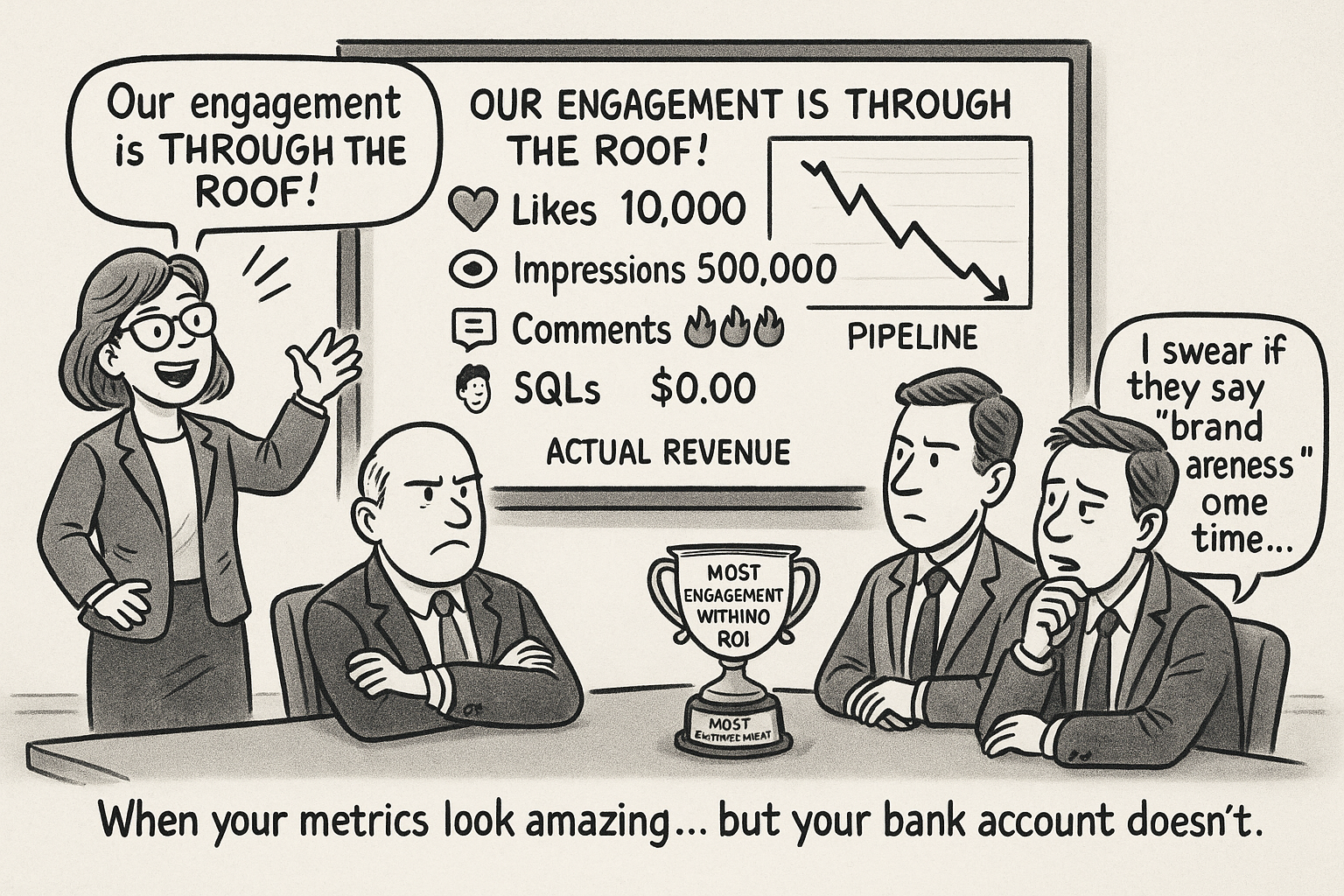
It's a blunt truth: most digital marketing dashboards are stuffed with junk metrics.
Sure, your last LinkedIn post got 1,000 impressions.
Your email had a 35% open rate.
Your blog traffic doubled last month.
But here's the real question: Did any of that generate sales pipeline?
In B2B, where sales cycles are long and buyers rarely impulse-purchase enterprise software, vanity metrics are dangerous.
Vanity metrics help marketers feel busy.
They look great in slide decks.
But they often have zero correlation with revenue.
Here are a few usual suspects:
Vanity metrics distract marketers from the real goal: generating and accelerating revenue.
Worse, they can create a false sense of success that leads to bloated budgets, misallocated resources, and misaligned marketing-sales relationships.
You’re not in B2C.
This isn’t about volume—it’s about precision.
You should be using a rifle and not a shotgun.
One CMO at your target account is worth more than 10,000 anonymous clicks.
It’s time to stop measuring noise and start measuring impact.
Not all metrics are created equal—and they shouldn’t be treated the same at every stage of your B2B marketing funnel.
The metrics that matter at the top of the funnel aren’t the same ones that matter when your sales team is chasing signatures.
Here’s how to separate signal from noise, based on where your prospect is in their buyer journey:
At this stage, your goal is visibility with the right audience—not just anyone with a browser. You’re planting seeds.
This is where curiosity turns into consideration. You need to know who’s leaning in.
Now it’s all about revenue. Time to get ruthless with your metrics.
By aligning your metrics to your funnel stages, you create clarity—not just for marketing, but for sales, leadership, and your P&L. If your dashboard doesn’t tell you where leads are stalling or accelerating, it’s time to rewire it.
If your team is running account-based marketing (ABM)—whether light-touch or fully orchestrated—you can’t rely on lead volume alone. Traditional funnel metrics don’t tell the full story when you’re targeting a narrow list of high-value accounts with personalized content and multi-channel outreach.
ABM success lives and dies on engagement from the right people at the right companies. Here’s what actually matters:
You can’t land a six-figure deal by only talking to an intern.
ABM isn’t about more leads. It’s about deeper relationships with fewer accounts.
These metrics help you monitor that depth—and make sure your marketing dollars are generating traction where it counts.
Let’s be real: your C-suite doesn’t care how many likes you got on LinkedIn or how many people opened last Tuesday’s newsletter. They care about pipeline. They care about efficiency. They care about revenue.
If you want marketing to sit at the grown-up table, these are the metrics that matter most:
High CAC = unscalable growth. Get it under control.
LTV tells you what a customer is worth. CAC tells you what they cost.
If your reports don’t include these numbers—or can’t explain how your SEO, ads, and content map back to them—you’re not doing marketing. You’re doing theater.
In an ideal world, a lead would click your ad, fill out a form, take a demo, and sign the contract—all while perfectly tracked in your CRM.
In the real world? They read a blog post six months ago, heard your CEO on a podcast, saw a LinkedIn ad, checked out three competitor sites, ignored five emails, Googled your brand name, and then converted.
Good luck attributing that to one “channel.”
Relying on single-touch attribution in B2B is like giving credit for a touchdown to the person who handed the ball off at the 1-yard line.
Marketing attribution in B2B isn’t about perfection. It’s about creating enough visibility to make smarter decisions. When in doubt, ask your closed-won customers: “How did you first hear about us?” Their answers might surprise you—and they won’t be in your CRM.
Each marketing channel has its own behavior, benchmarks, and BS. One-size-fits-all metrics are a fast way to waste money—or worse, misinterpret what’s actually working.
Below are the metrics that matter most, channel by channel:
SEO is a slow burn—track long-term ROI, not just rankings.
High CTR with low conversion = clickbait. Don’t confuse curiosity with intent.
LinkedIn is expensive—but powerful when hyper-targeted.
One strong reply from the right buyer beats 10,000 opens from randoms.
If nobody follows up after your webinar, did it really happen?
You’re borrowing someone else’s audience—make the most of it.
Most marketing dashboards are either a bloated mess of meaningless metrics or a barren wasteland with one lonely CTR stat. Neither tells a useful story. If your dashboard doesn’t help you make decisions, it’s not a dashboard—it’s decoration.
Here’s how to build a reporting system that actually helps you win:
Stop reporting on what you did. Start reporting on what it did for the business.
❌ “We published 8 blog posts and ran 4 webinars.”
✅ “Our blog generated 14 MQLs and influenced $72K in pipeline. Webinars sourced 2 SQLs and accelerated 1 deal.”
One dashboard does not fit all. Tailor the data to the decision-maker.
Your dashboard should work harder than your marketing intern. If it doesn’t, rebuild it.
Dashboards don’t create value. Your interpretation of them does.
Every dashboard should have a takeaway:
It turns data from static to strategic.
It’s one thing to measure what’s happening—it’s another to ensure that what’s happening actually supports your business objectives. That’s where most marketers drop the ball.
Marketing metrics without strategic alignment are just noise. Your KPIs should directly map to the things that matter most to your organization: growth, efficiency, pipeline velocity, and profitability.
Every marketing activity should support a strategic goal:
If a metric doesn't help you achieve one of these, it belongs in a marketing trivia night—not your dashboard.
Saying your CPL is $150 is meaningless unless you know that:
Benchmarking brings clarity—and helps you justify budget increases or reallocations.
Marketing doesn't exist in a vacuum. Strategy should evolve with data—and data should be shaped by strategy.
Good metrics don’t just inform—they provoke action.
Metrics should guide your next move—not just explain the last one.
When strategy and metrics are in sync, your marketing isn’t just reporting performance—it’s driving it.
Even experienced B2B marketers fall into traps when it comes to tracking (and presenting) marketing metrics. The tools make it easy to measure everything—but that’s exactly the problem.
Here are some of the most common mistakes that quietly kill marketing performance, trust, and budget:
When everything is important, nothing is. Bloated dashboards confuse stakeholders and bury insights. Focus on the few KPIs that actually move revenue, not a buffet of meaningless data.
❌ “We track 67 KPIs.”
✅ “We track 7 that tell us where to invest next month.”
Your execs don’t care how many blog posts you wrote or emails you sent. They care about what those activities delivered in terms of leads, pipeline, and revenue.
Stop saying: “We ran 3 webinars.”
Start saying: “Our webinars generated 14 SQLs and $40K in influenced pipeline.”
If your leads look good on paper but your sales team thinks they’re junk, your metrics are lying to you. Closed-loop reporting with sales is non-negotiable.
Your best metric? Sales actually wants to call your leads.
Averages lie. Segment by channel, buyer persona, industry, funnel stage—whatever gives you clarity. One superstar campaign can mask five that are quietly wasting budget.
Just because something is easy to measure doesn’t mean it matters. Impressions, likes, and open rates don’t pay the bills unless they correlate to pipeline or revenue.
Marketing theater is not marketing strategy.
A $200 CPL might be fine—unless last quarter it was $120. Without historical benchmarks, you can’t spot trends, diagnose problems, or make confident strategic moves.
Tools are built to be flexible, but many teams default to whatever their CRM or ad platform surfaces by default. That’s lazy.
Define your strategy first, then bend the tools to fit it—not the other way around.
Mistakes in metric strategy aren’t just embarrassing—they’re expensive. They mislead teams, misalign departments, and can cost your marketing team credibility when it matters most.
B2B marketing isn’t about looking busy—it’s about driving pipeline, shortening sales cycles, and fueling revenue growth.
The right metrics tell you what’s working, what’s not, and where to go next.
The wrong ones?
They just make your dashboard look pretty.
So here’s the bottom line: measure what matters.
Ignore the noise.
Ditch the vanity.
Build a measurement framework that’s grounded in real business outcomes, not just digital activity.
Align it to strategy, clean up the clutter, and get buy-in from sales and leadership.
Your metrics should be a compass—guiding your decisions, validating your experiments, and charting a path toward scalable growth.
But they should never be a crutch that excuses bad performance or hides behind high click-through rates.
Because at the end of the day, likes don’t pay invoices.
Pipeline does.

%201.svg)


Digital marketing dashboards are cluttered with metrics that look impressive—until you try to tie them to actual revenue.
And in B2B, where sales cycles are long, buyers are scarce, and deal values are high, chasing vanity metrics isn’t just unhelpful—it’s dangerous.
B2B marketers aren’t just selling to one person with a credit card.
They’re selling to committees, procurement teams, and decision-makers who read whitepapers in their spare time.
That means every digital marketing activity needs to be laser-focused on generating pipeline and accelerating deals—not just getting eyeballs.
This post cuts through the noise to spotlight the B2B digital marketing metrics that actually matter—the ones that drive pipeline and reveal digital marketing’s true ROI.
Whether you're in IT/software/SaaS, enterprise services, or complex consulting, these are the KPIs you should care about if you're serious about scaling your marketing strategy.
Forget the fluff. Let’s focus on what really moves the needle.
Most B2B marketers are drowning in data—and still can't prove ROI.
Here’s what you should be tracking within your org if you want to drive real pipeline and revenue:
Scrub out the vanity. Track what moves deals forward.
It's a blunt truth: most digital marketing dashboards are stuffed with junk metrics.
Sure, your last LinkedIn post got 1,000 impressions.
Your email had a 35% open rate.
Your blog traffic doubled last month.
But here's the real question: Did any of that generate sales pipeline?
In B2B, where sales cycles are long and buyers rarely impulse-purchase enterprise software, vanity metrics are dangerous.
Vanity metrics help marketers feel busy.
They look great in slide decks.
But they often have zero correlation with revenue.
Here are a few usual suspects:
Vanity metrics distract marketers from the real goal: generating and accelerating revenue.
Worse, they can create a false sense of success that leads to bloated budgets, misallocated resources, and misaligned marketing-sales relationships.
You’re not in B2C.
This isn’t about volume—it’s about precision.
You should be using a rifle and not a shotgun.
One CMO at your target account is worth more than 10,000 anonymous clicks.
It’s time to stop measuring noise and start measuring impact.
Not all metrics are created equal—and they shouldn’t be treated the same at every stage of your B2B marketing funnel.
The metrics that matter at the top of the funnel aren’t the same ones that matter when your sales team is chasing signatures.
Here’s how to separate signal from noise, based on where your prospect is in their buyer journey:
At this stage, your goal is visibility with the right audience—not just anyone with a browser. You’re planting seeds.
This is where curiosity turns into consideration. You need to know who’s leaning in.
Now it’s all about revenue. Time to get ruthless with your metrics.
By aligning your metrics to your funnel stages, you create clarity—not just for marketing, but for sales, leadership, and your P&L. If your dashboard doesn’t tell you where leads are stalling or accelerating, it’s time to rewire it.
If your team is running account-based marketing (ABM)—whether light-touch or fully orchestrated—you can’t rely on lead volume alone. Traditional funnel metrics don’t tell the full story when you’re targeting a narrow list of high-value accounts with personalized content and multi-channel outreach.
ABM success lives and dies on engagement from the right people at the right companies. Here’s what actually matters:
You can’t land a six-figure deal by only talking to an intern.
ABM isn’t about more leads. It’s about deeper relationships with fewer accounts.
These metrics help you monitor that depth—and make sure your marketing dollars are generating traction where it counts.
Let’s be real: your C-suite doesn’t care how many likes you got on LinkedIn or how many people opened last Tuesday’s newsletter. They care about pipeline. They care about efficiency. They care about revenue.
If you want marketing to sit at the grown-up table, these are the metrics that matter most:
High CAC = unscalable growth. Get it under control.
LTV tells you what a customer is worth. CAC tells you what they cost.
If your reports don’t include these numbers—or can’t explain how your SEO, ads, and content map back to them—you’re not doing marketing. You’re doing theater.
In an ideal world, a lead would click your ad, fill out a form, take a demo, and sign the contract—all while perfectly tracked in your CRM.
In the real world? They read a blog post six months ago, heard your CEO on a podcast, saw a LinkedIn ad, checked out three competitor sites, ignored five emails, Googled your brand name, and then converted.
Good luck attributing that to one “channel.”
Relying on single-touch attribution in B2B is like giving credit for a touchdown to the person who handed the ball off at the 1-yard line.
Marketing attribution in B2B isn’t about perfection. It’s about creating enough visibility to make smarter decisions. When in doubt, ask your closed-won customers: “How did you first hear about us?” Their answers might surprise you—and they won’t be in your CRM.
Each marketing channel has its own behavior, benchmarks, and BS. One-size-fits-all metrics are a fast way to waste money—or worse, misinterpret what’s actually working.
Below are the metrics that matter most, channel by channel:
SEO is a slow burn—track long-term ROI, not just rankings.
High CTR with low conversion = clickbait. Don’t confuse curiosity with intent.
LinkedIn is expensive—but powerful when hyper-targeted.
One strong reply from the right buyer beats 10,000 opens from randoms.
If nobody follows up after your webinar, did it really happen?
You’re borrowing someone else’s audience—make the most of it.
Most marketing dashboards are either a bloated mess of meaningless metrics or a barren wasteland with one lonely CTR stat. Neither tells a useful story. If your dashboard doesn’t help you make decisions, it’s not a dashboard—it’s decoration.
Here’s how to build a reporting system that actually helps you win:
Stop reporting on what you did. Start reporting on what it did for the business.
❌ “We published 8 blog posts and ran 4 webinars.”
✅ “Our blog generated 14 MQLs and influenced $72K in pipeline. Webinars sourced 2 SQLs and accelerated 1 deal.”
One dashboard does not fit all. Tailor the data to the decision-maker.
Your dashboard should work harder than your marketing intern. If it doesn’t, rebuild it.
Dashboards don’t create value. Your interpretation of them does.
Every dashboard should have a takeaway:
It turns data from static to strategic.
It’s one thing to measure what’s happening—it’s another to ensure that what’s happening actually supports your business objectives. That’s where most marketers drop the ball.
Marketing metrics without strategic alignment are just noise. Your KPIs should directly map to the things that matter most to your organization: growth, efficiency, pipeline velocity, and profitability.
Every marketing activity should support a strategic goal:
If a metric doesn't help you achieve one of these, it belongs in a marketing trivia night—not your dashboard.
Saying your CPL is $150 is meaningless unless you know that:
Benchmarking brings clarity—and helps you justify budget increases or reallocations.
Marketing doesn't exist in a vacuum. Strategy should evolve with data—and data should be shaped by strategy.
Good metrics don’t just inform—they provoke action.
Metrics should guide your next move—not just explain the last one.
When strategy and metrics are in sync, your marketing isn’t just reporting performance—it’s driving it.
Even experienced B2B marketers fall into traps when it comes to tracking (and presenting) marketing metrics. The tools make it easy to measure everything—but that’s exactly the problem.
Here are some of the most common mistakes that quietly kill marketing performance, trust, and budget:
When everything is important, nothing is. Bloated dashboards confuse stakeholders and bury insights. Focus on the few KPIs that actually move revenue, not a buffet of meaningless data.
❌ “We track 67 KPIs.”
✅ “We track 7 that tell us where to invest next month.”
Your execs don’t care how many blog posts you wrote or emails you sent. They care about what those activities delivered in terms of leads, pipeline, and revenue.
Stop saying: “We ran 3 webinars.”
Start saying: “Our webinars generated 14 SQLs and $40K in influenced pipeline.”
If your leads look good on paper but your sales team thinks they’re junk, your metrics are lying to you. Closed-loop reporting with sales is non-negotiable.
Your best metric? Sales actually wants to call your leads.
Averages lie. Segment by channel, buyer persona, industry, funnel stage—whatever gives you clarity. One superstar campaign can mask five that are quietly wasting budget.
Just because something is easy to measure doesn’t mean it matters. Impressions, likes, and open rates don’t pay the bills unless they correlate to pipeline or revenue.
Marketing theater is not marketing strategy.
A $200 CPL might be fine—unless last quarter it was $120. Without historical benchmarks, you can’t spot trends, diagnose problems, or make confident strategic moves.
Tools are built to be flexible, but many teams default to whatever their CRM or ad platform surfaces by default. That’s lazy.
Define your strategy first, then bend the tools to fit it—not the other way around.
Mistakes in metric strategy aren’t just embarrassing—they’re expensive. They mislead teams, misalign departments, and can cost your marketing team credibility when it matters most.
B2B marketing isn’t about looking busy—it’s about driving pipeline, shortening sales cycles, and fueling revenue growth.
The right metrics tell you what’s working, what’s not, and where to go next.
The wrong ones?
They just make your dashboard look pretty.
So here’s the bottom line: measure what matters.
Ignore the noise.
Ditch the vanity.
Build a measurement framework that’s grounded in real business outcomes, not just digital activity.
Align it to strategy, clean up the clutter, and get buy-in from sales and leadership.
Your metrics should be a compass—guiding your decisions, validating your experiments, and charting a path toward scalable growth.
But they should never be a crutch that excuses bad performance or hides behind high click-through rates.
Because at the end of the day, likes don’t pay invoices.
Pipeline does.

.svg)


.png)