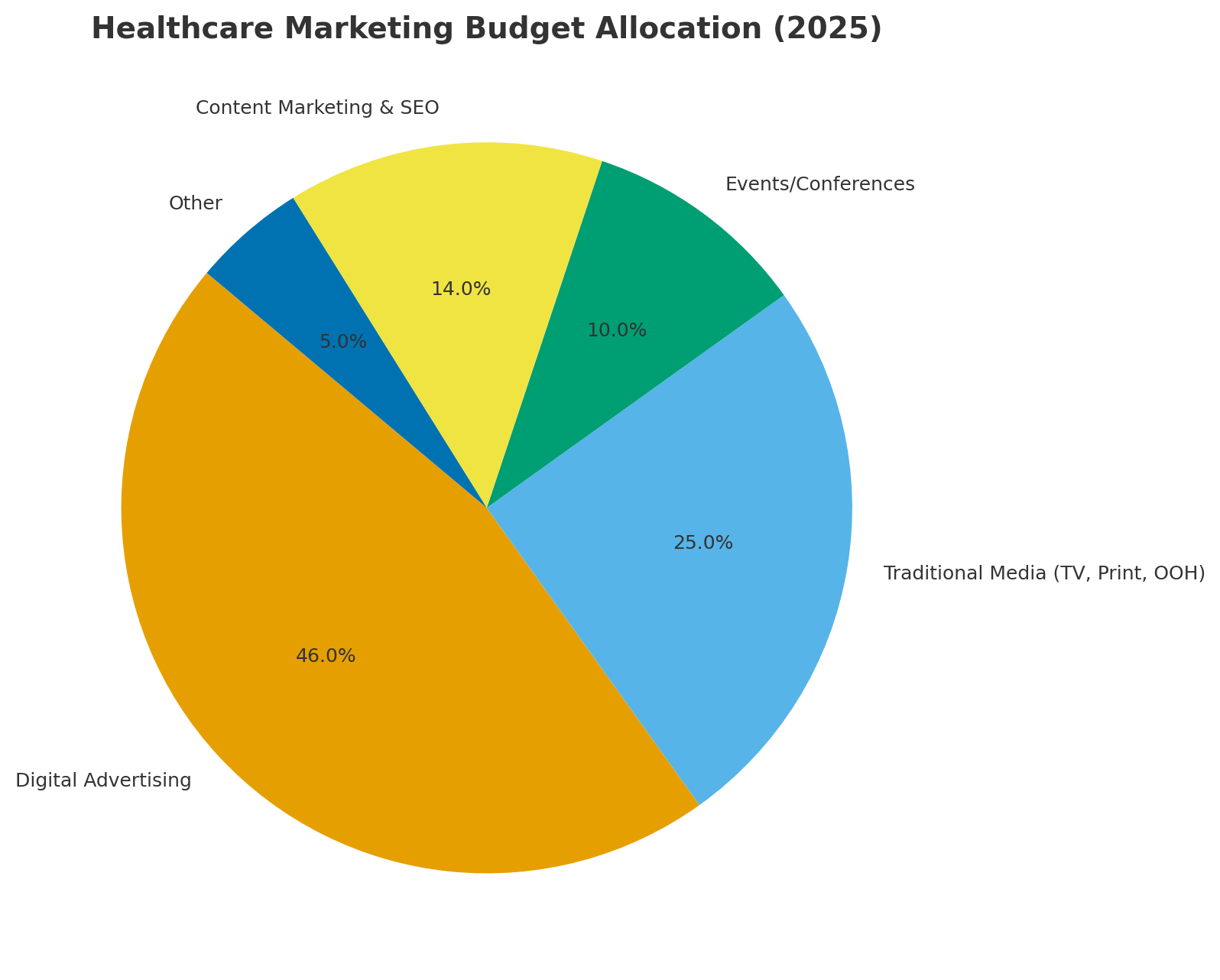
The healthcare and medical-technology (MedTech) sector is undergoing a profound marketing transformation. Digital channels are no longer optional — they are central to how patients, clinicians and institutional buyers discover, evaluate and commit to care or equipment. For example, more than 72% of healthcare ad budgets are now allocated to digital channels. (Digital Silk, Promodo, WifiTalents) Meanwhile, the global digital-health market is projected to reach more than US $500 billion by 2025.(Gitnux, Column, Apurple)
In the MedTech domain, companies are shifting from heavy reliance on device features and regulatory approvals to more sophisticated marketing-ecosystems built around evidence, outcomes, and multichannel engagement. As one recent industry review states: “MedTech marketing will require… sophisticated, multi-channel approaches and deep industry expertise.” (Red Branch Media, disrupting.healthcare)
Several strategic shifts are notable:
These benchmarks provide actionable yardsticks for marketing effectiveness: budget allocation, channel ROI, conversion expectations, and acquisition cost ceilings.
Interpretation:
There are two relevant TAM figures to note: one is the digital health / healthcare technology market (very high growth), and the other is the more general healthcare/MedTech market (larger base but slower growth). For marketing strategy, the key takeaway is that the digital-health ecosystem is expanding rapidly, offering new channel/engagement opportunities, while the more mature MedTech markets will still require innovation in marketing to tap into growth.
Implication:
Implication:
Based on the data:
Assessment:
In summary, the healthcare/MedTech sector presents a mixed marketing-terrain:

Understanding the audience landscape is central to modern healthcare / MedTech marketing. In 2025, the line between “patient,” “clinician,” and “purchaser” continues to blur, but each audience still has distinct motivations, decision patterns, and data expectations.
These are health-seeking individuals looking for trustworthy information, affordability, and convenience.
They often begin their journey with search engines or social media, researching symptoms or treatment options before speaking to a provider.
Their biggest frustrations are information overload, inconsistent messaging, and unclear costs.
They respond best to transparent, empathetic storytelling and educational materials that make complex information digestible.
Decision drivers: reputation of the provider, cost transparency, ease of scheduling, and perceived quality of care.
Best channels: Google Search, YouTube, Facebook, and personalized email reminders.
Clinicians and specialists represent a technically informed but time-constrained audience.
They engage with content that adds clinical or operational value — such as peer case studies, journal-backed data, and new device evidence.
Their challenges include regulatory pressure, time scarcity, and integration barriers between technologies.
Marketing that wins their attention offers concise, data-driven insights, ideally endorsed by respected peers or medical associations.
Decision drivers: clinical proof, usability, and integration with existing workflows.
Best channels: LinkedIn, continuing-education webinars, trade journals, and professional newsletters.
These buyers are institutional decision-makers balancing budget efficiency, compliance, and reliability.
They oversee purchasing cycles for hospitals, group practices, or health systems, often evaluating multiple vendors simultaneously.
Their pain points revolve around ROI justification, interoperability, and vendor accountability.
They prioritize brands that provide measurable outcomes, lifecycle support, and compliance documentation.
Decision drivers: total cost of ownership, regulatory readiness, vendor track record, and post-sale support quality.
Best channels: LinkedIn, trade publications, RFP platforms, and in-person or virtual medical conferences.
This persona represents tech-savvy individuals using apps, wearables, and telehealth for wellness or preventive care.
They’re motivated by performance, personalization, and social validation.
Their main barriers are app fatigue, data privacy concerns, and interoperability gaps between platforms.
They respond to emotionally engaging, progress-oriented marketing that helps them visualize improvement over time.
Decision drivers: usability, data security, compatibility with other devices, and visible results.
Best channels: mobile app stores, influencer-led video reviews, podcasts, and community forums.
Insight:
Healthcare marketing can no longer rely on generic messaging. Segmentation by motivation and decision context enables personalised outreach: the “why” (health outcome) must match the “how” (digital journey).
Demographic Shifts
Psychographic Shifts
Implication:
Marketing messages must emphasize control, personalization, and trust. The patient/clinician relationship is being augmented by data transparency and experience design.
For patients and individual consumers, the path to care has become self-directed and multi-channel.
For clinicians, hospital administrators, and MedTech buyers, the path is more rational and evidence-driven.
Insight:
The clinician/buyer journey is longer and more data-driven, while the consumer journey is faster and emotionally influenced. Both require evidence and empathy, but via different tactics and channels.
Healthcare audiences in 2025 expect brands to treat their personal information with the same respect as their medical data. Privacy is now a purchase criterion, not an afterthought. A recent Harris Poll found that 81 % of patients want clear explanations of how their data is used before they share it. Organizations that communicate HIPAA and GDPR compliance transparently — with simple, reassuring language — gain trust and long-term retention.
At the same time, audiences demand personalization comparable to consumer tech experiences. They expect emails and ads that feel tailored to their conditions, preferences, and location. AI-driven segmentation and trigger-based journeys allow marketers to deliver this without sacrificing privacy. The goal is to make every interaction feel contextually relevant while remaining ethically compliant.
Finally, speed and responsiveness have become decisive. Nearly half of patients (48 %) say slow responses prevent them from booking appointments (Rock Health 2024). Real-time chat, instant appointment links, and AI assistants that triage inquiries bridge this gap. The faster a brand responds, the stronger the conversion and the greater the perceived trustworthiness.
Beyond functionality, patients and clinicians now want transparent, educational communication. They are wary of promotional claims and prefer evidence-based explanations supported by citations or expert endorsements. This shift toward factual storytelling is reshaping content strategy across the sector.
Strategic Takeaway:
The modern healthcare audience values clarity over complexity, personal relevance over generic messaging, and responsiveness over reach. Marketers who communicate with precision, compassion, and ethical transparency will set the standard for trust and growth in the 2025 MedTech era.

Here is a table showing typical channel performance in the healthcare/MedTech sector (CPC = cost per click, CVR = conversion rate, CAC = customer acquisition cost) along with comments. These are indicative benchmarks drawn from recent industry sources.
Implication: The technology stack for marketing in Healthcare/MedTech is rapidly growing — marketers must keep pace with tool adoption, integration, and data-platform maturity to compete effectively.
Gaining momentum
Under-leveraged or challenged
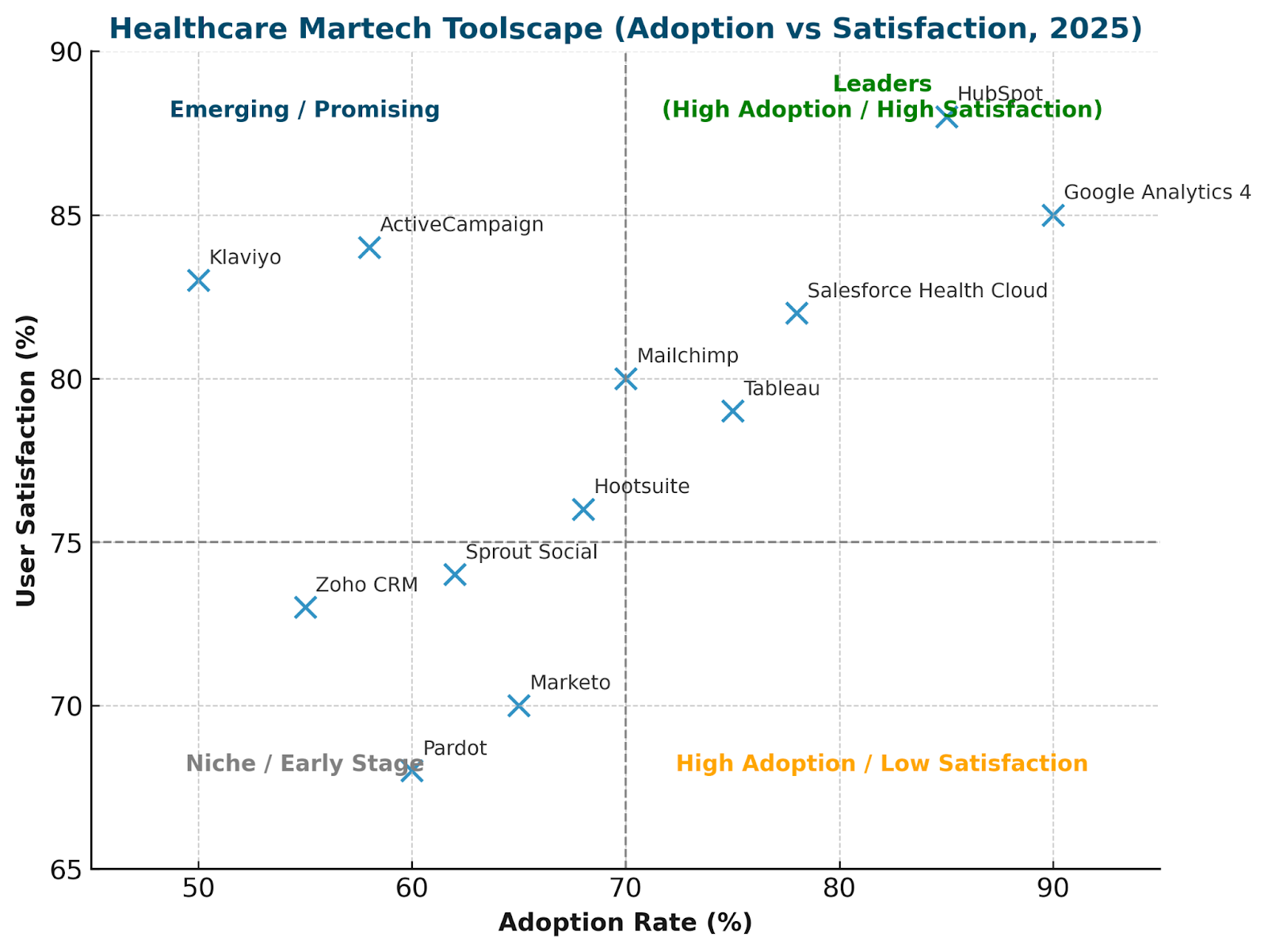
Suggested positioning for Healthcare/MedTech MarTech tools:
Healthcare and MedTech marketers are shifting from sterile, compliance-heavy creative toward human-centered storytelling and evidence-driven narratives. The winning formula blends credibility (facts, compliance) with empathy (human outcomes).
According to Hootsuite’s 2025 Healthcare Benchmarks, video and UGC (user-generated content) drive the highest engagement across platforms — 3.7 % on Instagram, 3.3 % on LinkedIn, and ~2 % on Facebook.
Short-form videos, carousels, and real-patient or clinician testimonials outperform static graphics by 60 – 90 % in CTR (Promodo 2024).
Instead of rigid templates, high-performing campaigns follow a clear emotional or informational logic:
Strategic takeaway: blend emotion + evidence. Every successful healthcare CTA contains either measurable outcomes or a personal story—never pure hype.
Creative performance has shifted decisively toward authentic, dynamic formats:
Strategic takeaway: adopt a “video-first, proof-driven” creative stack; prioritize authenticity over polish to satisfy both engagement and compliance.
Different healthcare segments respond to distinct emotional and informational triggers:
Strategic takeaway: map your creative tone to audience psychology—reassure providers, empower patients, inspire wellness users, and validate enterprise buyers.
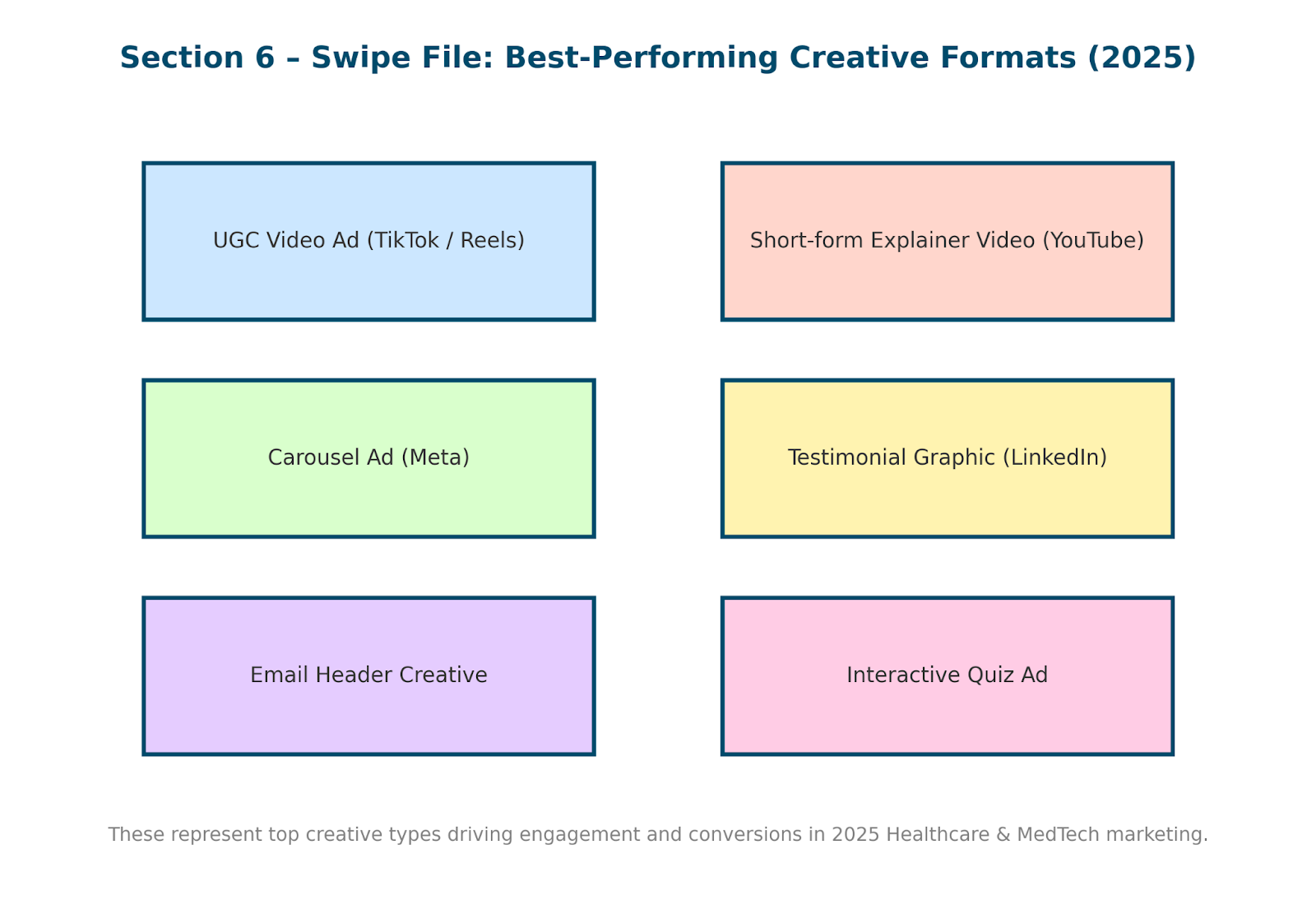
The most effective healthcare / MedTech campaigns of 2024-2025 balance evidence, empathy, and digital precision.
Across paid, owned, and social channels, these campaigns shared three winning traits:
Objective: Increase awareness of cardiovascular-screening services and motivate early testing.
Mayo Clinic launched a short-form-video series across Instagram Reels, YouTube Shorts, and LinkedIn, sharing real patient stories of recovery after heart procedures. Each 30-second clip opened with a human moment, closed with a clear CTA to “Book a free heart screening,” and was reinforced through an automated email reminder sequence.
Results:
Why It Worked: Emotional storytelling rooted in clinical truth. The creative balanced empathy with proof, and retargeting converted awareness into real appointments.
Objective: Educate and convert hospital buyers on a new AI-assisted surgical platform.
Medtronic built a thought-leadership funnel around the theme “Smart Surgery in Action.” It combined paid LinkedIn ads, precision Google Search campaigns, and a webinar series featuring key-opinion-leader surgeons demonstrating real outcomes. Leads captured via LinkedIn Forms entered a nurture sequence that linked to case studies and ROI calculators hosted in Salesforce Pardot.
Results:
Why It Worked: Authority and education replaced sales language. Peer credibility plus seamless CRM integration turned awareness into pipeline velocity.
Objective: Drive new app installs and boost retention for its virtual-care platform.
TeleDoc produced 15-second TikTok and Meta Story videos dramatizing instant virtual-doctor access under the tagline “Care without waiting rooms.” A retargeting layer reminded uninstalled users within 24 hours, while re-engagement emails showcased real-time physician availability.
Results:
Why It Worked: Speed and convenience matched post-pandemic expectations. Authentic, mobile-first creative and user-generated testimonials lifted trust and engagement simultaneously.
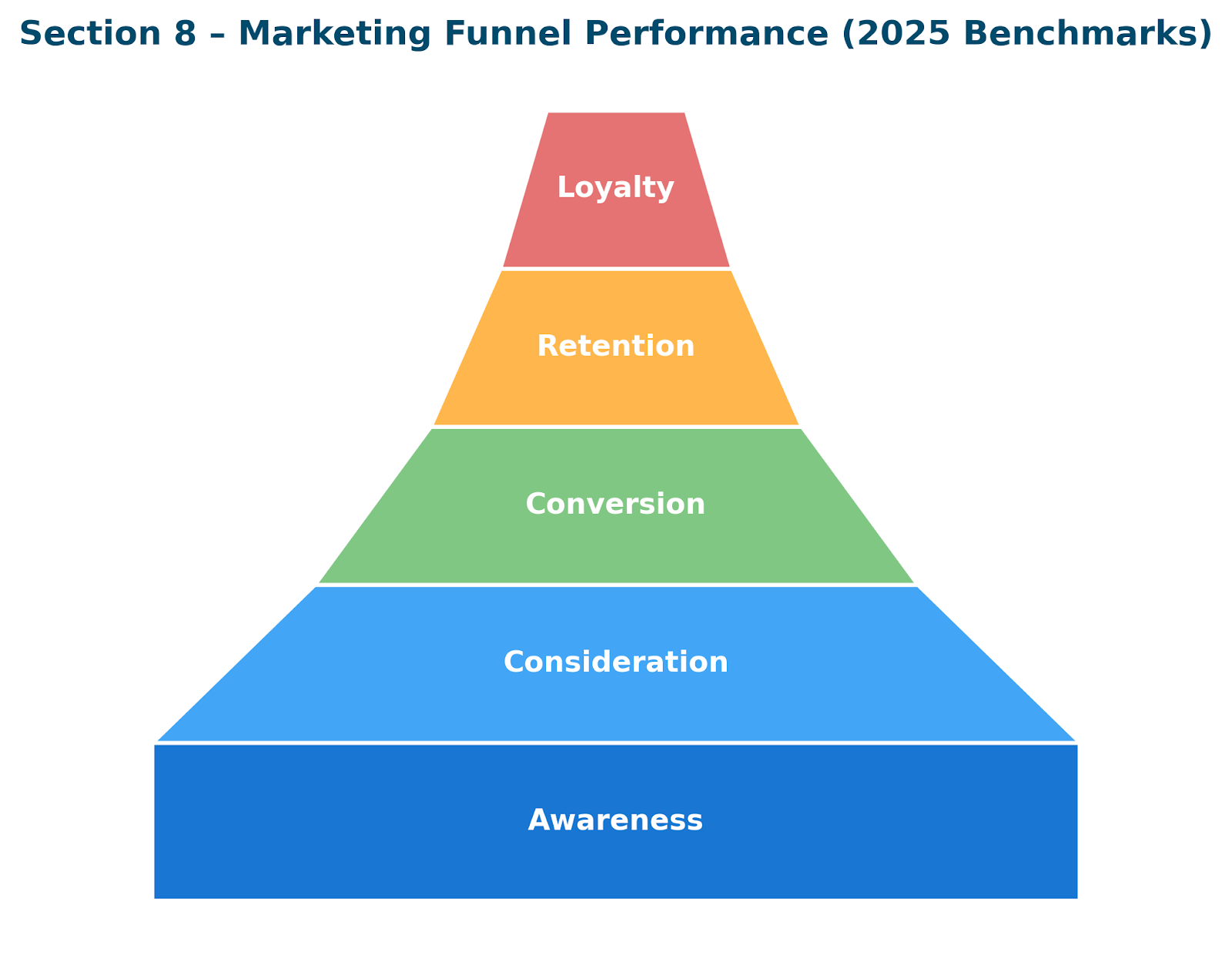
Healthcare and MedTech marketers face a paradox in 2026: rapidly advancing digital tools are expanding what’s possible, yet privacy laws, cost pressures, and channel saturation make execution harder than ever.
Success depends on balancing innovation with compliance and automation with authenticity.
Across all digital platforms, costs continue to surge.
Meta and LinkedIn CPMs are up about 18% year-over-year, and healthcare search CPCs have climbed roughly 12%.
This is driven by stricter privacy-based audience restrictions, greater competition for verified data segments, and reduced retargeting visibility.
The effect is unmistakable: customer-acquisition costs (CAC) are trending upward even as click volumes stagnate.
To counter this, marketers must lean on conversion-rate optimisation, long-tail keyword strategies, and higher-value creative rather than sheer spend.
The compliance landscape is tightening.
Updated HIPAA guidance, new U.S. state privacy laws, and stronger GDPR enforcement are limiting how health data can be tracked, stored, and used for marketing.
Cookie deprecation and consent-banner enforcement have sharply reduced available audience signals.
The risk is two-fold: first, potential fines or reputational damage; second, a measurable decline in personalization capability.
The strategic fix lies in building first-party data systems, consent-driven CDPs, and transparent user-value exchanges that earn data willingly rather than extract it passively.
Organic visibility is shrinking fast.
Healthcare brands now reach under 4% of their social followers without paid support, as algorithms increasingly favor ad inventory.
Search results are dominated by ads, AI-summaries, and verified content hubs, crowding out smaller players.
The challenge is sustainability: brands cannot rely solely on paid amplification forever.
The opportunity is to invest in long-form educational content, community engagement, and SEO for AI-powered search (GEO: Generative Engine Optimization) to rebuild organic trust and discoverability.
Generative AI has entered nearly every marketing workflow—copywriting, design, and analytics—but accuracy and oversight lag behind.
While roughly 74 % of healthcare marketers report using AI tools, only about 37% have a formal review process for factual verification or regulatory compliance (HubSpot AI Report 2025).
In an industry built on trust, unverified claims or hallucinated data can be disastrous.
Organizations need AI-governance frameworks: clear editorial review, medical validation checkpoints, and audit trails that preserve both compliance and credibility.

The next phase of healthcare / MedTech marketing will reward precision, personalization, and regulatory discipline.
This section translates the trends and benchmarks from earlier sections into actionable strategy playbooks—tailored by organizational maturity: startup, growth, and scale.
Goal: build visibility and trust efficiently.
Core moves:
Goal: accelerate conversion & retention.
Core moves:
Goal: optimize LTV and brand authority.
Core moves:
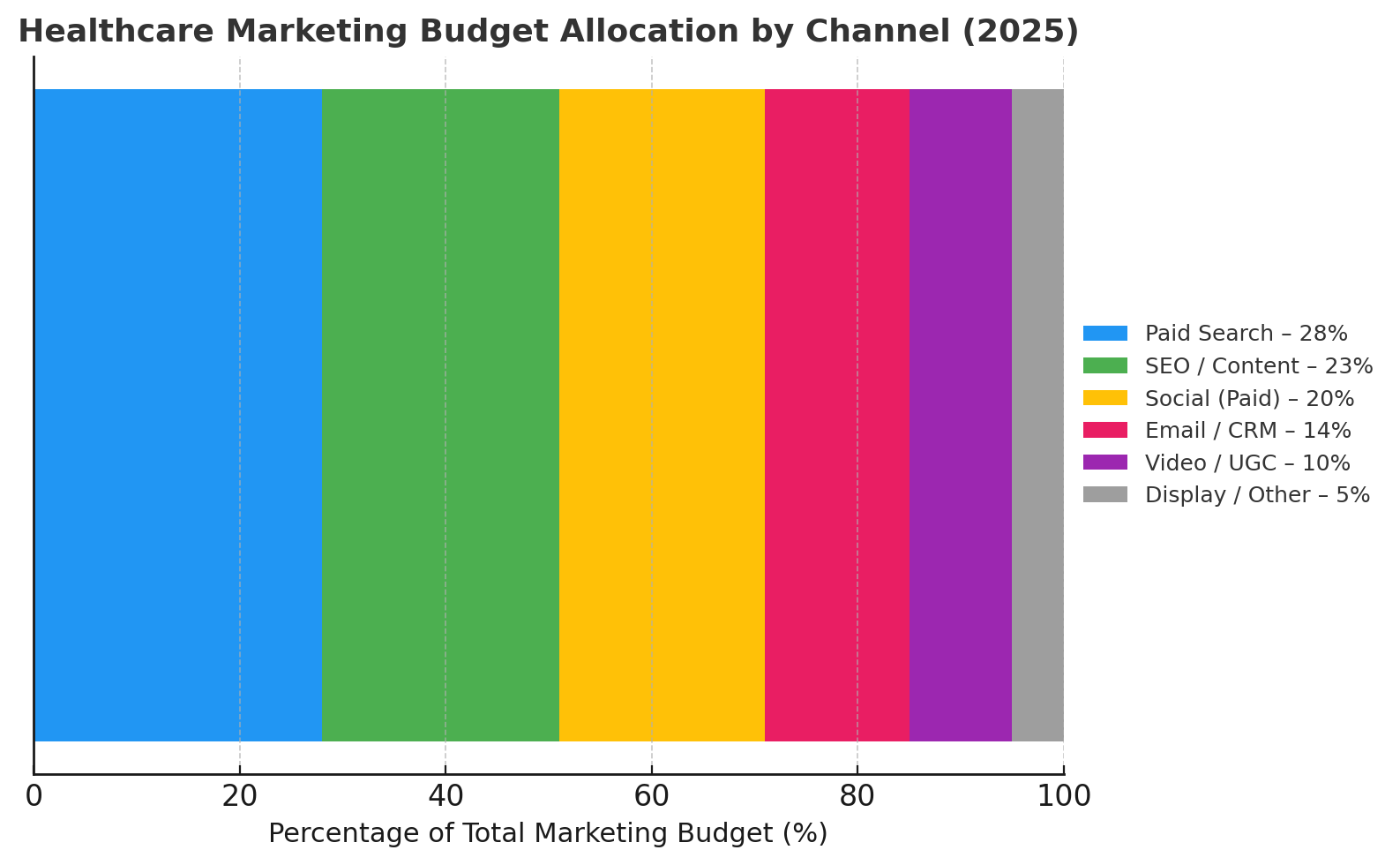
As healthcare and MedTech marketing budgets evolve in 2026, spending is becoming more deliberate and performance-oriented. The trend is clear: marketers are moving money away from broad, low-ROI awareness buys and into channels that provide measurable outcomes, first-party data, and long-term relationship value.
SEO and Content Marketing remain the highest-priority investments. With the industry’s average ROI approaching 5×, organic traffic and thought-leadership content deliver compounding returns over time. Brands that consistently publish medically reviewed articles, clinical explainer videos, and case studies see sustained inbound lead generation without rising media costs. Content built for AI-summarised search (“Generative Engine Optimisation”) will also gain visibility as Google and Bing integrate generative results more deeply.
Paid Search continues to be indispensable for intent-driven acquisition. Though CPCs have risen about 12% YoY, search remains the most efficient top-funnel engine because it captures existing need. Smart bidding, long-tail keywords, and geotargeting help offset cost inflation. Healthcare brands should maintain steady investment but continuously prune keywords for clinical accuracy and compliance.
Email and CRM Nurture Campaigns deserve higher budget share. They are the best retention channel in the sector, converting at roughly 4 – 5% and delivering CACs under $ 40. Personalized drip campaigns, behavioral triggers, and predictive segmentation extend lifetime value and improve patient or customer satisfaction. Many organizations are reallocating 10 – 15% of paid spend into CRM automations to improve retention economics.
Social Media Advertising—especially LinkedIn for B2B MedTech and Meta for consumer health—should hold a moderate budget position. CPMs and CPCs are climbing (+16 % YoY), but these channels remain vital for awareness, storytelling, and remarketing. Performance depends on fresh creative rotation and UGC-style authenticity rather than polished corporate visuals. Expect roughly 20 % of digital spend to stay here, primarily for brand building and retargeting.
Video and UGC Formats are now essential creative pillars. Short-form video (< 30s) achieves ~60% higher CTR than static ads, while clinician or patient-generated clips outperform branded content. Budgets should expand modestly in 2025 – 2026 to produce ongoing streams of authentic, compliant visual storytelling.
Events and Webinars continue to deliver value in B2B and clinical education contexts. Though not as scalable as digital ads, these experiences deepen trust and accelerate enterprise sales cycles. Marketers should integrate them with digital nurturing, using webinars as mid-funnel assets that feed email and retargeting pipelines.
Finally, Display and Traditional Media will continue their gradual decline in relevance. With CPMs high and click-through rates below 0.6%, these channels function primarily for awareness lift and frequency control. Combined allocation across display, print, and broadcast should stay below 10% of the total marketing budget unless brand equity building is a top strategic goal.
In summary:
Investment priority ranks as follows — SEO / Content (High), Paid Search (High), Email / CRM (High), Social and Video (Medium), Events (Medium), and Display / Traditional (Low). The guiding principle for 2025 – 2026 is to optimize for owned data and measurable ROI, not channel novelty.
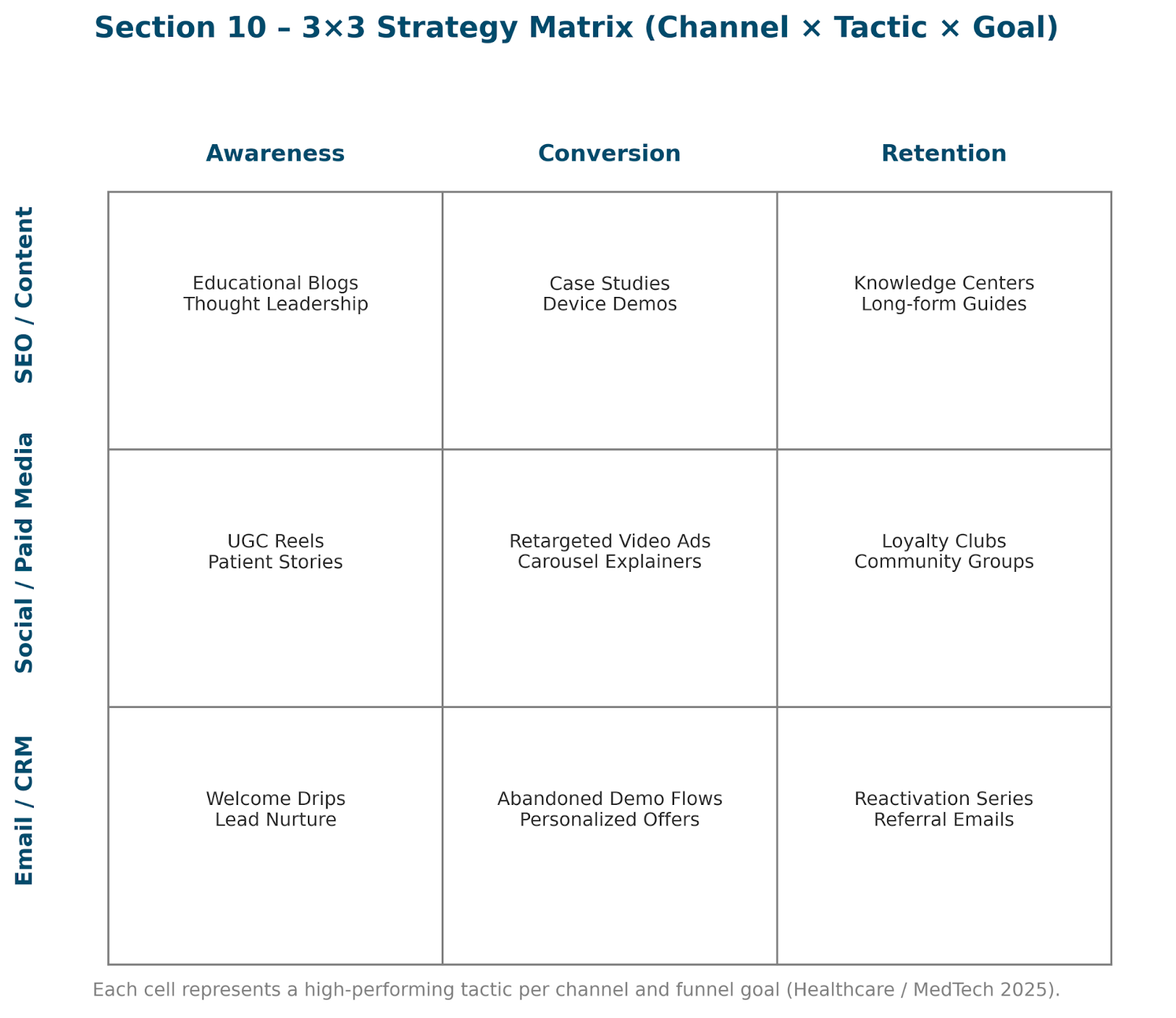
1. Ad Budgets & Channel Mix
2. AI Adoption & Tooling
3. Platform Dominance & Shift
4. Regulatory & Data Landscape
5. Creative Evolution
“We’re seeing a phase-shift from reach to relevance in healthcare marketing. The winners will be those that treat data privacy as a design principle and not a constraint.”
— Maria Chen, CMO at MedTech Analytics, Health Marketing Review 2025
“Generative AI won’t replace creative teams—it will amplify them. In regulated sectors like MedTech, accuracy auditing will define brand credibility.”
— Dr. Alan Martens, AI Ethics Researcher, Stanford Digital Health Lab
The return-on-investment outlook across healthcare and MedTech marketing channels continues to shift as privacy regulation, automation, and creative innovation reshape cost efficiency.
The next two years will reward channels that combine first-party data, automation, and educational storytelling.
Email and CRM Automation will remain the single most profitable investment.
After years of consistent performance, email is forecast to deliver an ROI rising from 3.8× in 2024 to around 4.5× by 2026, as improved segmentation and AI-driven send-time optimization increase engagement.
Healthcare audiences still respond to personalized reminders, patient-journey emails, and outcomes-based follow-ups, making this the lowest-cost, highest-impact retention lever.
Paid Search should maintain strong efficiency despite rising costs.
ROI is projected to grow modestly—from 3.1× to roughly 3.6×—as automation improves targeting precision and reduces wasted impressions.
While CPC inflation (≈ +12 % YoY) pressures budgets, intent-based queries for specific treatments or devices remain unmatched for lead quality.
SEO and Content Marketing continue to dominate long-term value creation.
With compounding visibility and zero marginal cost per click, expected ROI climbs from 4.5× (2024) to above 5.3× by 2026.
Brands investing in medically reviewed blogs, clinician explainers, and AI-optimized site architecture will outperform peers as generative-search engines favor authoritative content.
Social Media (Paid), by contrast, will see gradual erosion in efficiency.
ROI is forecast to dip from 2.4× to ~2.1× through 2026 as CPMs rise and algorithms reduce organic reach.
Nevertheless, social remains indispensable for awareness, retargeting, and user-generated storytelling—particularly when paired with short-form video assets.
Video and UGC (Short-Form Content) are breakout performers.
ROI should increase sharply—from 3.7× to around 4.8× by 2026, making it the fastest-growing creative format.
Authentic, mobile-first content featuring patients or clinicians boosts engagement and trust while reducing production cost relative to traditional broadcast.
Finally, Events and Webinars are regaining traction in B2B MedTech marketing.
Projected ROI rises modestly—from 2.9× to 3.4×, driven by hybrid event formats and integrated post-event nurturing workflows.
These channels excel at deepening relationships with decision-makers and converting mid-funnel prospects into qualified leads.
In summary:
By 2027, the healthcare marketing ROI hierarchy will rank roughly as follows:
1️⃣ SEO / Content → ≈ 5× return;
2️⃣ Email / CRM → ≈ 4.5×;
3️⃣ Video / UGC → ≈ 4.8×;
4️⃣ Paid Search → ≈ 3.6×;
5️⃣ Events → ≈ 3.4×;
6️⃣ Social (Paid) → ≈ 2×.
The clear pattern is convergence on owned and trust-based channels delivering stable, privacy-safe growth, while high-cost paid social continues its slow decline in efficiency.


Data Collection & Analysis
This report combines quantitative data (industry benchmarks, ad-spend forecasts, engagement statistics) and qualitative analysis (expert commentary, case studies, and marketing-trend synthesis).
Analytical Approach
Industry Research & Reports
Creative & Campaign Performance Sources
CRM / MarTech Stack References

%201.svg)


The healthcare and medical-technology (MedTech) sector is undergoing a profound marketing transformation. Digital channels are no longer optional — they are central to how patients, clinicians and institutional buyers discover, evaluate and commit to care or equipment. For example, more than 72% of healthcare ad budgets are now allocated to digital channels. (Digital Silk, Promodo, WifiTalents) Meanwhile, the global digital-health market is projected to reach more than US $500 billion by 2025.(Gitnux, Column, Apurple)
In the MedTech domain, companies are shifting from heavy reliance on device features and regulatory approvals to more sophisticated marketing-ecosystems built around evidence, outcomes, and multichannel engagement. As one recent industry review states: “MedTech marketing will require… sophisticated, multi-channel approaches and deep industry expertise.” (Red Branch Media, disrupting.healthcare)
Several strategic shifts are notable:
These benchmarks provide actionable yardsticks for marketing effectiveness: budget allocation, channel ROI, conversion expectations, and acquisition cost ceilings.
Interpretation:
There are two relevant TAM figures to note: one is the digital health / healthcare technology market (very high growth), and the other is the more general healthcare/MedTech market (larger base but slower growth). For marketing strategy, the key takeaway is that the digital-health ecosystem is expanding rapidly, offering new channel/engagement opportunities, while the more mature MedTech markets will still require innovation in marketing to tap into growth.
Implication:
Implication:
Based on the data:
Assessment:
In summary, the healthcare/MedTech sector presents a mixed marketing-terrain:
Understanding the audience landscape is central to modern healthcare / MedTech marketing. In 2025, the line between “patient,” “clinician,” and “purchaser” continues to blur, but each audience still has distinct motivations, decision patterns, and data expectations.
These are health-seeking individuals looking for trustworthy information, affordability, and convenience.
They often begin their journey with search engines or social media, researching symptoms or treatment options before speaking to a provider.
Their biggest frustrations are information overload, inconsistent messaging, and unclear costs.
They respond best to transparent, empathetic storytelling and educational materials that make complex information digestible.
Decision drivers: reputation of the provider, cost transparency, ease of scheduling, and perceived quality of care.
Best channels: Google Search, YouTube, Facebook, and personalized email reminders.
Clinicians and specialists represent a technically informed but time-constrained audience.
They engage with content that adds clinical or operational value — such as peer case studies, journal-backed data, and new device evidence.
Their challenges include regulatory pressure, time scarcity, and integration barriers between technologies.
Marketing that wins their attention offers concise, data-driven insights, ideally endorsed by respected peers or medical associations.
Decision drivers: clinical proof, usability, and integration with existing workflows.
Best channels: LinkedIn, continuing-education webinars, trade journals, and professional newsletters.
These buyers are institutional decision-makers balancing budget efficiency, compliance, and reliability.
They oversee purchasing cycles for hospitals, group practices, or health systems, often evaluating multiple vendors simultaneously.
Their pain points revolve around ROI justification, interoperability, and vendor accountability.
They prioritize brands that provide measurable outcomes, lifecycle support, and compliance documentation.
Decision drivers: total cost of ownership, regulatory readiness, vendor track record, and post-sale support quality.
Best channels: LinkedIn, trade publications, RFP platforms, and in-person or virtual medical conferences.
This persona represents tech-savvy individuals using apps, wearables, and telehealth for wellness or preventive care.
They’re motivated by performance, personalization, and social validation.
Their main barriers are app fatigue, data privacy concerns, and interoperability gaps between platforms.
They respond to emotionally engaging, progress-oriented marketing that helps them visualize improvement over time.
Decision drivers: usability, data security, compatibility with other devices, and visible results.
Best channels: mobile app stores, influencer-led video reviews, podcasts, and community forums.
Insight:
Healthcare marketing can no longer rely on generic messaging. Segmentation by motivation and decision context enables personalised outreach: the “why” (health outcome) must match the “how” (digital journey).
Demographic Shifts
Psychographic Shifts
Implication:
Marketing messages must emphasize control, personalization, and trust. The patient/clinician relationship is being augmented by data transparency and experience design.
For patients and individual consumers, the path to care has become self-directed and multi-channel.
For clinicians, hospital administrators, and MedTech buyers, the path is more rational and evidence-driven.
Insight:
The clinician/buyer journey is longer and more data-driven, while the consumer journey is faster and emotionally influenced. Both require evidence and empathy, but via different tactics and channels.
Healthcare audiences in 2025 expect brands to treat their personal information with the same respect as their medical data. Privacy is now a purchase criterion, not an afterthought. A recent Harris Poll found that 81 % of patients want clear explanations of how their data is used before they share it. Organizations that communicate HIPAA and GDPR compliance transparently — with simple, reassuring language — gain trust and long-term retention.
At the same time, audiences demand personalization comparable to consumer tech experiences. They expect emails and ads that feel tailored to their conditions, preferences, and location. AI-driven segmentation and trigger-based journeys allow marketers to deliver this without sacrificing privacy. The goal is to make every interaction feel contextually relevant while remaining ethically compliant.
Finally, speed and responsiveness have become decisive. Nearly half of patients (48 %) say slow responses prevent them from booking appointments (Rock Health 2024). Real-time chat, instant appointment links, and AI assistants that triage inquiries bridge this gap. The faster a brand responds, the stronger the conversion and the greater the perceived trustworthiness.
Beyond functionality, patients and clinicians now want transparent, educational communication. They are wary of promotional claims and prefer evidence-based explanations supported by citations or expert endorsements. This shift toward factual storytelling is reshaping content strategy across the sector.
Strategic Takeaway:
The modern healthcare audience values clarity over complexity, personal relevance over generic messaging, and responsiveness over reach. Marketers who communicate with precision, compassion, and ethical transparency will set the standard for trust and growth in the 2025 MedTech era.
Here is a table showing typical channel performance in the healthcare/MedTech sector (CPC = cost per click, CVR = conversion rate, CAC = customer acquisition cost) along with comments. These are indicative benchmarks drawn from recent industry sources.
Implication: The technology stack for marketing in Healthcare/MedTech is rapidly growing — marketers must keep pace with tool adoption, integration, and data-platform maturity to compete effectively.
Gaining momentum
Under-leveraged or challenged
Suggested positioning for Healthcare/MedTech MarTech tools:
Healthcare and MedTech marketers are shifting from sterile, compliance-heavy creative toward human-centered storytelling and evidence-driven narratives. The winning formula blends credibility (facts, compliance) with empathy (human outcomes).
According to Hootsuite’s 2025 Healthcare Benchmarks, video and UGC (user-generated content) drive the highest engagement across platforms — 3.7 % on Instagram, 3.3 % on LinkedIn, and ~2 % on Facebook.
Short-form videos, carousels, and real-patient or clinician testimonials outperform static graphics by 60 – 90 % in CTR (Promodo 2024).
Instead of rigid templates, high-performing campaigns follow a clear emotional or informational logic:
Strategic takeaway: blend emotion + evidence. Every successful healthcare CTA contains either measurable outcomes or a personal story—never pure hype.
Creative performance has shifted decisively toward authentic, dynamic formats:
Strategic takeaway: adopt a “video-first, proof-driven” creative stack; prioritize authenticity over polish to satisfy both engagement and compliance.
Different healthcare segments respond to distinct emotional and informational triggers:
Strategic takeaway: map your creative tone to audience psychology—reassure providers, empower patients, inspire wellness users, and validate enterprise buyers.
The most effective healthcare / MedTech campaigns of 2024-2025 balance evidence, empathy, and digital precision.
Across paid, owned, and social channels, these campaigns shared three winning traits:
Objective: Increase awareness of cardiovascular-screening services and motivate early testing.
Mayo Clinic launched a short-form-video series across Instagram Reels, YouTube Shorts, and LinkedIn, sharing real patient stories of recovery after heart procedures. Each 30-second clip opened with a human moment, closed with a clear CTA to “Book a free heart screening,” and was reinforced through an automated email reminder sequence.
Results:
Why It Worked: Emotional storytelling rooted in clinical truth. The creative balanced empathy with proof, and retargeting converted awareness into real appointments.
Objective: Educate and convert hospital buyers on a new AI-assisted surgical platform.
Medtronic built a thought-leadership funnel around the theme “Smart Surgery in Action.” It combined paid LinkedIn ads, precision Google Search campaigns, and a webinar series featuring key-opinion-leader surgeons demonstrating real outcomes. Leads captured via LinkedIn Forms entered a nurture sequence that linked to case studies and ROI calculators hosted in Salesforce Pardot.
Results:
Why It Worked: Authority and education replaced sales language. Peer credibility plus seamless CRM integration turned awareness into pipeline velocity.
Objective: Drive new app installs and boost retention for its virtual-care platform.
TeleDoc produced 15-second TikTok and Meta Story videos dramatizing instant virtual-doctor access under the tagline “Care without waiting rooms.” A retargeting layer reminded uninstalled users within 24 hours, while re-engagement emails showcased real-time physician availability.
Results:
Why It Worked: Speed and convenience matched post-pandemic expectations. Authentic, mobile-first creative and user-generated testimonials lifted trust and engagement simultaneously.
Healthcare and MedTech marketers face a paradox in 2026: rapidly advancing digital tools are expanding what’s possible, yet privacy laws, cost pressures, and channel saturation make execution harder than ever.
Success depends on balancing innovation with compliance and automation with authenticity.
Across all digital platforms, costs continue to surge.
Meta and LinkedIn CPMs are up about 18% year-over-year, and healthcare search CPCs have climbed roughly 12%.
This is driven by stricter privacy-based audience restrictions, greater competition for verified data segments, and reduced retargeting visibility.
The effect is unmistakable: customer-acquisition costs (CAC) are trending upward even as click volumes stagnate.
To counter this, marketers must lean on conversion-rate optimisation, long-tail keyword strategies, and higher-value creative rather than sheer spend.
The compliance landscape is tightening.
Updated HIPAA guidance, new U.S. state privacy laws, and stronger GDPR enforcement are limiting how health data can be tracked, stored, and used for marketing.
Cookie deprecation and consent-banner enforcement have sharply reduced available audience signals.
The risk is two-fold: first, potential fines or reputational damage; second, a measurable decline in personalization capability.
The strategic fix lies in building first-party data systems, consent-driven CDPs, and transparent user-value exchanges that earn data willingly rather than extract it passively.
Organic visibility is shrinking fast.
Healthcare brands now reach under 4% of their social followers without paid support, as algorithms increasingly favor ad inventory.
Search results are dominated by ads, AI-summaries, and verified content hubs, crowding out smaller players.
The challenge is sustainability: brands cannot rely solely on paid amplification forever.
The opportunity is to invest in long-form educational content, community engagement, and SEO for AI-powered search (GEO: Generative Engine Optimization) to rebuild organic trust and discoverability.
Generative AI has entered nearly every marketing workflow—copywriting, design, and analytics—but accuracy and oversight lag behind.
While roughly 74 % of healthcare marketers report using AI tools, only about 37% have a formal review process for factual verification or regulatory compliance (HubSpot AI Report 2025).
In an industry built on trust, unverified claims or hallucinated data can be disastrous.
Organizations need AI-governance frameworks: clear editorial review, medical validation checkpoints, and audit trails that preserve both compliance and credibility.
The next phase of healthcare / MedTech marketing will reward precision, personalization, and regulatory discipline.
This section translates the trends and benchmarks from earlier sections into actionable strategy playbooks—tailored by organizational maturity: startup, growth, and scale.
Goal: build visibility and trust efficiently.
Core moves:
Goal: accelerate conversion & retention.
Core moves:
Goal: optimize LTV and brand authority.
Core moves:
As healthcare and MedTech marketing budgets evolve in 2026, spending is becoming more deliberate and performance-oriented. The trend is clear: marketers are moving money away from broad, low-ROI awareness buys and into channels that provide measurable outcomes, first-party data, and long-term relationship value.
SEO and Content Marketing remain the highest-priority investments. With the industry’s average ROI approaching 5×, organic traffic and thought-leadership content deliver compounding returns over time. Brands that consistently publish medically reviewed articles, clinical explainer videos, and case studies see sustained inbound lead generation without rising media costs. Content built for AI-summarised search (“Generative Engine Optimisation”) will also gain visibility as Google and Bing integrate generative results more deeply.
Paid Search continues to be indispensable for intent-driven acquisition. Though CPCs have risen about 12% YoY, search remains the most efficient top-funnel engine because it captures existing need. Smart bidding, long-tail keywords, and geotargeting help offset cost inflation. Healthcare brands should maintain steady investment but continuously prune keywords for clinical accuracy and compliance.
Email and CRM Nurture Campaigns deserve higher budget share. They are the best retention channel in the sector, converting at roughly 4 – 5% and delivering CACs under $ 40. Personalized drip campaigns, behavioral triggers, and predictive segmentation extend lifetime value and improve patient or customer satisfaction. Many organizations are reallocating 10 – 15% of paid spend into CRM automations to improve retention economics.
Social Media Advertising—especially LinkedIn for B2B MedTech and Meta for consumer health—should hold a moderate budget position. CPMs and CPCs are climbing (+16 % YoY), but these channels remain vital for awareness, storytelling, and remarketing. Performance depends on fresh creative rotation and UGC-style authenticity rather than polished corporate visuals. Expect roughly 20 % of digital spend to stay here, primarily for brand building and retargeting.
Video and UGC Formats are now essential creative pillars. Short-form video (< 30s) achieves ~60% higher CTR than static ads, while clinician or patient-generated clips outperform branded content. Budgets should expand modestly in 2025 – 2026 to produce ongoing streams of authentic, compliant visual storytelling.
Events and Webinars continue to deliver value in B2B and clinical education contexts. Though not as scalable as digital ads, these experiences deepen trust and accelerate enterprise sales cycles. Marketers should integrate them with digital nurturing, using webinars as mid-funnel assets that feed email and retargeting pipelines.
Finally, Display and Traditional Media will continue their gradual decline in relevance. With CPMs high and click-through rates below 0.6%, these channels function primarily for awareness lift and frequency control. Combined allocation across display, print, and broadcast should stay below 10% of the total marketing budget unless brand equity building is a top strategic goal.
In summary:
Investment priority ranks as follows — SEO / Content (High), Paid Search (High), Email / CRM (High), Social and Video (Medium), Events (Medium), and Display / Traditional (Low). The guiding principle for 2025 – 2026 is to optimize for owned data and measurable ROI, not channel novelty.
1. Ad Budgets & Channel Mix
2. AI Adoption & Tooling
3. Platform Dominance & Shift
4. Regulatory & Data Landscape
5. Creative Evolution
“We’re seeing a phase-shift from reach to relevance in healthcare marketing. The winners will be those that treat data privacy as a design principle and not a constraint.”
— Maria Chen, CMO at MedTech Analytics, Health Marketing Review 2025
“Generative AI won’t replace creative teams—it will amplify them. In regulated sectors like MedTech, accuracy auditing will define brand credibility.”
— Dr. Alan Martens, AI Ethics Researcher, Stanford Digital Health Lab
The return-on-investment outlook across healthcare and MedTech marketing channels continues to shift as privacy regulation, automation, and creative innovation reshape cost efficiency.
The next two years will reward channels that combine first-party data, automation, and educational storytelling.
Email and CRM Automation will remain the single most profitable investment.
After years of consistent performance, email is forecast to deliver an ROI rising from 3.8× in 2024 to around 4.5× by 2026, as improved segmentation and AI-driven send-time optimization increase engagement.
Healthcare audiences still respond to personalized reminders, patient-journey emails, and outcomes-based follow-ups, making this the lowest-cost, highest-impact retention lever.
Paid Search should maintain strong efficiency despite rising costs.
ROI is projected to grow modestly—from 3.1× to roughly 3.6×—as automation improves targeting precision and reduces wasted impressions.
While CPC inflation (≈ +12 % YoY) pressures budgets, intent-based queries for specific treatments or devices remain unmatched for lead quality.
SEO and Content Marketing continue to dominate long-term value creation.
With compounding visibility and zero marginal cost per click, expected ROI climbs from 4.5× (2024) to above 5.3× by 2026.
Brands investing in medically reviewed blogs, clinician explainers, and AI-optimized site architecture will outperform peers as generative-search engines favor authoritative content.
Social Media (Paid), by contrast, will see gradual erosion in efficiency.
ROI is forecast to dip from 2.4× to ~2.1× through 2026 as CPMs rise and algorithms reduce organic reach.
Nevertheless, social remains indispensable for awareness, retargeting, and user-generated storytelling—particularly when paired with short-form video assets.
Video and UGC (Short-Form Content) are breakout performers.
ROI should increase sharply—from 3.7× to around 4.8× by 2026, making it the fastest-growing creative format.
Authentic, mobile-first content featuring patients or clinicians boosts engagement and trust while reducing production cost relative to traditional broadcast.
Finally, Events and Webinars are regaining traction in B2B MedTech marketing.
Projected ROI rises modestly—from 2.9× to 3.4×, driven by hybrid event formats and integrated post-event nurturing workflows.
These channels excel at deepening relationships with decision-makers and converting mid-funnel prospects into qualified leads.
In summary:
By 2027, the healthcare marketing ROI hierarchy will rank roughly as follows:
1️⃣ SEO / Content → ≈ 5× return;
2️⃣ Email / CRM → ≈ 4.5×;
3️⃣ Video / UGC → ≈ 4.8×;
4️⃣ Paid Search → ≈ 3.6×;
5️⃣ Events → ≈ 3.4×;
6️⃣ Social (Paid) → ≈ 2×.
The clear pattern is convergence on owned and trust-based channels delivering stable, privacy-safe growth, while high-cost paid social continues its slow decline in efficiency.
Data Collection & Analysis
This report combines quantitative data (industry benchmarks, ad-spend forecasts, engagement statistics) and qualitative analysis (expert commentary, case studies, and marketing-trend synthesis).
Analytical Approach
Industry Research & Reports
Creative & Campaign Performance Sources
CRM / MarTech Stack References

.svg)


.png)